How we picked: four criteria, in this order
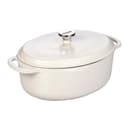
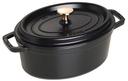
1. Base length, not quarts.Nobody buys an oval for its volume — a round pot holds the same amount in less cupboard. You buy it because the floor is longer, so a joint, a rack or a bird lies flat and browns in one layer. That makes the published length the first number to read and the base diameter the second: Staub publishes a 19.7 cm base under a 23 cm pot, and that one figure tells you more about what the pot can do than its price does.
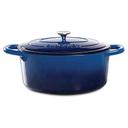
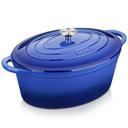
2. A published oven ceiling.An oval roaster is sold for the hot-oven job, so a maker that will not state a temperature is withholding the spec its own marketing depends on. Lodge and Velaze both publish 500°F. Staub publishes a 250°C knob limit and no body figure in Fahrenheit. Crock-Pot, Bayou Classic and Le Creuset’s Amazon listing publish nothing. We rank on that, and where nothing is published we say 450°F is the sensible working ceiling rather than inventing a number.
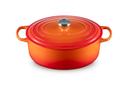
3. Weight, treated as a cost. An oval gets carried at full length, two-handed, usually from an oven at waist height. Lodge publishes 16.36 lb empty; Le Creuset publishes 12.59 lb for nearly the same capacity. That four-pound difference is the clearest thing the premium price buys on this page, and it is worth more to small hands than any enamel color.
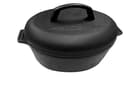
4. Material against the food you actually cook. Enamel for tomato, wine and long wet cooking; bare iron for fire, a grill and the lowest price. Five of these six are enameled, which is not an accident: a long acidic braise is the hardest thing you can do to a young seasoning.
What an oval costs you, in Lodge’s own numbers
This is the most useful comparison on the page, and it is available because one maker publishes a full spec sheet for both shapes in the same product line. Lodge’s round 6-quart Essential Enamel: 13.25 in long, 11.6 in wide, 6.0 in high, 13.52 lb. Lodge’s oval 7-quart from the same line: 15.56 in long, 10.18 in wide, 12.43 in high, 16.36 lb.
So for one extra quart the oval is 2.31 in longer, 1.42 in narrower and 2.84 lb heavier. The width is the part people miss: an oval is not a bigger pot, it is a redistributedone, and it gives up width to buy length. On a hob that matters twice over — a 15.56-inch pot overhangs a standard burner, so the ends never reach the temperature the middle does. Browning a long cut on the stovetop in an oval means working in sections or accepting that the ends do less. In an oven, where the heat surrounds the pot, the problem disappears entirely, which is why an oval is a roaster first and a stovetop pot second.
Oval and bread: the honest answer
“Best oval Dutch oven for sourdough” is the most-searched version of this query, and the answer is not the one the search implies. A round pot suits a round loaf, which is what most no-knead recipes produce; an oval suits a bâtard, the long loaf, and it is genuinely better for that shape because the dough is supported along its length instead of slumping. If bread is the main reason you are buying, the deciding features are not on this page — they are lid clearance, how safely you can lower dough into a 500°F pot, and whether the base is flat. Best Dutch ovens for sourdough bread ranks on exactly those, and do you need a Dutch oven for sourdough is the page to read first if the pot has not been bought yet.
Three checks before you buy an oval
Measure your oven, not your hob. A 15.5-inch pot with handles needs a shelf that takes it with air around it, and a wall oven that fits a round pot comfortably can be tight on an oval once the door seal and the shelf runners are accounted for.
Decide whether you brown on the stovetop. If you do, the overhang is a real cost and a round pot plus a separate skillet may serve you better. If you brown in the oven or not at all, it costs you nothing.
Count the quarts you will actually fill. An oval tempts people upward because the shape looks like a roasting tin, and a 7.5-quart pot a third full scorches the rim of the liquid. The rule is the same as for round pots: aim to finish two-thirds to three-quarters full.
Where to go instead
If the shape question is not settled, round vs oval Dutch oven is the page that decides it rather than selling you one. If capacity is the real constraint, best 6-quart Dutch ovens and best large Dutch ovens hold capacity constant and rank on everything else. If the budget is the constraint, under $100 and under $200 both include ovals and argue about what the extra hundred dollars adds. And if what you actually want is the wide shallow pot for browning and serving rather than the long one, best cast iron braisers is that shelf.
One live oval we chose not to rank: MUELLER HOME’s 5.5-quart publishes a 500°F rating and all-cooktop compatibility, which is more than Crock-Pot does, but its published footprint is 9 x 9 inches — a shape that is barely an oval at all, and not the long floor this page is about. It is a reasonable cheap enameled pot; it is not a reason to buy an oval.