How we chose these lidded skillets
A lid does three things to a cast iron pan: it traps steam so a sear can turn into a braise, it keeps spatter off the stove, and it holds heat around the top of the food instead of letting it leave. Nothing in that list is about the pan. So the criteria below are mostly about the cover — which is the opposite of how these products are sold, where the pan gets the photograph and the lid gets a line in the bullet list.
1. What the lid is made of, because that sets the oven ceiling
This is the finding worth knowing before you spend anything. Lodge’s bare iron pans publish no maximum oven temperature; their stated habitat is the stovetop, the oven, the grill and the campfire. Lodge’s tempered glass lids publish “Oven safe up to 400°F” and are made in China, where its cast iron lids are made in the USA and carry no temperature statement at all.
That single difference reorders the whole category. If you braise at 325°F and want to see the liquid level, glass is genuinely nice and genuinely cheaper. If you finish anything above 400°F, cover a pan on a grill, or ever cook over fire, a glass lid is the wrong component and no amount of care will change its rating. Every lid we ranked is cast iron for exactly that reason. Our guide to how hot cast iron can actually go collects every published rating on the site, and the pattern is consistent: it is never the iron that limits you, it is the glass, the knob or the enamel.
2. Depth, because a lid on a shallow pan is just a spatter guard
A standard cast iron skillet has sloped walls roughly two inches tall. Put a lid on it and you have a covered frying pan — useful for melting cheese, steaming the last minute of a fillet, or keeping fat off the backsplash. You do not have a braiser. Liquid has nowhere to sit, and anything you add to the pan displaces the food upward and out of contact with the hot iron.
Lodge publishes the numbers that show the difference. Its 10.25-inch deep skillet is 3.06 inches high without the lid and 5.62 inches with it; the same pan in the classic shallow shape is shorter again. Three quarts of capacity is the point where a lid starts earning its keep — enough to hold a cup or two of braising liquid under chicken thighs or short ribs without the lid sitting on the food. If you want the wide-and-shallow version of that job in enamel, the braiser roundup ranks pans built for it, and a braiser and a Dutch oven differ on exactly this axis.
3. Whether the lid fits your pan — it is not a universal part
Lids are brand-matched, and the makers say so in writing. Lodge states that its 10.25-inch lid is “compatible with Lodge 10.25 inch skillets and round pans.” Field says its No.8 lid is an exact match for the No.8 Field Skillet and No.8 Dutch Oven. Neither describes its cover as a general-purpose 10.25-inch lid, and we are not going to promise a fit that the people who cast the iron decline to promise.
Practically: look at the number on the bottom of your pan, buy that number from the same brand, and ignore the inch marking on a third-party lid that claims to fit everything. Lodge sells the same cast iron cover in 6.5, 8, 9, 10.25, 12 and 13.25-inch sizes, so the common skillet sizes are all covered. If you are not sure which pan you own, the skillet size guide explains how the stated size relates to the actual cooking floor, and why a “12-inch” pan is not twelve inches of usable surface.
4. Weight, and the arithmetic the makers publish
Adding a lid to cast iron is not a small change to how the pan feels. Lodge publishes 6.39 pounds for its uncovered 10.25-inch deep skillet and 10.25 pounds for the covered version of the same pan — so the lid is roughly 3.9 pounds on its own, which matches the 4.09 pounds Lodge publishes for the lid sold separately. At 12 inches it is worse: 9.28 pounds uncovered against 14.49 pounds covered.
For comparison, Lodge’s plain 10.25-inch classic skillet is 5.66 pounds. A covered 12-inch deep skillet is therefore about two and a half times the pan most people picture when they think “heavy cast iron,” and that weight arrives before any food goes in. If lifting is already the thing you dislike about cast iron, read the lightweight roundup first and consider buying only the lid for a pan you can already handle.
5. What the lid costs you, not just what it buys
A lid is the enemy of crust. Trapped steam is the whole point when you are braising and the whole problem when you are searing: the surface of the meat stays wet, the Maillard browning stalls, and a crust you spent ten minutes building goes soft. Nothing about cast iron changes that physics.
So the right technique is sequential, not simultaneous. Brown uncovered, hard and dry, then add liquid and cover. Take the lid off again for the last stretch if you want the sauce to reduce and the top to tighten. If searing is the main reason you own a cast iron pan, our steak skillet roundupis the better place to spend money — and a steak pan with a lid on it is a steak pan being used wrong.
The picks in context
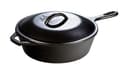
Lodge 10.25-inch Covered Deep Skillet — the best overall
This is the pan that answers the search for most people. The footprint is the familiar Lodge 10.25-inch, the walls are taller than a skillet’s, and the cast iron lid is included rather than sold as an upgrade. Lodge rates it for every heat source it rates anything for, which means it can brown on an induction hob, go into a hot oven uncovered, come out covered, and finish on a grill if that is where dinner is happening.
Lodge publishes the full spec: 16.56 inches long, 10.43 wide, 5.62 high, 10.25 pounds, made in Tennessee, pre-seasoned, PFAS-free, under the Made Right warranty. The costs are weight and clarity. Ten pounds of empty pan is a two-handed lift, and the listing and the maker disagree on the capacity — Amazon titles it 3 Quart where Lodge’s own page for part L8CF3 says 3.2 quarts. We have stated both rather than picking the flattering one.
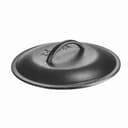
Lodge 10.25-inch Cast Iron Lid — the best for a pan you own
Read this one before you buy anything above it. If the skillet in your cupboard is a 10.25-inch Lodge — the size this site recommends more often than any other — then the cheapest, most space-efficient route to a lidded cast iron skillet is to buy the lid and stop. Same foundry, same iron, same warranty, no second pan to store, and a fraction of the price of a covered pan.
Two honest limits. Lodge sells it as compatible with its own 10.25-inch skillets and round pans, so it is not the answer for a Victoria, a Stargazer or a vintage Griswold unless you can confirm the fit yourself. And a lid cannot add depth: your shallow skillet becomes a covered shallow skillet, which is excellent for steaming and spatter and still not a braiser. The budget skillet roundup covers the pan this lid is designed for.
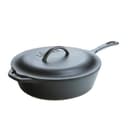
Lodge 12-inch Covered Deep Skillet — the best for frying and a crowd
Five quarts with a 12-inch floor is the size that cooks for four or more without crowding, and it is the one we would choose for frying. Lodge’s own buttermilk fried chicken recipe is written for a 12-inch cast iron deep skillet with the oil at 350°F, and a lid matters more in that job than people expect: it is what you reach for when the oil spits, and what lets the chicken rest covered without drying out.
It is also the heaviest thing on this page — 14.49 pounds by Lodge’s figure, before oil — and 18.26 inches long, which will not spin freely in a small oven. If your frying ambitions involve a deeper bath of oil than a skillet holds, a pot is the better tool and the deep-frying Dutch oven roundup ranks vessels for exactly that.
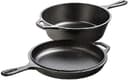
Lodge Combo Cooker — the best two pans in one
The cleverest value on the page, and the only pick whose lid is a second usable pan: a 3.2-quart deep pot with a 10.25-inch skillet as its cover. Used the normal way it is a covered pot. Used upside down — loaf on the shallow skillet, deep pot inverted as the dome — it is the cheapest genuinely good bread vessel in cast iron, which is why it also appears on our sourdough roundup.
The trade-offs are honest ones. Lodge publishes 12.85 pounds for the pair, so it is heavier than the covered deep skillet despite holding the same 3.2 quarts. The skillet-as-lid has two short loop handles rather than a long one, so it is less pleasant as a frying pan than a real skillet. And both halves are bare iron that wants drying and oiling after every wash.
Lodge Essential Enamel Braiser — the best enameled option
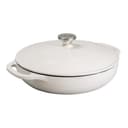
If what you actually want is a wide, shallow, lidded pan for braising and you do not want to maintain seasoning, buy enamel and stop shopping for a covered skillet. Lodge’s 3.6-quart braiser needs no seasoning, handles tomato and wine from day one, publishes an oven rating of 500°F, and is the same shape argument the covered deep skillets make — with a glazed surface instead of a seasoned one.
What you give up is the heat source list. Lodge does not recommend its enameled cookware for a grill or a fire, and metal utensils are out, where its bare iron welcomes both. Enamel also chips if you treat it like iron. Our enameled versus bare comparison lays out that decision properly, and enameled skillets covers the open-pan side of it.
Field Company No.8 Skillet Lid — the best brand-matched lid
The lid for people who bought the nice pan. Field casts it in the USA from recycled iron, seasons it with grapeseed oil, and puts vintage-style self-basting ridges on the underside so condensation drips back onto the food instead of running to the rim — a feature Lodge’s plain lids do not publish. Field states 10.25 inches, 4 pounds, and 4.5 inches of closed height with the skillet, and backs it with a 45-day trial and a lifetime warranty.
The reasons not to buy it are equally clear. It costs what a whole budget skillet costs and it is only a lid. Field sells it as an exact fit for the No.8 Field Skillet and No.8 Dutch Oven, with no fit claimed on anything else, so it is not a general-purpose cover. And Field publishes no oven, grill or stovetop temperature for it at all, which we have left as an absence rather than borrowing a number from another brand’s page. Our Field Company review covers the skillets this lid was cast for.
Glass lid or cast iron lid?
Both are legitimate, and the choice is not about quality. A glass lid is lighter — Lodge publishes 1.56 pounds for its 10.25-inch glass cover against 4.09 for the iron one — cheaper, dishwasher safe, and lets you watch a reduction without lifting anything. A cast iron lid is heavier, pricier, needs drying and oiling like the pan, and carries no published temperature limit whatsoever.
Decide on the hottest thing you plan to do. Simmering, steaming and moderate oven braises all live comfortably under 400°F, and glass is the more pleasant tool there. Roasting at 425°F, finishing under a broiler, covering a pan on a grill, or any kind of fire cooking needs iron, because Lodge’s own 400°F figure is a rating rather than a suggestion. One more detail people miss: a glass lid’s weak point is usually the knob and its silicone, not the glass, which is why the number is as low as it is.
What we left off, and why
Lodge’s Blacklock 4-quart covered deep skillet is the most interesting product in this category and we could not rank it: on October 1, 2026 Amazon reported single-digit remaining stock, and this site does not build pages around items that sell out in a week. It deserves a mention anyway, partly because it punctures its own marketing. Lodge publishes 10.76 pounds for it — the lightweight line, with a lid, weighing more than the thicker 3.2-quart covered skillet above, because it is a bigger pan. It is a thin triple-seasoned casting with elevated handles and a raised high-heat aluminum knob, made in the USA, at roughly triple the price. If it is in stock when you look and the knob and handles matter to you, it is a good pan; the Blacklock versus Classic comparison explains what the line does and does not buy you.
FINEX’s cast iron skillet lidswere in the same position for the same reason — its 10, 12 and 14-inch lids all showed single-digit stock on the day we checked. They are beautiful, they cost more than most complete skillets, and they are brand-matched to FINEX’s octagonal pans, so they were never going to be the general recommendation.
House-brand “skillet with lid” setsare everywhere in this search — 12-inch pans bundled with a cast iron or glass cover, a silicone handle sleeve and a scraper, at prices that undercut Lodge. We left them unranked for the reason we always do: none publishes a spec sheet we can check a claim against, and several advertise temperature ratings that no maker with a published spec will put in writing. If budget is the binding constraint, our budget roundup names the inexpensive pans we are willing to stand behind.
Universal glass lidssold as fitting “10.25-inch cast iron” from no identifiable maker were excluded on the fit question alone. A cover that nearly fits vents steam at the rim, which defeats the one thing you bought it for.
Do you actually need a lid?
Often not, and it is worth saying on a page that earns a commission when you buy one. If you own a cast iron skillet and a pot with a lid, you can already braise — brown in the skillet, transfer to the pot, cover. Two pans and a transfer is slightly less elegant and exactly as good. A sheet pan or a loose sheet of foil laid over a skillet also traps most of the steam for the last few minutes of a dish, which covers a surprising share of the real use cases.
A lid earns its money in three situations. You want one pan to go from sear to braise with nothing transferred, usually because you are cooking for one or two and resent the washing up. You fry often enough that spatter control matters. Or you already own the exact pan a cheap brand-matched lid fits, in which case the decision is small enough not to need an argument. If none of those is you, put the money toward a better pan instead — the main skillet roundup is where that money works hardest.
Living with a lidded cast iron pan
Brown first, cover second. Get the pan properly hot and dry, sear uncovered until the crust is where you want it, then add liquid and put the lid on. Covering early steams the food and you lose the browning entirely. Our preheating guide has the timings by pan thickness.
Never store food under the lid.A covered bare iron pan in the fridge is a sealed, humid box pressed against unsealed seasoning, and acidic leftovers in it will strip the film and start rust. Move leftovers to a container. Enamel is the exception — Lodge says its enameled surface is safe to store in the fridge — which is one real advantage of the braiser pick.
Dry both pieces, every time. The lid is the part people forget, and it is the part that sits in trapped steam all through cooking. Wash it, dry it on a warm burner or in the residual oven heat, and wipe a thin film of oil over it exactly as you would the pan. Our cleaning guide has the full routine and the rust guidecovers the fix if a lid has already been left wet. Then store the pan and the lid separately, or with a paper towel between them, so moisture has somewhere to go — the storage guide explains why a tightly stacked pan and lid is the most common cause of a rust ring.