How we ranked the brands
1. Does the maker publish an oven rating?
This is the single most revealing test, because it is the number you need most and the one brands most often skip. Lodge publishes “oven up to 500℉” for its Essential Enamel pots and a stainless steel knob to go with it. Staub states most of its pieces are oven safe to 500°F with the lid, and that certain cocottes withstand 900°F without the lid.
Tramontina is the counter-example. Its own care page says cast iron and enameled cast iron should be hand washed and that many pieces are oven safe — without publishing a temperature anywhere. Cuisinart publishes less specification detail than Lodge, which is why several rows on our card for its pot read “Not published”. We never fill those gaps in with a plausible number; see can you put cast iron in the oven for every rating we have actually found.
2. Does it say where the pot is made?
Le Creuset and Staub are made in France and say so; Staub’s own site dates the brand to French cast iron since 1974. Lodge is unusually direct about the awkward version of this answer: its Essential Enamel pages state manufacture by Lodge’s partners in China or Vietnam, and its enameled skillet listing reads “Enamel Cast Iron made in China to Lodge specifications. All other Lodge Cast Iron Cookware made in USA”.
Tramontina, Cuisinart and Amazon Basics publish no country of manufacture for the pots we list. That is worth knowing if origin matters to you, and worth nothing at all if it does not — an unstated origin tells you about the brand’s disclosure habits, not about how the pot braises. Lodge does run a separate US-made enamel line, described on its own collection page as the only colorful enameled cast iron made in the United States, sold direct rather than on Amazon.
3. What has the enamel been tested for?
Staub sets the standard here and nobody else on this page comes close. Its safety and materials page states plainly: “Staub is Cadmium Free, Lead-Free, PFOA Free, PTFE Free, and PFAS Free”, with regular third-party certified lab testing and compliance stated against FDA guidelines and California Proposition 65 limits. It also explains what the black interior is — a vitreous, quartz-enhanced matte enamel fired onto the casting, not bare iron and not a synthetic nonstick coating, which “will not flake off with use”.
Lodge states its enamel is made without PFAS. The other three brands here publish no materials-testing statement we could find. For what that actually means for your kitchen — including what the FDA has and has not acted on — read is enameled cast iron safe.
4. Warranty, and who you call
Le Creuset’s lifetime warranty and Staub’s limited lifetime warranty are a real part of what the French premium buys, and Staub publishes the procedure for a damaged pot: if cookware becomes chipped or damaged, discontinue use of the affected area and contact Customer Service. Lodge covers its Essential Enamel skillet with a lifetime limited manufacturer’s warranty. Tramontina publishes no warranty for the pot we list, and neither do Cuisinart or Amazon Basics on the listings we read.
The brands in context
Lodge — the best overall
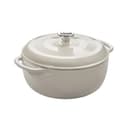
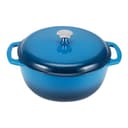
An American company whose bare iron is made in Tennessee and whose mainstream enamel is not, and which is straightforward about both. For the 6-quart round Essential Enamel pot Lodge publishes dimensions, weight, knob material, the full cooktop list, a 500°F oven rating, fridge storage, PFAS-free manufacture, hand washing, “metal utensils not recommended” and “Not made for use on a grill or over a fire”. At roughly a quarter of the French price, that is the most pot-per-pound of certainty on this page.
Two honest notes. The enamel is not US-made, as above. And Lodge’s disclosure has been inconsistent over time: a September 18, 2026 reading of this same 6-quart page recorded no weight, no oven temperature, no cooktop list, no care rules and no origin at all, and Lodge has since added every one of them. We record both visits rather than pretending the page always said this. Our Lodge review covers the brand in full.
Le Creuset — the best buy-it-for-life
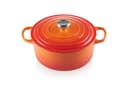
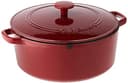
The reference point the whole category is priced against: French-made, a light sand-coloured interior that shows you exactly how a fond or a stock is developing, oversized handles that fit real oven mitts, a lifetime warranty, and the colour range and resale value that come with the name. If you cook in one pot every week for thirty years, this is the pot that will still be doing it.
It costs several times the Lodge and the braise tastes the same, which is the honest headline. Five and a half quarts is also a four-serving pot rather than a batch-cooking one, so a household of five will outgrow it. Our Le Creuset review and Lodge against Le Creuset are the two pages to read before spending.
Staub — the best for braising
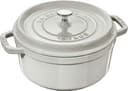
The brand to buy if you brown more than you simmer, and the best documented brand here by a distance. The black matte interior is built for searing, the lid’s underside spikes and swirls are designed to condense steam and redistribute it back into the dish, and Staub publishes unusually direct care answers: dishwasher safe with hand washing recommended, silicone or wooden utensils preferred, warm soapy water and a soft sponge, baking soda as an enamel-safe abrasive, and Bar Keepers Friend explicitly recommended for stubborn stains.
For soup specifically it is the wrong pick, and we say so on the soup pot roundup: a black interior hides the colour of a stock completely, and self-basting spikes do nothing in a thin broth. Staub also tells you that dull, cloudy or rainbow-coloured enamel is residue rather than damage, which is the most useful sentence any of these brands publishes. Le Creuset against Staub settles the French choice.
Tramontina — the best value
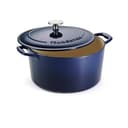
The pot recommended as the Le Creuset alternative more often than any other, and deservedly: 6.5 quarts is slightly more capacity than the French pots are built around, the light interior is genuinely useful for judging a fond or a stock, and the price undercuts the French names dramatically.
What you give up is paperwork. Tramontina’s care page says hand wash and that many pieces are oven safe, with no temperature stated anywhere, and it publishes no origin and no warranty for this pot. A pale interior also stains with turmeric, tomato and long stocks in a way a dark one does not — cosmetic, but you will see it. Our Tramontina review and Tramontina against Le Creuset go further.
Cuisinart — the best for big batches
Seven quarts is stock-pot territory and that is the reason to pick this brand: a chicken carcass fully submerged, chilli for a crowd, four batches of soup frozen in an afternoon. Per quart it is one of the better-value enameled pots on the site, and the extra capacity costs very little over a 6-quart.
The trade is one you feel on every lift, and one you read in the spec table. Seven quarts of soup weighs over fourteen pounds before the pot, and Cuisinart publishes less detail than Lodge does — no oven temperature, no origin, no warranty on the listing we read — so several rows on its card read “Not published”. See the large Dutch oven roundup for the whole 7-quart-and-up end.
Amazon Basics — the cheapest way in
The honest floor of the category. Six quarts of enameled cast iron that braises and bakes bread like any enameled pot, for less money than any branded alternative, and a perfectly sensible first pot if you are not sure you will use one often.
You give up finish quality, published specifications and recourse rather than core function — no origin, no oven rating and no warranty on the listing we read. Care is the same as any enameled pot: hand wash, avoid thermal shock, do not drop it. The budget Dutch oven roundup ranks this tier properly.
Brands we did not include, and why
Lodge’s bare cast iron pots.Excellent, cheap, American-made and rated by Lodge for the stovetop, oven, grill or campfire — but they are a different product with different rules, not an enameled brand comparison. They have their own page: bare cast iron Dutch ovens.
The boutique American skillet makers. Field, Stargazer, Smithey and Finex are among the best cast iron makers in the world and none of them is primarily a Dutch oven brand, so putting them on a pot comparison would be a padding exercise. They are ranked where they belong, on the skillet brand roundup.
Any brand we could not price or stock-check.A brand with no live listing cannot carry an honest price on this site, and a recommendation you cannot act on is not a recommendation. That rules out several well-regarded names, and it is why Lodge’s US Enamel line is discussed above rather than ranked.
Does the brand actually change the food?
Barely. Three things genuinely vary between these pots and none of them is the badge. The interior colour changes what you can see: a light interior shows the fond and the clarity of a stock, a black matte one hides both but browns beautifully. The shape changes the cooking: Lodge publishes 11.6 inches of width on its 6-quart round pot against 10.18 inches on its 7-quart oval, which is more browning floor in the smaller pot. And weightchanges whether you use it — 13.52 lb for the round Lodge, 16.36 lb for the oval, before food.
Everything else is finish, provenance, documentation and recourse. Those are real reasons to spend more, and they are different reasons from “it cooks better”. Anyone telling you a French pot braises differently from a Tennessee-specified one is selling the badge. Our enameled roundup ranks the pots themselves, and the size guide is where the decision that actually affects your cooking gets made.