How we chose these accessories
Every pick had to clear three tests. It has to fix a problem that actually happens to cast iron owners; the maker has to publish enough about it that we can tell you what it is made of and how big it is; and nothing it does to the pan can be worse than the problem it solves. That last test is what knocks out most of the category. A cast iron pan is a seasoned surface, and a surprising amount of “cast iron care” gear works by removing that surface.
1. Does it fix something, or is it a solution to a myth?
Cast iron has three real recurring problems: food welds onto the cooking surface, the seasoning thins where you scrub, and the handle is the same temperature as the pan. Everything on this page addresses one of those. Rust is a fourth, but it is an event rather than a routine, which is why the rust eraser is ranked fifth rather than first — it is the best tool for a job most owners will do once.
What is noton this page is the gear sold against problems the pan does not have. You do not need a dedicated cast iron soap, because ordinary dish soap is fine on a seasoned pan — our guide to whether soap ruins cast iron walks through why, with Lodge’s own position on it. You do not need a seasoning “conditioner” blend, because the oil question has a cheap answer. And you do not need a storage system; you need somewhere dry, which the storage guide covers for nothing.
2. What is it made of — and is that safe on your finish?
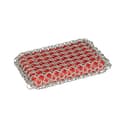
This is the criterion that reorders the page, because bare cast iron and enameled cast iron want opposite toolsand almost nobody selling accessories says so. Chainmail is magnificent on bare iron: Lodge states its pad “removes stubborn food easily, without removing seasoning”, and the reason it can make that claim is that polymerized seasoning is bonded to the metal while the food on top of it is not. Nothing on Lodge’s chainmail page clears it for enamel, and we are not going to extend a claim the maker declines to make. A glaze is a hard, thin, brittle layer, and dragging 304 stainless steel across it is a bad trade.
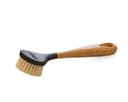
For enamel, the tool is the nylon brush at number three — the one Lodge’s own page describes as “the perfect everyday tool to use on both seasoned and enameled cast iron”. That sentence is the only place in Lodge’s cleaning range where a product is cleared for both finishes, and it is why a $10 brush outranks three more expensive things here for anyone who owns an enameled Dutch oven. Our enamel cleaning guide has the rest of the routine.
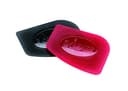
The scrapers sit between the two: stiff plastic is firm enough to pop carbonised food off a cooking floor and soft enough not to mark a glaze, which makes them the one pick that genuinely suits every pan in the cupboard. Lodge’s page calls the material nylon; the Amazon listing calls it polycarbonate. We have recorded both rather than picking the one that sounds better.
3. What does the maker say you cannot do with it?
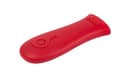
Read the restrictions, not the headline. The silicone handle holder is the clearest example on the site. Lodge’s description says it protects your hands “up to 500°F”, which almost everyone reads as an oven rating. The feature list on the same page says “No direct flame; not intended for use in oven” and “Not intended for use during cooking, grilling, or baking”. Those two bullets mean the 500°F figure describes gripping iron that has already come off the heat — a carrying aid, not a heat shield you leave on.
That is a genuinely useful thing to know before you buy, because the single most common reason people want a handle holder is to leave it on while the pan finishes in the oven, and that is the use Lodge excludes. If what you actually need is to move a 450°F pan from oven to counter, the answer is a dry folded towel or a leather mitt, not a silicone sleeve. Our guide to how hot cast iron can go collects every published temperature limit on the site, and the pattern holds here too: the iron is never the thing that caps you, the accessory is.
4. Price, because this is a category where cheap usually wins
Four of the six picks sit in single digits or just above, and the rankings reflect that deliberately. The chainmail pad is top because it changes the daily experience of owning a bare pan more than anything else — but it is also the most expensive chainmail on the shelf, and generic 316-steel scrubbers sell for roughly a third of its price. We have not ranked one, because none of the cheap ones publishes a maker spec sheet we could read, and “316” on a listing title is a claim rather than a document. If you want to save ten dollars there, you are buying on the listing’s word, and that is a reasonable choice as long as you know that is what you are doing.
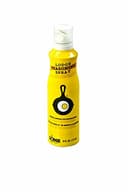
Where we will not hedge: the seasoning spray is canola oil. Lodge says so in its own feature list — “made of 100% canola oil—no additives or propellants”. It is a nicer way to apply oil than pouring, the pump gives a thinner film than a glug does, and a thin film is the whole secret of good seasoning. It is also, functionally, the supermarket bottle. Buy it for the convenience; do not buy it believing it is a different substance.
What we deliberately left off
Steel wool and metal scouring pads.They work, and what they are working on is your seasoning. These are strip-it tools, appropriate only when you have decided to take a pan back to bare metal — which is the procedure in our reseasoning guide, not a cleaning routine.
Cast iron “conditioner” pucks and wax blends. Several are sold at four or five times the price of oil, with ingredient lists built around beeswax. Nothing we could source demonstrates a durability advantage over plain oil applied thinly and heated past its smoke point, and a wax that is not polymerized is a coating that will come off in the next hot pan. Our seasoning guide explains the chemistry that actually matters.
All-in-one care kits. Lodge sells a four-piece bare iron kit and a five-piece enameled kit, and they are reasonable gifts. They are not the cheapest way to get the contents, and they bundle at least one thing you probably will not use. If you are buying for someone else, the under-$50 cast iron gift guide has better-value bundles.
Universal glass lids and “fits any pan” parts. Lids are brand-matched and the makers say so; we go through the published fit statements on the lidded skillet page.
What to buy first, in order
If you own one bare cast iron pan and nothing else, buy the scrapers. They cost less than a coffee, they will be the thing you reach for most, and they solve the specific moment that makes new owners think the pan is defective — food fused to the cooking floor after a sugary or starchy cook. Then the chainmail pad, once you have met a mess the scraper cannot shift. Those two cover ninety percent of cast iron maintenance between them.
Add seasoning spray only if you find you are skipping the oil step because the bottle is awkward; the point is the habit, not the product. Add the rust eraserthe day you inherit or rescue a rusty pan, and not before — and read Lodge’s warning that it takes the surface down to bare iron, so the pan goes straight into a reseasoning cycle afterwards. The rust removal guide has the full sequence, including the cheaper route with salt and potato if the rust is light.
If your pans are enameled, invert the whole list: buy the nylon brush and the scrapers, skip the chainmail, skip the seasoning spray entirely (enamel cannot take seasoning and does not need it), and skip the rust eraser, because there is no bare iron to rust. Our enameled vs bare comparison lays out the rest of the maintenance difference.
And if you are shopping for accessories because the pan itself is fighting you, the gear may be the wrong answer. A pan that sticks usually has thin seasoning or is being used too cool, not a tooling deficit — the sticky pan guide and the preheating guide fix more sticking than anything you can add to a basket.