How we chose these grill pans
Grill pans are a category where the marketing copy is almost interchangeable — every listing promises even heat, restaurant-quality marks and lifetime durability. The differences that actually change your experience of owning one are duller than that, so those are what we ranked on.
1. Usable cooking area, not the number on the box
A “10-inch” grill pan is measured across the rim, and the ridged floor is always smaller. Shape matters more than the headline number: a square pan uses its corners, a round pan of the same nominal width doesn’t. In practice a 10-inch square holds four chicken thighs or two large steaks; a 10-inch round holds three thighs or one big steak comfortably. Lodge publishes 81 square inches of cooking surface for its 11-inch Chef Collection pan, which is the largest single-burner figure any maker on this list states outright.
2. Handles — the thing that decides whether you keep using it
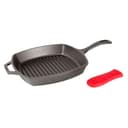
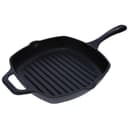
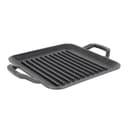
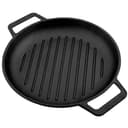
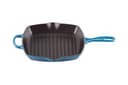
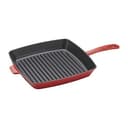
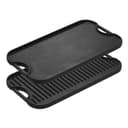
A grill pan full of food weighs six to nine pounds and comes off the heat hot. There are two designs, and neither is universally better. A long handle(Victoria’s square pan, the classic Lodge) lets you steer the pan one-handed and slide it under a broiler, but it eats counter space and can foul the pan beside it on a crowded stovetop. Two short loop handles(Le Creuset, Staub, Lodge’s Chef Collection, Victoria’s round pan) keep the footprint tight and are far better for going straight into the oven or onto the table — but they always need two mitts. If you cook on a small stove or store pans in a tight cupboard, loop handles win. If you want to move the pan around a hot burner, take the long handle.
3. Ridge height and pour spouts
Taller ridges make crisper marks and hold food further out of the fat. That fat then has to go somewhere: pans with pour spouts on both sides (Victoria’s square, Le Creuset’s) let you tip it into a bowl cleanly, and pans without them dribble down the outside and bake on. It sounds trivial until the third time you clean the underside of a pan.
4. Bare iron or enamel — really a cleaning question
Bare cast iron grill pans need seasoning, get scrubbed with a brush and hot water, and must be dried and oiled. Enameled pans (Le Creuset, Staub) skip all of that: soap is fine, most are dishwasher-rated, and there is no seasoning to protect. What you pay for that convenience is roughly a ten-fold price increase, plus a 500°F oven ceiling that bare iron doesn’t have and an enamel surface that will chip if you drop the pan or shock it under cold water. Neither finish grills better. See our full enameled vs bare cast iron comparison if you’re weighing that trade-off across your whole kitchen.
How to actually cook on a grill pan
Grill pans reward a different technique than a skillet, and most disappointment comes from treating them the same.
Preheat longer than you think, on medium
Ridges are thin sections of iron sitting above a thicker floor, and it takes a few minutes for the whole casting to reach an even temperature. Start on medium, give it five minutes or so, and test with a drop of water — it should skitter, not sit and boil. Cranking to high to speed it up warps nothing but it does scorch the ridge tops while the channels stay cool, which is exactly how you get pale marks and a smoky kitchen.
Oil the food, not the pan
Oil poured into a grill pan runs straight into the channels, where it pools, smokes and does nothing for the sear. Brush or rub a thin film onto the food instead. It goes where it’s needed, and it dramatically reduces the smoke.
Press once, then leave it alone
Contact is everything when only the ridge tops touch. Lay the food down, press it flat for a couple of seconds, and then don’t move it until the marks have set — two to four minutes for most cuts. Turning 90 degrees halfway through gives you the crosshatch; flipping repeatedly gives you neither marks nor crust.
Ventilate, and expect smoke
Fat dripping onto hot iron is what makes grill flavor, and it is also what makes smoke. This is not a defect of any particular pan. Run the extractor, open a window, and don’t start a grill pan five minutes before guests arrive.
Cleaning the ridges, honestly
Every grill pan on this page is harder to clean than a flat skillet, and any review that says otherwise is selling something. The method that works on bare iron: while the pan is still warm, pour off the fat, run hot water in and go along the channels with a stiff brush or a chainmail scrubber — along them, not across. Stubborn residue lifts with coarse salt and a folded paper towel. Then dry it fully on the stovetop and wipe a very thin film of oil over the ridges. A little dish soap is fine on modern seasoning; our cast iron cleaning guide covers why that myth persists. If the seasoning between the ridges ever goes patchy, the seasoning guide gets it back.
Enameled pans are genuinely easier here — soap, a nylon brush, and the dishwasher if you can’t face it. Both Le Creuset and Staub still recommend hand washing to keep the finish looking new, which is advice about appearance rather than function.
Who should skip a grill pan entirely
If you own one cast iron pan and it’s doing everything — eggs, cornbread, a roast chicken, a steak — a grill pan is a second pan that does one thing. Buy the best budget skillet first. If what you want is a big flat surface for pancakes, bacon and smash burgers, you want a cast iron griddle, not a ridged pan. And if you mainly want a hard sear on steak, the flat skillet in our cast iron steak methodwill out-crust any grill pan made, because it touches the whole surface of the meat. And if you already own an outdoor grill, the cheaper fix may be under the food rather than in the cupboard — swapping thin steel bars for cast iron grill grates gets you the same stored heat outdoors, if you can find a set that fits your model.