How we chose these roasting pots
1. Published interior width, not quarts
This is the only measurement that reliably predicts whether a whole chicken will sit flat in a pot, and almost no maker publishes it. Lodge does: a 10.5-inch cooking surface width and a 6.87-inch flat bottom on its 6-quart Essential Enamel pot. The flat bottom is the part a bird actually rests on; the wider cooking surface above it is the taper of the walls. A pot whose floor is narrower than the bird will hold it at an angle, with the legs riding up one side.
We are not going to tell you the dimensions of a supermarket chicken, because we have not measured one and we do not publish numbers we cannot source. What we can tell you is the test: put the bird in the pot, breast up, before you turn the oven on, and close the lid. If the lid sits flat on the rim, it fits. If it rides on the bird, you need a bigger or wider pot, or you need to roast uncovered.
2. Lid clearance, which is where most pots fail
Height is the constraint people discover too late. Lodge publishes 4.75 inches of cooking surface height on the 6-quart and 7.31 inches of total height with the knob fitted, with the knob itself accounting for 2 inches. A whole chicken is tall, and the breast is the tallest part; a pot with enough floor but not enough headroom will hold the lid off the rim, which vents the steam you were trying to trap and bakes the top of the bird against hot iron.
Two practical ways round it. Roast uncovered for most of the cook, which is the better technique anyway. Or buy a pot with more height than you think you need — which is one of the honest arguments for a 7-quart over a 6. Our Dutch oven size guide has the full relationship between quarts, floor and height.
3. Round or oval, and whether it is worth hunting for one
A chicken is longer than it is wide, so an oval pot is the shape that genuinely matches it, and the Bayou Classic oval roaster is here for exactly that reason. In an oval pot the bird sits along the long axis with room at the sides for potatoes and aromatics; in a round pot of the same capacity the bird occupies the middle and the corners go unused.
The counter-argument is everything else you will ever cook. A round pot is better for soup, for stew, for bread, for frying and for anything stirred, and it sits over a single burner properly where an oval overhangs and heats unevenly on a hob. Unless you roast birds and joints more often than you do all of that combined, buy round and accept the compromise.
4. The oven ceiling, because roasting runs hot
Bare cast iron publishes no maximum oven temperature at all. Lodge rates its bare pots for the stovetop, oven, grill or campfire without naming a figure. Enamel always has a number, and it is the number to check before you follow a hot recipe.
What the makers publish on this site: Lodge states 500°F for its 3-quart Essential Enamel pot, with a stainless steel knob. Staub’s knobs are rated to 464°F. Le Creuset publishes a 500°F oven limit on its square skillet grill. Tramontina’s care page says many pieces are oven safe and publishes no temperature anywhere. Our oven temperature guide collects every rating in one table, and the pattern holds: it is never the iron that limits you, it is the knob or the glaze.
The picks in context
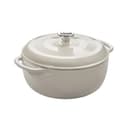
Lodge 6-quart Essential Enamel — the best overall
The only pot here you can check against a bird before you buy it, because Lodge publishes the numbers: 10.5-inch cooking surface width, 6.87-inch flat bottom, 4.75 inches of cooking surface height, 13.56 inches handle to handle, 7.31 inches total with the knob. Lodge also states the porcelain enameled surface stands up to acidic ingredients and can store leftovers in the fridge, which matters more than it sounds — a roast chicken becomes stock, and stock is acidic and gets refrigerated.
The gaps are absences rather than faults. Lodge’s page for this particular pot publishes no weight, no oven temperature, no cooktop list and no country of manufacture, all of which it does publish for the 3-quart from the same line (9.5 lb, 500°F, hand wash, no metal utensils, not for a grill or open fire, made by Lodge’s partners in China or Vietnam). We have not copied those across, because a different part number is a different product.
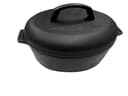
Bayou Classic 6-quart oval roaster — the best shape for a bird
The only pot on the site whose shape was designed around the thing you are cooking. An oval 6-quart gives a chicken its long axis and leaves room at the sides for potatoes, onions and carrots, which is how most people actually want to roast one — everything in one vessel, the vegetables cooking in the fat.
Three honest limits. It is bare cast iron, so a long acidic braise will dull the seasoning and you must not refrigerate in it. An oval base overhangs a round burner, so stovetop browning heats unevenly and you will be moving the pot around. And Bayou Classic publishes no country of manufacture and less specification detail than Lodge, so several rows on our card read “Not published”. It also appears on our large Dutch oven roundup for the same shape reason.
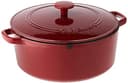
Cuisinart 7-quart — the best for a big bird
The pick if you buy large chickens, or if you want the pot to take a small turkey or a joint as well. The extra quart over a 6 buys mostly height, and height is where lid clearance comes from — so this is the sensible choice if you intend to roast covered rather than uncovered.
Weight is the price. A 7-quart enameled pot with a bird and vegetables in it is a genuinely heavy two-handed lift out of a hot oven, done with mitts, at eye level. That is the most dangerous moment in this whole category and it is worth rehearsing empty. Cuisinart also publishes little specification detail, so our card for it carries several unresolved rows rather than guesses.
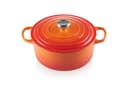
Le Creuset 5.5-quart Signature — the best premium
Buy this if you want the pot that outlives the oven. Le Creuset is one of only two brands in this category that reliably publishes a full specification, it is made in France, and the pale interior lets you see exactly how dark the pan juices are getting, which is the difference between gravy and a burnt scrape.
Five and a half quarts is the constraint to take seriously here: it is the smallest pot on this page, so a large bird is a tight fit and a large bird with vegetables will not happen. It also costs several times the Lodge for a chicken that tastes the same. Lodge against Le Creuset is the argument in full.
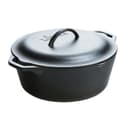
Lodge 7-quart bare cast iron — the best bare iron
Seven quarts of American-made bare iron at a budget price, rated by Lodge for the stovetop, oven, grill or campfire with no published temperature ceiling at all. For roasting that rating is a genuine advantage: you can run the oven as hot as you like, and you can finish the bird over a fire if that is where dinner is.
The caveats are the usual bare-iron ones and they bite here. Pan juices with wine or lemon in them are acidic, so a long roast will dull the seasoning, and you cannot refrigerate the carcass in the pot. It is also heavy before anything goes in — Lodge publishes 12.37 lb for its 5-quart Double Dutch Oven, which sets the scale for bare pots of this size. The bare cast iron pot roundup covers the line properly.
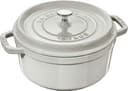
Staub 5.5-quart round cocotte — the best for browning first
If your method is to brown the bird hard on the stovetop and then put it in the oven, Staub is built for the first half. Its interior is a textured matte black enamel that Staub describes as made for browning and needing no seasoning, and its lid carries self-basting spikes so condensation drips back down onto the meat rather than running to the rim.
Two things to know. The dark interior hides the colour of the pan juices completely, which is a real loss when you are trying to judge a gravy, and the knob is rated to 464°F rather than the 500°F Lodge publishes — so a very hot finish means taking the lid out of the oven. Le Creuset against Staub settles the choice between the two French makers.
What we left off, and why
Braisers.Wide, shallow and lidded is a beautiful shape for a cut-up chicken in sauce and the wrong shape for a whole bird — there is not enough height, so the lid rides on the breast. The braiser roundup ranks them for the job they are built for, and Dutch oven versus braiser explains the shape difference.
Camp Dutch ovens. Legged pots with flanged lids roast a chicken beautifully over coals, and Lodge states they are for outdoor use rather than indoor cooking. The legs make them unstable on an oven rack. They belong on the camping page.
Pots under 5 quarts. The small Dutch oven rounduphas excellent pots in it, including Lodge’s 9.5 lb 3-quart, and none of them will take a whole bird. They are for two to three servings of something, not for a roast.
How to actually roast a chicken in a Dutch oven
Take the lid off for the skin. This is the most useful thing on the page and it costs nothing. A covered pot is a steam chamber: the skin stays wet, browning stalls, and you get a pale, soft bird with excellent moist meat. Roast uncovered, or cover for the first part and uncover for the last thirty minutes or so, and let the dry oven air do what it is good at. Our lidded skillet roundup makes the same argument about searing: brown dry, cover second.
Brown on the stovetop first if you want a gravy.Breast down in hot fat on the flat bottom, a few minutes a side, then turn it over and send the pot to the oven. The fond that forms is the gravy. This is the one step where a 6.87-inch flat bottom and a pale interior both pay for themselves — you need the contact area and you need to see the colour.
Use the pot for what comes after. The best argument for roasting in a Dutch oven rather than a roasting tin is the second meal: the carcass, an onion and water go straight back into the same pot for stock, it simmers for hours on the hob or in a low oven, and in enamel the finished stock can go into the fridge in the pot it was made in. Our soup and stew roundupcovers that half of the pot’s life, and what you can cook in a Dutch oven covers the rest.