How we chose these braisers
Braisers look more alike than they cook. These are the things that actually separate them, and what we ranked on.
1. The wide, shallow shape is the whole point
The reason to own a braiser instead of just using a dutch oven is surface area. Browning is where a braise gets its flavor, and browning needs contact with hot metal — pieces of meat crowded and stacked in a deep pot steam in their own juices instead of searing. A braiser’s wide floor lets a whole batch lie flat, so it all browns at once, and the low sides let you reach in to turn and baste. If a pan can’t do that, it is a shallow pot, not a braiser.
2. Capacity — smaller than a dutch oven, and that’s fine
Braisers run shallower and so hold less than a dutch oven of similar width — typically three-and-a-half to five quarts. That is plenty for a braise, which is a single layer of food under a modest amount of liquid, not a pot of soup. A 3.5-quart braiser feeds two to four; a 4- to 5-quart braiser is the family size. Buy for the size of the layer you want to brown, not for volume.
3. Light interior vs dark interior
This is the quiet decision that shapes how a braiser cooks for you. A light, sand-colored interior (Lodge, Le Creuset, Tramontina) lets you see exactly how dark your browning and fond are getting, so you deglaze at the right moment; the trade-off is that it stains over time (cosmetic only). A dark, matte interior (Staub) is textured specifically for high-heat searing and hides stains, but it also hides the fond, asking a little more of the cook. Neither is wrong; they suit different priorities.
4. Fit, finish and provenance — what the premium buys
The French braisers are beautifully made, come in the widest color ranges, carry lifetime warranties, and hold their resale value. All of that is real — but none of it makes the braise taste better. The value pans give up refinement, warranty length, made-in-France provenance and color choice, not cooking. Deciding how much those things are worth to you is most of the buying decision.
5. Care is the same enameled routine
Every braiser here is enameled, so none needs seasoning and all are safe with acidic food. The care that matters is protecting the enamel: let the pan cool before washing, hand wash it (soap is fine on enamel), skip the metal scourers, and never plunge a hot pan into cold water, because thermal shock is what chips and crazes enamel. Do that and a braiser lasts for decades.
The braisers, one by one
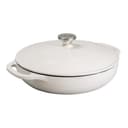
Lodge Essential Enamel Braiser (3.6 qt) — the best overall value
The braiser most people should buy. It is a 3.6-quart enameled cast iron pan that does the whole wide-and-shallow job — searing then simmering chicken thighs, short ribs or greens under a lid — for a fraction of the French names’ price. It is enameled inside and out so there’s no seasoning and no worry with tomato or wine, oven-safe to 500°F, induction-ready and PFAS-free. The honest trade-offs are the value ones: it is not made in France and the fit and finish aren’t at the French-brand level, the enamel can chip if dropped or shocked, and it is not made for use on a grill or over a fire. For most kitchens, none of that changes the braise, and this is the easy recommendation.
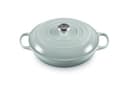
Le Creuset Signature Braiser (3.5 qt) — the best heirloom
The braiser people picture when they picture the pan: a 3.5-quart French-made enameled braiser with a light, easy-to-read sand-colored interior, large mitt-friendly handles, a wide low profile, and a lifetime warranty. It braises no better than the Lodge — the physics of enameled cast iron are the same — but if the object, the finish, the color range and the warranty are part of why you are buying, this is the one that delivers them. The cautions are the price (roughly four to five times the Lodge for the same braise), the light interior staining over time (cosmetic), and a heavy tight lid that makes the full pan a two-handed lift. Buy it for what it is: a buy-it-for-life pan where finish and provenance are the point.
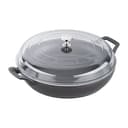
Staub Cast Iron Braiser with Glass Lid (3.5 qt) — the best for searing
The braiser for the cook who sears hard. Staub’s textured matte-black interior enamel is the one finish genuinely built for high-heat browning, and this 3.5-quart French-made pan pairs it with a glass lid so you can watch a braise without lifting it and releasing the heat. It is made in France, dishwasher safe, and handsome enough to serve from. The trade-offs are real: it is as expensive as the Le Creuset, the dark interior makes fond and browning harder to read than a light one, and the glass lid isn’t the self-basting cast iron lid Staub’s round cocottes are famous for. If a hard sear is the part of braising you care about most, this is the interior that rewards it.
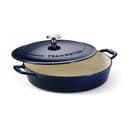
Tramontina Enameled Cast Iron Braiser (4 qt) — the best larger / family size
The larger value braiser: a roomy 4 quarts of enameled cast iron with a light, easy-to-read interior, from the maker most people already recommend as the Le Creuset alternative. If you cook for a family and want the widest, shallowest pan for the least money, this is the sensible pick — a little more capacity than the Lodge, still a fraction of the French price. You give up French-brand fit and finish, it can chip like any enamel, and it is heavier and less refined than the premium pans. But as a big, light-interior braiser that won’t make you wince at the price, it earns its spot.
Crock-Pot Artisan Enameled Braiser (5 qt) — the cheapest and largest
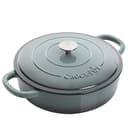
The biggest and cheapest braiser here, from the brand best known for slow cookers. At 5 quarts it holds the most, it is enameled inside and out so there’s no seasoning and it’s safe with acidic food, and it comes with a matching lid — all at the lowest price on this list. It is basic: the finish and warranty are entry-level, the enamel durability is a step below the premium brands, and the country of manufacture isn’t clearly stated. But if you want the most braising capacity for the least money and don’t care about the badge, it does the core wide-and-shallow job that makes a braiser worth owning.
Braiser or dutch oven — which do you actually need?
They are close cousins, and plenty of cooks own only one. A dutch oven is the deep, do-everything pot: soups, stews, chili, big batches, deep-frying and tall loaves of bread. A braiseris the specialist for browning a full layer and then braising it low — chicken thighs, short ribs, sausages and peppers, greens, a pan of enchiladas — and for going straight from oven to table. If you can only buy one and you make a lot of soup and bread, buy the dutch oven; if you mostly braise and sear, the braiser is the more natural everyday pan. We work through the full comparison in dutch oven vs braiser, and if the enamel side is new to you, what is enameled cast ironexplains what the coating does and doesn’t change.
Caring for an enameled braiser
Enameled cast iron is the low-maintenance side of the family: no seasoning to build, no reason to fear acidic sauces, and it’s usable the moment you unbox it. The care that matters is protecting the coating. Let the pan cool before washing so you don’t thermally shock the enamel, hand wash it with a soft sponge and a little dish soap (soap is fine on enamel), and skip steel wool and harsh scourers. For stuck-on fond, simmer some water with a little baking soda to loosen it rather than scraping; for stains on a light interior, a paste of baking soda does most of the work. Our full guide to cleaning enameled cast iron covers lifting stubborn stains without scratching the finish.