How we chose these small Dutch ovens
Shrinking a Dutch oven changes which specs matter. Weight stops being the deciding factor because every pot here is liftable. Cooking floor starts mattering a great deal, because there is so little of it. Here is the order we weighed things in.
1. Capacity, and what it really feeds
Allow roughly a quart to a quart and a half per person for a main-course braise, and leave headroom so the pot is not filled to the rim. That puts 2 to 3.5 quarts at one to two people and 4 to 5 quarts at two to three, which is the same arithmetic our size guide uses and the reason this page stops at 4.3 quarts. Above that you are simply buying a normal Dutch oven, and the main roundup is the better page for you.
Two things surprise people at this end of the range. A 2-quart pot is smaller than it sounds — it is a side dish, a grain, or one person’s dinner, not a family meal reduced. And a 4.3-quart pot is much closer to a standard Dutch oven than to a 3-quart one; the gap between the bottom and the top of this page is more than double. Decide which of those two you are actually shopping for before you compare brands, because it matters more than any brand difference below.
2. Cooking floor, not just volume
This is the specification nobody lists and the one that decides whether a small pot is pleasant to cook in. Volume can be bought with height, and a tall, narrow 3-quart pot has a cooking floor barely wider than a coffee mug. Put two chicken thighs in it and they touch, release water, and steam instead of browning — the exact failure a Dutch oven is supposed to prevent.
The fix is width. Where a maker publishes a diameter or a footprint, we quote it, and where a pot is deliberately wide and shallow we say so, because that shape is the single best argument for a small pot. The trade runs the other way for bread: a boule needs vertical room to spring, so the wide pots that sear beautifully are the wrong shape for a loaf. No small pot is good at both, and any page that tells you otherwise is selling.
3. Enameled or bare cast iron
The same decision as at full size, with one extra wrinkle. Enamel needs no seasoning, tolerates tomato, wine and vinegar from day one, and is what most people should buy. Bare cast iron is cheaper, tougher, takes a grill or a campfire, and is the bakers’ choice — but it wants a seasoning routine and it will not thank you for a long acidic braise while that seasoning is young. Our enameled vs bare comparison covers the full decision.
The wrinkle is that a small pot is often a second pot, bought alongside a big one. If your existing Dutch oven is enameled, a small bare pot adds a capability you do not have — fire, grill, bread. If your existing pot is bare, a small enameled one adds the acidic braises you have been avoiding. Buying the same material twice is the least interesting version of this purchase.
4. Published weight and oven limits
Weight is less critical here than on a 7-quart pot, but it is still the difference between a pan that lives on the stove and one that lives in a cupboard. The pots on this page run from under 7 pounds for the bare 2-quart Lodge to a little over 11 for the 4.3-quart enameled ones, which is a meaningful spread for a one-handed lift.
Oven limits matter more than they should, because listings in this category are careless with them. Most enameled pots here are stated at 500°F, and knobs are usually the real ceiling — Staub publishes 464°F for its brass and nickel-plated knobs while the same listing advertises 900°F for the pot without its lid. Where numbers conflict, we give you both and tell you which one to cook to. Where nothing is published, the spec table says Not published rather than a figure we invented.
5. Where the pot is made, when anyone will say
Country of manufacture is a real buying factor in cast iron and it is unevenly disclosed. Lodge states plainly that its bare iron is made in the USA and, to its credit, that its Essential Enamel line is made by partners in China or Vietnam. Le Creuset and Staub state France. The budget enameled pot here states nothing at all, which is a finding rather than a gap — we record it as Not published and let you weigh it.
The pots, one by one
Lodge Essential Enamel, 3 quart — the best overall
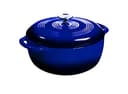
The straightforward answer for most people, and the pot that makes the fewest demands on you. Three quarts is the middle of this range: big enough for a two-person braise with leftovers, small enough that the liquid sits deep rather than spreading thin. It is enameled, so there is nothing to season and nothing to fear from a tomato sauce, and Lodge’s own page gives the whole spec plainly — 9.5 pounds, oven-safe to 500°F, a matching lid with a stainless steel knob, hand wash, no metal utensils.
Two honest caveats, both from Lodge itself rather than from us. This enameled line is not the Tennessee-made iron the brand is famous for; Lodge says it is made by trusted partners in China or Vietnam, and that is worth knowing if you are buying Lodge for the American manufacture. And unlike Lodge’s bare pots, this one is not designed for a grill or an open fire — enamel and live flame do not mix. Neither changes what it does on a stove, which is everything a small pot needs to do at roughly a quarter of what the French makers charge for the same three quarts.
Amazon Basics 4.3 quart — the best budget pot
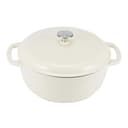
The cheapest honest way into enameled cast iron at this size, and the sensible pick if you are not yet convinced a small pot earns its shelf. At 4.3 quarts it is the largest pot on this page — the listing says it serves three to four — so it doubles as a perfectly reasonable everyday Dutch oven for a couple rather than a specialist. It states 500°F, a smooth enamel finish inside and out, and 11.24 pounds.
You give up three things and it is worth naming them. There is no meaningful warranty. No country of manufacture appears anywhere on the listing, so you are buying without that information. And the care instructions are stricter than the price implies: hand wash in warm soapy water, no citrus-based cleaners, no metal utensils. If you will follow that, it braises the same dinner as pots costing five times more, because at this size the physics is not what you are paying for.
Lodge 2 quart with loop handle — the best for cooking for one
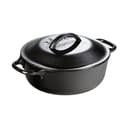
The smallest genuinely useful cast iron pot we can point you at, and a proper little Dutch oven rather than a novelty. Lodge lists it as the L2SP3: made in the USA, supplied with a cast iron lid, seasoned with vegetable oil, made without PFAS, and usable on any stovetop including induction as well as in the oven, on a grill or over a campfire. That last clause is the reason to prefer bare iron here — it goes places the enameled pots are not allowed.
Two quarts is genuinely small, and you should picture what that means before buying: a portion of chili, a pot of rice or beans, a side of braised greens, one person’s stew. It is also the lightest pot on this page by a distance, at 6.67 pounds by Lodge’s figure and 6.99 by Amazon’s. Being bare iron, it wants the usual wash-dry-oil routine — our seasoning guidecovers it in ten minutes of reading. One oddity worth flagging because it will confuse you otherwise: Amazon’s feature bullets on this listing describe Lodge’s Double Dutch Oven, a different product entirely. Read the specifications, not the marketing copy.
Lodge Combo Cooker, 3.2 quart — the best for a single loaf
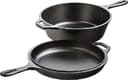
The pot bakers reach for, and the best value on this page if bread is why you are here. It is a deep pot plus a 10.25-inch skillet lid, and the trick is that bakers invert it: the loaf goes on the shallow skillet, where loading and scoring are easy, and the deep pot drops over the top as a dome. Compare that with lowering a wet dough into a preheated 5-quart pot and you understand why it has the following it does.
It is bare American cast iron, pre-seasoned, and it is effectively two pans for the price of one cheap skillet. The limits are shape-driven: 3.2 quarts and a 10.25-inch floor suit round boules rather than long loaves, and as bare iron it needs drying and oiling after washing. If bread is the main event rather than a side interest, our sourdough Dutch oven roundup goes deeper on the shapes.
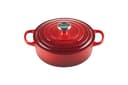
Le Creuset Round Wide, 3.5 quart — the best premium pot
The one small French pot whose shape is chosen for what small pots are actually used for. Instead of scaling the classic deep round down until the floor is useless, Le Creuset made this one wide and shallow — 3.5 quarts across a 9.4-inch footprint — so a couple of chicken thighs or a chopped onion and a pile of mushrooms can sit in one layer and brown rather than steam. That single decision is the argument for it over a cheaper 3.5-quart pot.
The rest is the familiar Le Creuset package: enameled cast iron, no seasoning, a light interior that lets you read fond as it builds, all cooktops, 500°F, dishwasher safe, made in France. The costs are equally familiar. It is several times the price of the Lodge for the same capacity, the light interior stains permanently with use (a cosmetic matter, not a functional one), and the wide shape that makes it a good searing pot makes it a poor bread pot — a boule wants depth for oven-spring. Le Creuset’s claim that this is the lightest cast iron per quart on the market is the maker’s, not a measurement of ours; the listed 8.47 pounds is, for what it is worth, the lightest enameled pot here.
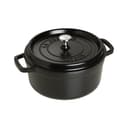
Staub 4-quart Round Cocotte — the best for browning
If the small pot exists to brown things, this is the one. Staub’s interior is matte black enamel rather than the pale sand finish Le Creuset uses, and it is built for high-heat searing rather than for showing you what is happening. The cast iron lid carries self-basting spikes that condense steam and drip it back over the food, which is a genuine advantage over a long, slow braise in a pot this size, where there is not much liquid to lose. Made in France, 4 quarts, a 9 3/8 inch diameter, and a limited lifetime warranty against manufacturing defects.
Three honest costs. It is the most expensive pot here by a wide margin. The dark interior that makes it a good searing pan also hides the fond, so browning is judged by smell, sound and time rather than by eye — some cooks find that liberating and some find it maddening. And the temperature claims on the listing do not agree with each other: it advertises oven safety to 900°F without the lid, while Staub’s own retail data gives 500°F and the knob is rated to 464°F. Cook to 500°F and you will never test which number is right.
Do you actually need a small Dutch oven?
Worth asking honestly, because for a lot of people the answer is no. If you own one 5.5 or 6-quart pot and you cook for two, that pot handles almost everything; the small one is a convenience rather than a capability. Buying it because your existing pot feels too big for weeknight cooking is a reasonable motive, but it is a comfort purchase, and it is fine to call it that.
The cases where a small pot genuinely earns its place are narrower and clearer. You cook for one, routinely, and hate reheating. You want a dedicated bread vessel and the combo cooker is easier to load than your big pot. You already own enameled and want bare iron you can put on a grill, or the reverse. Or you cook a lot of side dishes — rice, beans, braised greens, a small batch of sauce — that get lost in a 6-quart. If one of those is you, this is a good buy. If none of them is, spend the money on the right full-size pot instead and put the difference into a better one.
Small Dutch oven or braiser?
These two categories overlap more than the naming suggests, and at 3 to 4 quarts they are competing for the same shelf. A braiser is a Dutch oven pressed wide and shallow: it trades depth for cooking floor, so it browns a full single layer beautifully and then simmers it under a lid. A small Dutch oven keeps more depth, which is what you want for anything liquid — soup, stock, rice, a loaf of bread.
The practical rule: if what you cook is mostly wet, buy the pot; if what you cook mostly starts with a sear, buy the braiser. The Le Creuset Round Wide above is deliberately in between, which is why it is the small pot we would pick for someone who does both. Our Dutch oven vs braiser comparison works through the full trade-off, and the braiser roundup covers that side of the range.
Living with a small pot
Care is the same as any cast iron, with two adjustments that only show up at this size. First, small pots come to temperature fast and hold less thermal mass, so they respond to burner changes much more quickly than a 6-quart. Use a lower flame than you would in a big pot, especially with enamel, and give it a couple of minutes to settle before you judge the heat. Scorching a small enameled pot is easier than scorching a large one.
Second, burner match matters more. A 2 or 3-quart pot on a large burner gets a ring of fierce heat around its edge and a cool middle, which is exactly how a braise catches at the sides. Put small pots on small burners. Beyond that, the routine is the usual one: hand wash enamel and avoid thermal shock, dry and oil bare iron, and see our cleaning guide for anything stubborn. If you are new to the material entirely, what a Dutch oven actually is is the better place to start than a shopping page.