How we chose these skillets for steak
The order matters. A pan that fails the first test is not rescued by winning the last one.
1. Mass, because mass is stored heat
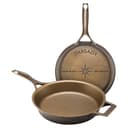
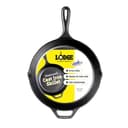
Cast iron does not conduct heat especially well; what it does is hold a great deal of it. The more iron under the steak, the smaller the temperature drop when the meat goes in, and the sooner the surface is back where you want it. That is why the published weights lead every card on this page. Lodge lists its classic 10.25-inch skillet at 5.66 lb and the 13.25-inch Chef Collection at 8.16 lb; Stargazer publishes 6.5 lb for its 12-inch; Amazon’s spec table gives 6.61 lb for the Lodge dual-handle 12. Those are the numbers we ranked on, and they are the reason the thinner Blacklock line is absent: Lodge’s own figure for the 10.25-inch Blacklock is 4.61 lb, a full pound lighter than the classic, and the classic’s own registry entry notes the thinner walls hold slightly less heat for a long, hard sear. For everyday cooking that trade is worth making. For steak it is the wrong direction.
2. The cooking floor, not the rim
A skillet’s size is measured across the top, and the sloped walls eat into it. Stargazer is unusually honest about this: its 12-inch pan publishes a 9.4-inch cooking surface. Lodge’s dual-handle 12 has a cooking floor of roughly 10.5 inches by its listing. Field publishes 8.75 inches of cooking area on its 10.25-inch No. 8. The rule of thumb we used: one thick steak wants about a 9-inch floor with room around it; two want the 13.25-inch Chef Collection or the reversible two-burner griddle. Crowd the pan and the juices pool, the temperature crashes and the crust never forms — the exact failure this whole category exists to prevent.
3. Handle and oven fit
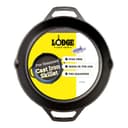
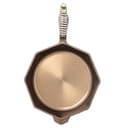
Most reliable steak methods involve the oven: a reverse sear that starts there, or a thick cut that finishes there. A long handle is comfortable on the stove and a liability in a small oven, which is why the two-loop Lodge earns a place. Its listing gives 14.56 inches overall against roughly 19 for a long-handled pan of the same diameter, and Lodge rates the line for oven, grill and campfire. Stargazer’s long handle is the one designed to run cooler on the stovetop, and Finex’s coiled stainless-and-brass spring handle is built to stay cool longer than solid iron. Every bare pan here is oven-safe by its maker’s statement; for the temperature detail, see can you put cast iron in the oven.
4. Surface finish, which matters less than you think
Machined-smooth pans from Stargazer and Finex release food sooner and feel wonderful. They do not brown a steak any better than a pebbled Lodge, because a steak is not sticking to the pan; it is sitting in rendered fat and building a crust through the Maillard reaction, which cares about heat and dryness, not texture. Buy the smooth pan for the handle, the finish and the eggs, not for the sear.
5. Flat or ridged
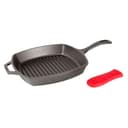
A grill pan puts marks on a steak and lifts it out of its fat. What it cannot do is brown the whole surface, because only the ridge tops touch the meat. That is why the Lodge grill pan sits last here with an honest award: it is the best pan on this page for the look of a grilled steak and the worst for an edge-to-edge crust. If the marks are the point, our grill pan roundup compares six of them.
The picks, in one paragraph each
Stargazer 12-inch leads because it gets everything right at once: 6.5 lb of iron under a published 9.4-inch floor, a machined surface, a long handle designed to stay cooler, and made in the USA. It costs several times a Lodge and does not sear better than one; it is simply the nicest pan to do this job in. Lodge Chef Collection 13.25-inch is the pan for two steaks, or one enormous one, and its sloped walls make it easy to get a spatula under the meat; at 8.16 lb by Lodge’s own figure it is a two-hands lift and too big for a small burner to heat evenly. The classic Lodge 10.25-inch is the budget pick and the pan most people should start with: 5.66 lb, made in Tennessee, and a fraction of every other price here. Its floor is one steak’s worth. Lodge dual-handle 12-inch is the oven-finisher, with real skillet walls, a roughly 10.5-inch floor and a footprint that fits an oven a long-handled pan will not; the trade is two mitts every time. Finex 12-inch is the premium object, with a polished surface, an octagon that pours from every corner and a handle that stays cool — at Le Creuset money for a bare skillet, and it is heavy. Lodge square grill pan is for grill marks indoors and knows its place.
What about enameled cast iron for steak?
Two cautions, both from the makers rather than from us. Enameled pans carry a published oven ceiling — 500°F on the Lodge, Le Creuset and Staub skillets in our enameled skillet roundup, 450°F on the lidded Tramontina — and a hard sear on the stovetop sits at the hot end of what glass-on-iron is rated for. Bare iron has no such ceiling; Smithey’s FAQ puts it as bluntly as any maker: your oven cannot get too hot for it. If you already own an enameled skillet, Staub’s textured matte black interior is the one enamel the maker specifically describes as built for browning, and the Lodge vs Staub comparison covers it. If you are buying a pan for steak, buy bare.
How to use whichever one you buy
Preheat it properly — thick iron takes longer than you expect, and our preheating guide explains how to tell when it is ready. Dry the steak, salt it early, and use a fat with a high smoke point; our oil guide lists them. Do not move the meat until it releases on its own. Rest it on a board, not in the pan, because the pan is still hot enough to keep cooking it. And when you are done, the pan will look terrible and be fine: hot water, a scrub, dry on the burner, a wipe of oil. A steak pan is the easiest cast iron to keep seasoned, because every use is a hot, fatty one.