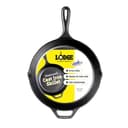
How we chose these pizza pans
Pizza asks less of a pan than braising does, so most of the usual cast iron criteria fall away. Nobody needs a lid. Enamel is the wrong material, because the temperatures that make good pizza sit at or above the point where most enameled cookware is rated to stop. What is left is a short list, and it is not the list the listings emphasize.
1. The flat cooking surface, not the diameter
This is the whole game, and it is where the marketing is loosest. Every pan is sold by its widest measurement, which on a walled pan is the top of the rim and on a handled pan may include the handles. Neither is the flat circle your dough sits on. Victoria is the only maker on this page that publishes the honest figure outright: its 12-inch comal has a 10.5-inch flat cooking surface. The budget Home-Complete pan states 11.6 inches on a 12-inch pan. Lodge does not state one for its skillets, but the rule from our skillet size guideholds — the floor runs roughly an inch to an inch and a half under the rim, so a 10.25-inch skillet bakes about a 9-inch pizza and a 12-inch bakes about 10.5.
The exception, and the reason it takes the top pick, is a genuinely rimless pan. Lodge’s 15-inch pizza pan has nothing to lose to a wall, so 15 inches is 15 inches of crust. If the size of the pizza is what you care about, that difference is larger than any other on this page.
2. Whether the maker allows it on the stovetop
Here is the finding that surprised us, and it is not a small one. Lodge’s round pizza pan and its rectangular baking pan are sold as bakeware, and Lodge’s own product pages for both say, in the features list, “Oven safe, not recommended for stovetop use.” Lodge’s skillets and its dual handle pans carry the opposite line: compatible with any stovetop including induction, plus oven, grill and campfire.
That matters because one of the best home-pizza techniques is a stovetop finish — you bake the pizza, then set the pan back on a live burner for a minute or two to drive the last of the moisture out of the base. Our own cast iron pizza recipe ends that way. You cannot do it on the two Lodge bakeware pans without going against the maker. It is not that iron minds; it is that these pans are thinner, flatter castings than a skillet and Lodge is not willing to stand behind them over a concentrated burner. We report what they publish and let you decide, and it is why those two pans show Induction-safe: No in the spec tables below.
3. Rim or no rim — which decides the pizza, not the pan
A rimless pan makes thin, wide, crackly pizza and slides it off easily. A walled pan makes pan pizza: you oil the pan, press the dough in, let it puff, and the oil shallow-fries the base and the edges into something closer to focaccia with cheese on it. Those are not the same food and neither is the better one.
Be honest with yourself about which you actually want to eat, because the pan cannot be talked into the other job. A flat pan will not hold a pan pizza — the oil runs off. A skillet will make thin crust, but the walls trap steam at the edge and you lose the crisp rim that was the point.
4. Overall length against your actual oven
Cast iron pizza pans are long. Lodge’s 15-inch round is 19.25 inches from handle to handle, its rectangular baking pan is 19.06, and the Victoria comal is listed at 19 by Amazon — all long enough to foul the walls of a compact or apartment oven, and awkward to turn halfway through a bake. The two-loop pans are the compact ones: the Lodge dual handle 12-inch is 14.56 inches overall and the Home-Complete is 14. If your oven is small, that specification outranks every other one on this page.
5. Weight, because you are moving it hot
The published weights here run from Victoria’s claimed 4.49 pounds (Amazon says 6 for the same pan, and we record both rather than picking) to 9.91 pounds for the big Lodge. That top figure is worth pausing on. Ten pounds of 500°F iron with a hot pizza on it, carried on two loop handles with oven mitts on, is a genuinely two-handed job and the reason every pan here has at least two handles. If lifting is a concern, buy the smaller pan; the pizza will be smaller and nobody will mind.
6. Seasoning, and who did it
The Lodge pans and the Victoria arrive with factory seasoning — vegetable oil at Lodge, three layers of flaxseed oil at Victoria — and can bake on day one. The Home-Complete listing says “Season Before First Use” and supplies its own method, which is a real cost in time even though it is not a cost in money. If that is your first experience of cast iron, read our seasoning guide before you start rather than following the bullet on the box.
The pans, one by one
Lodge 15-inch Pizza Pan — the best overall
If you want the biggest, thinnest, most pizzeria-shaped pizza a home oven will produce, this is the pan, and the reason is geometry rather than brand. Amazon’s listing describes it as a rimless design supporting edge-to-edge baking, and with no wall to lose surface to, the full 15 inches is crust. Nothing else here is close: the next widest usable circle on this page is 11.6 inches.
The costs are all physical. Lodge publishes 9.91 pounds and 19.25 inches of overall length, so it is heavy and it is long — measure the inside of your oven, not the shelf. There is no rim, so deep-dish and pan pizza are off the table by design. And Lodge lists it as oven-only, which rules out the stovetop finish. Within those limits it does one job better than anything else here, it is made in Tennessee, and it arrives seasoned and ready.
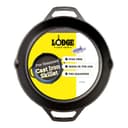
Lodge 12-inch Dual Handle Pan — the best for pan pizza
Lodge’s own description of this line is the useful one: it is the classic skillet redesigned with two assist handles instead of one long one. That makes it a skillet in every way that matters for pizza — proper walls to hold an oiled crust, a stovetop rating including induction, oven, grill and campfire — while cutting the overall length from roughly 19 inches to 14.56. In a normal oven that means you can actually turn it halfway through the bake without a wrestling match.
The compromises are the ones any two-loop pan has. You need two mitts and two hands, always, and you have no leverage to slide or shake the pan the way a long handle gives you. And the 12 inches is the rim, so plan on a pizza around 10.5. At 6.61 pounds by the listing’s figure it is mid-weight for this page. If you want a pan for exactly the cast iron pan pizza we publish — oil, press, bake hot, finish on the burner — this is the one we would buy.
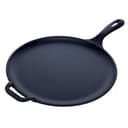
Victoria 12-inch Comal & Pizza Pan — the best stovetop-and-oven pan
The most versatile pan here and the one that will get used between pizzas. Victoria rates it for gas, electric, ceramic and induction cooktops as well as the oven, the grill and a campfire, and because it is a comal first it also does tortillas, roti, flatbread and pancakes properly. It comes pre-seasoned with three layers of flaxseed oil, it is made in the company’s own Colombian factories, and it carries a long handle plus a loop, which is the best handle arrangement on this page for a one-handed slide followed by a two-handed lift.
Two honest deductions and one oddity. The flat cooking surface is 10.5 inches on a pan sold as a 12 — we are giving Victoria credit for publishing that, but you are still baking a 10.5-inch pizza. The long handle puts overall length back up around 19 inches, so it buys you no oven room over the big Lodge. And Victoria’s own page and the Amazon listing disagree on the basics: 4.49 pounds against 6, and 14.75 inches against 19. We have recorded both rather than averaging them into a number nobody published. Worth noting too that Victoria’s care instructions say warm water only, no soap — stricter than the current consensus, which our soap-on-cast-iron guide covers.
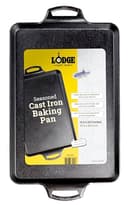
Lodge 15.5 x 10.5-inch Baking Pan — the best for Sicilian squares
Round is a convention, not a requirement, and a rectangular pan with a real 1.5-inch wall is the right vessel for the pizzas that are actually easiest to make well at home: Sicilian, grandma pies, thick focaccia-style squares. You oil the pan, let the dough relax and spread into the corners over a couple of hours, top it, and the wall keeps the oil where it can fry the edge. Lodge’s own listing names pizza among its jobs alongside cookies and casseroles.
It also uses an oven better than a circle does — a 15.5 x 10.5 rectangle covers most of a standard rack where a 15-inch round wastes the corners. The limits are the same two as the round pizza pan: 19.06 inches of overall length, and Lodge’s “not recommended for stovetop use”. At 7.5 pounds it is the lightest of the three Lodge pans here, which is a small mercy when it comes out full.
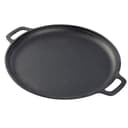
Home-Complete 12-inch Pizza Pan — the best budget flat pan
The sensible pick if you are not yet sure a dedicated pizza pan earns a place in your cupboard. It is a flat, two-loop-handled cast iron disc with a stated 11.6-inch cooking surface — more usable circle than the Victoria — at appreciably less money, and its 14-inch overall length makes it one of the two pans here that will fit a small oven.
What you are giving up is verification. The listing says “Season Before First Use”, so it ships bare and the first job is yours. No weight, no country of manufacture and no warranty appear anywhere on it, and there is no maker’s site to check against — unlike Lodge and Victoria, whose own pages we read for every figure above. That absence is a finding rather than a complaint: for a first pizza pan that costs less than a delivery pizza, it may be exactly the right trade, and if you use it weekly, the Lodge is still there.
Lodge 10.25-inch Classic Skillet — the best pan you may already own
We would be selling you something you do not need if we left this off. The single most common cast iron pizza in American kitchens is made in a plain 10.25-inch Lodge skillet, and it is very good: the walls make it a pan-pizza mold, the long handle turns and slides it one-handed, it is rated for every heat source including the stovetop finish, and if you own any cast iron at all this is probably it.
The honest limits are size and shape. A 10.25-inch rim gives you about a 9-inch pizza, which is one person’s dinner rather than a shared pie, and the tall-ish walls trap enough steam at the edge that a genuinely thin, crackly crust is not on offer. If you already have one, make pizza in it this weekend before you buy anything on this page — that is the cheapest way to find out which of the pans above you actually want. Our main skillet roundup covers this pan in its day job, and the large skillet roundup covers the 12 and 13.25-inch versions if you want the same idea bigger.
Do you need a pizza pan at all?
For a lot of people, no, and it is worth saying so on a page that makes money when you buy one. If you own a 10 or 12-inch cast iron skillet and you make pizza a few times a year, that skillet is already the answer and a second flat pan is a convenience rather than a capability.
A dedicated pan earns its shelf in three situations. You want a pizza bigger than about 10 inches, which no skillet on this site will give you. You want thin, crackly, edge-to-edge crust, which the walls of a skillet actively prevent. Or you want the rectangular shape, because Sicilian and grandma-style pies are the easiest good pizza to make at home and a round pan cannot make them. If none of those is you, keep the money.
Cast iron pizza pan vs pizza stone vs steel
Cast iron sits between the two, and the trade-off is honest in both directions. A stone is porous, so it pulls moisture out of the base and gives a drier, crisper crust than iron does; it is also brittle, cracks from thermal shock, and cannot be moved once hot. A baking steel conducts faster than either and is what most serious home pizza people end up with, but it is expensive and heavy and does exactly one thing.
Cast iron gives you most of the thermal-mass benefit, survives being dropped, moves in and out of the oven with handles, goes on a grill or a campfire (if the maker allows it), and cooks a hundred other things the rest of the year. That versatility is the argument, not outright crust performance. If pizza is a serious hobby rather than a Friday, a steel will beat any pan on this page.
Getting the most out of it
Preheat the pan, not just the oven — for thin-crust pans this is most of the technique. Put the empty pan in as the oven comes up to its maximum and give it at least 20 minutes at temperature, then build the pizza fast and get it back in. Cast iron takes longer than air to reach temperature, and a pan that is merely hot rather than saturated is why home pizzas go pale underneath. For pan pizza the rule reverses: press the dough into a cold, generously oiled pan so it relaxes and puffs, then bake.
Afterwards, treat it like any bare cast iron. Scrape while warm, hot water and a brush, dry it fully, wipe on a thin film of oil. Baked-on cheese and sugary sauce are the two things that stick worst, and both come off with a plastic scraper and a little patience — the cleaning guide has the full routine, and why cast iron goes sticky covers the most common thing people do wrong afterwards. Cornmeal or semolina under the dough helps release and is a very old trick for a reason.