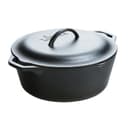
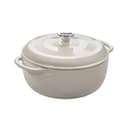
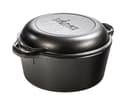
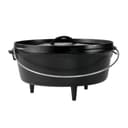
Finding two: the pot most people buy is the least documented in its own line
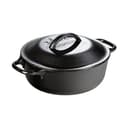
Lodge is unusually open for a cookware brand — it publishes a per-size weight table for all nine Classic skillets, which almost nobody does. That makes the gap here conspicuous. On the pages we read, Lodge publishes a weight and full dimensions for the 2-quart (6.67 lb), the 5-quart Double Dutch Oven (12.37 lb) and the 3.2-quart Combo Cooker (12.85 lb) — and no weight at all for the 7-quart. So the biggest pot in the range, the one a “Lodge cast iron Dutch oven” search most often lands on, is the one you cannot look up before you lift it.
We are not going to estimate it. Scaling from the pots that are published would produce a number that looks like a fact and is not one, and the whole point of this site is that an unpublished figure stays unpublished. What we can say is the direction: a 5-quart double pot with a skillet lid is 12.37 lb, so a 7-quart pot with a full iron lid is a two-handed object and should be planned for as one.
The lid is the spec nobody checks
This pot comes with a cast ironlid, and that matters more than it sounds. An iron lid has the same effective heat tolerance as the pot, so the whole vessel can go as hot as your oven goes. Lodge’s tempered glass lids, by contrast, publish the only oven temperature on any Lodge lid: 400°Ffor the 10.25-inch GL10. If you have ever wondered why bread recipes insist on an iron lid, that is the number behind it — 400°F is below where most no-knead loaves start.
What Lodge does not publish for bare iron: an oven ceiling
And that is the correct answer rather than an omission. There is no coating to fail, no knob plating to discolour and no enamel to craze, so a bare pot is limited by your oven rather than by itself. It is also the one place the cheap pot beats the expensive ones outright: Lodge’s own enamelled line states 500°F, Staub states 500°F with the lid, and the bare 7-quart simply has no stated limit. Our oven guide covers the practical limits.
Care, in Lodge’s own words
For seasoned cast iron, Lodge’s care hub is three words: “wash, dry, and rub with oil”. For its enamelled pots it is “Hand wash in warm, soapy water—it’s that simple”. Worth noting because Lodge offers no dishwasher endorsement for eitherfinish, which is the direct opposite of Staub’s published answer for its own enamel. Our seasoning guide and first-use guide cover the routine; the only bare-iron-specific caution for a pot is acidic cooking, because a two-hour tomato braise in a young pot will lift some seasoning.
Four reasons to buy a different pot
You cook for one or two. A half-full large pot scorches at the edges; buy the 2-quart or read the small pots page. You cook acidic food constantly. Buy enamel. You want to leave leftovers in the pot in the fridge. Lodge rates the enamelled interior for that and does not rate bare iron for it. You want it to be a colour. It never will be. Against that, our enamelled vs bare comparison is the page that settles the material question, and Dutch ovens under $100 shows what else the same money buys.
Verdict
A genuinely good pot that is mis-sold by its own search term. Judged as what it is — a large, American-made, fire-rated bare iron vessel with an iron lid at well under half the price of enamelled pots its size — there is nothing to complain about except the missing weight on the spec sheet. Judged as the thing most people typing “Lodge cast iron Dutch oven” are actually shopping for, which is a no-maintenance pot for braises and bread, it is the wrong pot and the enamelled 6-quart is the right one.