How we chose these grill grates
Grates are the one product on this site where the buying criteria are almost entirely about the object’s relationship to your grill, not about the object itself. Here is the order we weighed things in.
1. Fitment, and who is making the claim
Every grate here states which grills it fits. The difference that matters is whois making that statement. When Weber says part 7853 fits a Genesis 300 from 2016 onward, that is the company that designed both parts telling you they mate. When a parts seller lists forty model numbers, that is a seller’s research, and it is usually right — but it is their word, not the grill maker’s, and the returns process is yours to deal with if it is wrong. We rank manufacturer-original sets above aftermarket ones for exactly this reason, and where no manufacturer part exists on Amazon for a grill family, we say so rather than pretending.
Two practical habits make either kind safe. Read your nameplate — it is usually a sticker or plate on the inside of a cabinet door or the back of the firebox — and write down the full model number, including the letters. Then measure your existing grates corner to corner and compare against the dimensions in the listing. If a listing does not publish dimensions, that is a reason to skip it, not a detail to shrug at.
2. Bare iron or porcelain enamel
This is the second real decision, and it matters more outdoors than it does in a kitchen. Bare cast iron grates are the same material as a skillet, protected only by seasoning, living on a patio through whatever weather you get. They will rust if you let them, and several listings for bare grates cheerfully claim otherwise. Porcelain-enameled cast iron is iron with fused glass over it: no seasoning, no rust, and the reason nearly every manufacturer now ships enamel rather than bare iron. The trade is that enamel chips, and a chip is a rust point, so you brush it warm and gently rather than attacking it cold with a wire brush.
Our default recommendation is enamel unless the price gap is large and you genuinely will oil the grate. Bare iron is not a mistake — it is cheaper, it cannot chip, and if you already keep a skillet seasoned the routine is familiar. It is just a commitment, and we would rather say that than sell you a spring rust project.
3. Published weight
Weight is the closest thing to a performance spec that exists in this category, because heat retention is a function of mass. A set of grates that weighs 15 or 17 pounds will behave very differently from one that weighs nine, and the difference shows up precisely when you need it — the moment cold food hits hot iron. Some listings publish a figure and some do not. Where a maker or seller publishes one, we quote it; where nobody does, the spec table says Not published rather than a number we made up.
4. What it costs against the grate it replaces
A cast iron grate set can cost anywhere from a fraction of a grill’s value to a meaningful percentage of it. The manufacturer sets sit at the top of that range, the aftermarket sets at the bottom, and the gap between them for the same grill can be three or four times. That gap is real money and it deserves an honest answer rather than a reflex: if your grill is a decade old and you are keeping it alive, the cheap iron is the sane buy. If your grill is newer, expensive and you plan to keep it another ten years, the manufacturer part is the one that will still be described correctly on a parts diagram when you need a second set.
5. What we did not consider
We ignored every claim about “professional searing,” “locking in juices” and restaurant-grade results, which appear on almost every listing in this category and mean nothing. We also excluded one popular set that ranks well against cast iron searches — a 21.5-inch hinged kettle grate whose own listing describes it as stainless steel. If a product is not cast iron, it does not belong on this page whatever it is filed under.
The grates, one by one
Weber Crafted cooking grates — the best manufacturer set
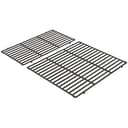
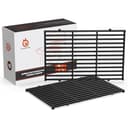
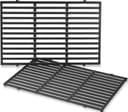
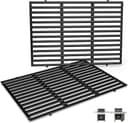
If you own a Genesis 300 from 2016 or later, this is the straightforward answer and the only one on this page where the grill maker itself vouches for the fit, the material and the weight. Weber describes part 7853 as porcelain-enameled cast iron, lists the fitment as Genesis 300 series 2016 and newer, and the listing reports 17.4 pounds for the pair — the heaviest set here. Enamel means you will never season or de-rust them. The honest problems are the price, which is several times what an aftermarket set for the same grill costs, and a common point of confusion: these grates are a direct replacement on their own, but the WEBER CRAFTED grillware accessories — the griddle, the rotisserie basket and so on — also need a separate frame kit. Buy the grates for the grates.
QuliMetal 7638 set — the best value
The cheapest genuinely cast iron set here, and the one that fits the widest span of Weber cook boxes: the 17.5 by 11.9 inch grate is shared across the Spirit 300 series, Spirit II 300, Spirit 700, Weber 900 and the whole Genesis Silver, Gold and 1000–3500 generation. It is bare cast iron rather than enameled, which is exactly why it costs what it does. Two cautions. First, the listing claims the bare iron will not rust easily; bare cast iron left outdoors absolutely will, so plan on wiping it with oil while it is warm and keeping the grill covered. Second, no weight is published, so you cannot compare its mass against the manufacturer sets — you are buying on dimensions and price, not on a heat-retention number. Genesis Silver A and Genesis II LX owners are explicitly excluded; check your nameplate.
Weber 7524 grates — the best for a 2007-2016 Genesis
Weber’s own porcelain-enameled cast iron set for the Genesis 300 generation that ran from 2007 to 2016 — a huge installed base of grills that are still going, and one of the most common cast iron grate purchases in America. Because it is a Weber part, the fitment comes with the years attached, and those years are the point: the listing states plainly that it does not fit Genesis II, Genesis II LX 300 series, or Genesis grills made from 2022 onward. Get that wrong and nothing else about the grate matters. It is enameled, so there is no seasoning routine, and it costs meaningfully less than the current Crafted set. The trade-off is that at this price you are paying a manufacturer premium to keep a grill going that may be closer to the end of its life than the start.
QuliMetal 66095 set — the best for a Genesis II
The Genesis II 300 generation, from 2017 onward, is the awkward case: Weber does not offer a cast iron grate for it on Amazon, so the choice is entirely aftermarket. Of the sets that fill that gap, this is the one we would take, for two reasons. It is porcelain-enameled rather than bare, which is what you want on a grill that lives outside all year, and it publishes a weight — 15.83 pounds for the pair — so you can compare it against the grates you are pulling out. It also names the Weber part numbers it replaces (66095, 66802 and 66805) rather than gesturing at compatibility. The costs are the ones every aftermarket part carries: it costs more than the bare-iron sets that fit the same grill, Weber will not stand behind the fit, and enamel chips if you attack it with a wire brush. Measure your old grates first.
Uniflasy 8835 kettle grate — the best for a charcoal kettle
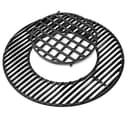
A 22-inch Weber kettle ships with a plated steel grate, so putting iron under the food means going aftermarket. This one copies the Gourmet BBQ System layout: a full 21.5-inch cast iron grate with a 12-inch center that lifts out, so you can feed charcoal mid-cook without moving the food, and so the GBS griddle, wok and sear grate inserts still drop in. Fitment covers the 22 and 22.5-inch kettles — Original Kettle, One-Touch, Bar-B-Kettle, Master-Touch, Performer and the 22.5-inch Smokey Mountain Cooker. The trade-offs are worth stating plainly: it costs more than Weber’s own steel 8835, it is bare iron on a grill that lives outdoors, and cast iron grates are heavy and breakable if they are dropped or badly packed in transit. If you cook over charcoal often and keep the kettle covered, it is a genuine upgrade. If your kettle lives uncovered by the fence, buy the steel one.
Weber Gourmet BBQ System sear grate — the best sear-zone insert
Not a replacement grate at all, and the pick we would point most kettle owners at first. It is a roughly 12-inch disc of porcelain-enameled cast iron — Weber’s own page states the material and gives the dimensions as half an inch by 11.9 by 11.9 — that drops into the hole in a Gourmet BBQ System grate. If you already have a GBS-compatible grate, it turns part of your kettle into a sear station for a fraction of the cost and weight of re-grating the whole grill, and enamel means it needs no seasoning. The limits are obvious once you look at the size: it sears two steaks, maybe three, and the rest of the grill is exactly as it was. You also need that GBS grate with a removable center already in place, and third-party inserts of the same diameter sell for roughly a third of the price — if you would rather not spend this much on a 12-inch circle of iron, that is a reasonable call and we would not argue with it.
If you do not own a Weber
Worth saying plainly, because the picks above are Weber-shaped and that is not an editorial preference: the cast iron grate market on Amazon is overwhelmingly organized around Weber part numbers, because Weber publishes them and its grills stay in service for decades. If you own a Char-Broil, a Nexgrill, a Dyna-Glo or one of the big-box four-burners, cast iron grates that fit do exist, but they come almost entirely from parts specialists rather than from your grill’s manufacturer, and we are not going to hand an award to a brand we cannot tell you anything meaningful about.
What we can give you is the buying rule, and it is the same one that governs this whole page. Find your grill’s model number on the nameplate. Search for that number rather than for “cast iron grill grates.” Then shortlist only the listings that publish exact dimensions and the original part number they replace, measure your existing grates before you order, and prefer porcelain-enameled iron unless you are certain you will oil bare iron. A listing that gives you a real measurement is telling you something checkable; a listing that gives you adjectives is not.
Is a cast iron grate actually worth it?
For some grilling, honestly, no. If you mostly cook chicken thighs and vegetables over medium heat, the grate material barely enters into it, and thin stainless will do the job while weighing a third as much and surviving total neglect. Our cast iron vs stainless steel grill grates comparison works through that trade-off properly.
The case for iron is narrow and real: thick food, high heat, and the moment of contact. Steaks, burgers, chops and anything you want a hard crust on all benefit from a grate that does not surrender its temperature the second it is loaded. That is the same physics that makes a cast iron grill pan work indoors, and the same reason a heavy skillet outperforms a thin one. If searing is why you own a grill, iron is worth the weight and the maintenance. If it is not, spend the money on charcoal.
Caring for cast iron grill grates
The routine is short and it is different from the one your skillet gets, mostly because a grate lives outside and you cannot put it in the sink. After cooking, run the grill hot for ten to fifteen minutes to burn residue off, then scrape while the grate is still warm. Match the brush to the surface: a stainless brush is fine on enamel if you are not aggressive, and Weber’s own instruction for its enameled grates is to preheat on high for fifteen minutes and brush clean. On bare iron, wipe on a thin film of high-smoke-point oil while the grate is warm; that is the whole seasoning maintenance, and it is what stands between the grate and a rusty spring.
Two failure modes are worth knowing. Enamel chips: bang a grate against a concrete step or gouge it cold with a wire brush and the iron underneath is exposed, and that spot will rust even though the rest of the grate never does. Bare iron rusts wholesale if it is left wet and uncovered, which is not a defect — it is what bare iron does. If yours has already gone orange over a winter, it is recoverable using the same method a neglected pan gets; our rust removal guide covers it, and the seasoning guide covers what to do once the iron is bare again. A grill cover does more for cast iron grates than any product you can buy for them.