How we chose a cast iron loaf pan
1. Lid or no lid — this decides everything else
Bread dough needs two different climates in sequence. For the first part of the bake it needs humidity, so the skin stays soft and elastic long enough for the loaf to expand; a lid does that by trapping the steam the dough itself gives off. For the second part it needs dry radiant heat to set and color the crust, which is why bakers take the lid off part-way. An open pan can only ever give you the second phase.
This is not a subtlety. A yeasted sandwich loaf made with milk, butter or sugar does fine in an open pan, because the enriched dough does not depend on steam. A lean sourdough in an open pan rises a little, sets early and stops. If sourdough is the reason you are buying a cast iron pan at all, buy one with a lid, and our guide to whether you need a Dutch oven for sourdough explains the same mechanism in more detail — including several ways to fake it for free with equipment you already own.
2. Published capacity, not the inches on the box
Loaf pans are the one shape where the headline number is nearly useless. “9x5” describes the rim of the pan; what your recipe cares about is volume. Lodge is unusually straight about this and publishes capacity in cups: 6 cups for the standard pan and 9 cups for the large one. Almost every American loaf recipe is written for an 8.5x4.5 or a 9x5 tin, which land in that range.
The practical test is batter height. Fill a loaf pan much past two thirds and you get the classic overflow-and-crater, because iron keeps feeding heat into the batter long after a thin tin would have given up. So if you are between sizes, the honest advice is to size for the recipe you actually bake most, not for the biggest loaf you can imagine.
3. What the maker publishes at all
This is the criterion that reorders the page, and the reason two American-made pans at under $30 outrank lidded pans that would be more fun to own. Lodge publishes dimensions, weight, capacity, country of manufacture, care instructions, a PFAS statement and a warranty for both of its loaf pans. The lidded pans in this roundup come from brands with no reachable product page of their own, so every figure we print for them is the Amazon listing’s figure — and where the listing is silent, our spec table says “Not published” rather than filling in something plausible.
That matters more than it sounds for cast iron, because the facts you actually need are maker facts. Is it pre-seasoned? Is it rated for a burner? What happens if it cracks? Northriver’s listing never says pre-seasoned, which is why ours says it is not published and why we would season it before first use. Articasting’s listing says pre-seasoned and publishes nothing else useful.
4. The spec nobody checks: stovetop clearance
Both Lodge loaf pans carry the same line in Lodge’s own feature list: “Not intended for stovetop use”. That is a real restriction and not boilerplate. It rules out the hot-pan trick that makes skillet cornbread work, it rules out starting a meatloaf with a sear, and it means the pan only ever heats in an oven. Lodge publishes the same warning across several of its bakeware pieces and we flag it on every page where it changes a method, such as the baking skillet roundup.
Lodge publishes no oven temperature ceiling for bare cast iron anywhere we have read, so we never quote one — with bare iron your limits are the oven and the smoke point of whatever you greased it with. Enamel is the finish that does carry numbers, and none of the picks here is enameled.
The two Lodge pans, side by side
These are the only pans in the category where one maker publishes the same spec sheet for two sizes, which makes it the cleanest comparison available. Every figure below is Lodge’s own.
| Published spec | Standard (BW8LP) | Large (BW10LP) |
|---|
| Capacity | 6 cup | 9 cup |
| Length | 12.0 in | 13.53 in |
| Width | 4.69 in | 5.37 in |
| Height | 3.68 in | 3.13 in |
| Weight | 3.68 lb | 5.6 lb |
| List price | $24.95 | $34.95 ($29.90 sale) |
| Made in | USA | USA |
| Stovetop | Not intended for stovetop use | Not intended for stovetop use |
| Oven ceiling | Not published | Not published |
| Care | Hand wash, dry, oil | Hand wash, dry, oil |
Two things in that table are worth saying out loud rather than tidying up. The first is that the larger pan is published as shorter— 3.13 inches high against 3.68 for the standard pan — which cannot be the same measurement in both rows. We reproduce both as published rather than guessing which one includes the handles. The second is that 50% more capacity costs 1.92 lb and about $5 to $10, which is a small enough gap that the decision really is just “which size does your recipe want”.
One listing error to be aware of if you buy the large pan on Amazon: the spec table there says 13.3 lb where Lodge publishes 5.6 lb. Lodge is the maker and the figure that fits the pan; we record Amazon’s number only so you are not alarmed by it.
Why a loaf shape at all, when you own a skillet
This is the fair challenge to the whole category, and it deserves a straight answer: for most of what people bake in cast iron, a skillet is better. It is more versatile, it goes on a burner, and a round pan of cornbread or cobbler is easier to serve from.
A loaf pan earns its place in three situations and we would not buy one outside them. Recipes written for a tin. Banana bread, zucchini bread, pound cake, pumpkin loaf and most quick breads are volume-specific and sliceable, and they want tall straight walls. Meatloaf. The shape is in the name; the iron browns the outside in a way a glass dish does not; and the walls hold the fat rather than letting it run out across a sheet pan. Sandwich bread. A square-ish slice needs a square-ish pan, which no skillet will ever give you.
What iron adds over a thin tin is heat retention and durability. The heat retention gives a darker, firmer side crust — genuinely better on a savory quick bread, and arguably worse on a delicate cake, which can set its edges before the middle rises. The durability is the part that is simply true: Lodge’s own copy for the line says cast iron bakeware “won’t dent, bend, or warp at high temperatures”, and anyone who has watched a thin aluminized tin buckle in a hot oven knows the difference. For the broader is-it-worth-it question, see is cast iron worth it.
The picks in context
Lodge Standard Loaf Pan — the best overall
Part BW8LP, $24.95 at list. Six cups, 12.0 x 4.69 x 3.68 inches, 3.68 lb, made in the USA, seasoned with 100% natural vegetable oil, made without PFAS, dual loop handles, and covered by Lodge’s Made Right warranty. For the recipes most people bake in a loaf pan, there is no argument to be had: it is the cheapest pan here, the only one at this price with a maker standing behind it, and the lightest to lift out of the oven full.
Three honest limits. Lodge states it is not intended for stovetop use, so there is no burner preheat and no searing. Six cups is a standard loaf and nothing larger. And it is bare iron, which means sugar-heavy batters need real greasing — butter or shortening up the walls, not a wipe of oil — until the seasoning has built up. Our sticky-pan guide covers the residue that sweet batters leave behind.
Lodge Large Loaf Pan — the best for a bigger loaf
Part BW10LP. Nine cups, 13.53 x 5.37 x 3.13 inches and 5.6 lb by Lodge’s figures, with the same American manufacture, pre-seasoning, PFAS statement and warranty. This is the pan to buy if your recipe is a 9x5 one, or if you have ever had batter climb out of a smaller tin. Thirteen and a half inches is still short enough to turn in a normal oven.
The same “not intended for stovetop use” applies. Two extra pounds is noticeable when the pan comes out hot and two-handed. And it is genuinely the wrong pan for one small quick bread, which will spread out and bake flatter and paler than it should.
Northriver Casting 9x5 with lid — the best lidded pan for sourdough
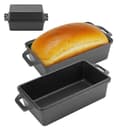
The cheapest honest route into lidded cast iron bread baking. You get two identical 9x5 pans; use them separately as two loaf pans, or nest one on the other to make a covered vessel — which is the same trick bakers play with Lodge’s Combo Cooker, in a loaf shape instead of a round one. The listing states the set is “fully made of high grade cast iron” and suits any cooktop, oven, electric stove, induction or campfire, and that the two pans are designed to stack for storage.
Three things we will not dress up. Northriver publishes no spec page of its own, so the 9.1 x 5 x 2.75 inch dimensions and the 10 lb set weight are the Amazon listing’s figures and nobody else’s. The listing never claims pre-seasoning, so plan to season it yourself before the first bake — our seasoning guidefollows Lodge’s published method. And the care line on the listing is emphatic in a way that is worth repeating: hand wash, dry on low heat, oil it, no dishwasher, no air drying.
Articasting 11x5 with lid — the best for long batards
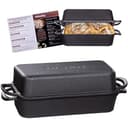
Two extra inches of length, which is the difference between a batard lying flat and a batard baked into a bend. The listing gives 11x5 inches and 5.8 quarts, a 2-in-1 lidded design, and states the pan is pre-seasoned. If the loaves you shape are long rather than square, this is the shape to look for, and there were very few of them in stock anywhere when we checked.
The documentation gap is the same as Northriver’s and we rank it fourth for exactly that reason: Articasting publishes no maker page, so there is no oven rating, no cooktop list, no care instruction and no country of manufacture — all four read “Not published” on our card rather than being inferred from the fact that it is iron. The listing’s own 13.3 lb is also a lot of pan to move in and out of a hot oven.
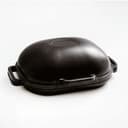
Challenger Bread Pan — the best for serious bakers
The one pan in the category built by a company that only makes bread equipment, and the only American-made lidded option we found. A wide, low base you can load and score without contorting your wrist, and a tall lid with room for a big oven spring — it is the vessel a lot of bakers move to after they outgrow improvising with a Dutch oven, and it takes a round boule or a batard.
It costs several times what everything else on this page costs, it does exactly one thing, and it is big and heavy to store. Those are not objections if you bake weekly; they are decisive if you bake twice a year. Compare it against the pots in our sourdough Dutch oven roundup before committing, and read Dutch oven vs bread cloche if you are weighing dedicated bread vessels generally.
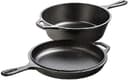
Lodge Combo Cooker — the best cheap lidded alternative
Here because the most useful thing a loaf-pan roundup can tell some readers is that they do not need a loaf pan. Inverted, the Combo Cooker’s shallow 10.25-inch skillet becomes the base you load and score on and the deep pot becomes the steam dome — the same mechanism as a lidded loaf pan, for about the same money, in two pans that are both useful on their own. It is American-made bare iron and Lodge clears the line for a burner, an oven, a grill or a campfire.
The limit is shape: at 3.2 quarts and 10.25 inches round, it suits boules rather than long loaves, and it will not give you a square sandwich slice. If what you want is specifically a loaf, buy a loaf pan. If what you want is great bread, this is the better buy, and our Dutch oven bread recipe is written around it.
Baking in a cast iron loaf pan: what changes
Grease more than you would a nonstick tin, and grease the corners.A loaf pan has four inside corners and a long wall, which is a lot of surface for a sticky batter to grab. Butter or shortening works better than oil here because it stays where you put it. On a newer pan, a parchment sling across the long axis is not cheating — it is how you avoid tearing the bottom off a banana bread while the seasoning is still young.
Expect the edges to run ahead of the middle, and lower the temperature if they do. Iron delivers heat steadily and keeps delivering it after the oven goes off, so an iron loaf browns at the sides sooner than a tin loaf. If your first bake comes out dark at the walls and underdone in the center, drop the oven 25 degrees and add time rather than tenting it.
Turn it out while it is warm, not hot and not cold.Straight out of the oven, a loaf is too fragile to hold its own shape; fully cold in an iron pan, the sugars have set to the walls. Five to ten minutes on a rack, then run a thin spatula down the long sides and tip it out.
Clean it like a skillet, because it is one.Hot water, a brush or a scraper, no soak, dry on a warm burner if the pan is cleared for one — and for these Lodge pans, which are not, dry it in the cooling oven instead. Then a thin film of oil. Our cleaning guide covers the whole routine, and the accessories roundup covers the scrapers that get a corner clean without stripping the seasoning out of it.