How we chose these cast iron woks
A wok is judged on different things than a flat skillet, and the marketing rarely talks about the ones that matter at home. These are what we ranked on.
1. Heat retention — the reason to choose iron at all
The single argument for a cast iron wok over a carbon-steel one is thermal mass. A thin wok is prized in a restaurant precisely because it is light and responsive over a burner that can pump out several times the heat of a home hob. On a domestic stove that advantage flips: the light pan cools the moment cold food lands, and the stir-fry sweats instead of searing. Heavy cast iron soaks up and holds a big reserve of heat, so a batch of chicken and vegetables keeps sizzling rather than stewing. If you are buying a wok to solve the “my stir-fries go watery” problem on a normal kitchen stove, iron is a genuine fix.
2. How the base seats on your cooktop
This is the detail that decides how well any wok works for you. A rounded or heavily graduated base concentrates heat at the very bottom and needs a gas grate (or a wok ring) to sit securely; on a flat glass, electric or induction cooktop it makes poor, unstable contact. A flatter base sits stably and heats more evenly on a modern flat stove but gives you a smaller true “bowl” for pushing food up the sides. We flag which picks suit which stove, because a mismatch here is the most common reason a wok disappoints.
3. Size and usable capacity
Woks are measured across the rim, and the sloped sides mean the flat cooking zone at the bottom is much smaller than the number suggests. A 14-inch wok is a genuine family-size pan; a 12.5-inch is an easier-to-handle everyday size; a 9- or 10-inch is really a one-to-two-serving pan or a serving dish. Match the size to how many people you cook for — a big wok half-full wastes heat, and a small wok crowded past its bottom zone steams.
4. Weight and handling
Cast iron is heavy, and a wok concentrates that weight in a deep bowl with two short loop handles rather than one long steering handle. That means two mitts every time and no tossing — you push and turn food with a spatula instead. A 14-inch iron wok full of food is a serious two-handed lift. None of this is a defect; it is the honest cost of the material, and it is why we call the mini wok a serving-and-small-batch pan rather than a stir-fry workhorse.
5. Does it come with a lid?
A lid quietly doubles what a wok can do. With one, the same pan steams dumplings and fish, simmers a curry, and finishes a braise; without one it is a stir-fry and deep-fry bowl only. Lodge sells its woks bare; the value picks here include a wooden or glass lid, which is a real chunk of extra usefulness for the money — as long as you remember a wooden or glass lid can’t take high oven heat.
The cast iron woks, one by one
Lodge 14-inch Wok — the best overall
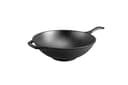
The wok for most kitchens: a full 14-inch, family-size bowl with a graduated sloped surface for searing, dual loop handles, and Lodge’s American-made, pre-seasoned build, seasoned with vegetable oil and free of PFAS. It sears a real batch of stir-fry without crowding, and the heavy iron holds its heat when cold food lands — the whole point of choosing iron over a thin wok. The honest cautions are the size’s own cost: at roughly thirteen pounds it is far too heavy to toss the way wok cooking traditionally wants, its base is only partly flattened so it seats best on a gas grate, and the two short loop handles mean two mitts and no long handle to steer with. On a gas stove, for a family, it is the best cast iron wok you can buy.
Lodge Chef Collection 12.5-inch Wok — best for flat cooktops
Lodge’s cooking-focused wok, and the smarter pick if you cook on flat glass, electric or induction. It has a flatter, more stable base that sits properly on a smooth cooktop and heats more evenly there than a rounded wok, plus sloped, spatula-friendly sidewalls that make pushing and turning food easy. It is American-made and naturally seasoned, ready to use out of the box. The trade-offs are that 12.5 inches holds less than the 14-inch family wok, it is still heavy cast iron with no light-wok toss, and it usually costs a little more than the larger standard wok. If your stove is flat, this is the one that will actually sit flat on it.
NutriChef 14-inch Wok with Wooden Lid — the best value with a lid
The value wok with the extra Lodge leaves out: a wooden lid, which turns the bowl into a steamer and a covered simmer pot as well as a stir-fry pan. It is a big 14-inch, 5.8-quart bowl with loop handles, pre-seasoned and rated for induction and other cooktops, at noticeably less than a premium wok. It is budget-import iron rather than heirloom quality — expect a rougher casting and factory seasoning — the country of manufacture isn’t clearly stated, and the wooden lid is hand-wash-only and can’t go in the oven. But for a cook who wants steaming and simmering as well as stir-fry without paying for two pans, it is a lot of versatile cookware for the money.
Lodge Mini Wok (9-inch) — best for serving and small batches
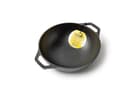
Not really a stir-fry wok, and we’d be doing you a disservice to pretend otherwise — a 9-inch mini is too small for a proper stir-fry for more than one. What it is genuinely good at is serving and small jobs: melting butter, toasting spices, sizzling a small batch of garlic shrimp, or bringing a hot side to the table still bubbling. It is light and easy to handle, naturally seasoned, American-made, and the cheapest way into a Lodge wok. Buy it for what it is — a small, charming, useful pan — not as your main stir-fry vessel.
Tramontina Utsava 2.3-quart Cast Iron Kadai — the best small pick with a lid
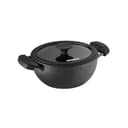
The small-batch pick, and a slightly different shape from everything above it: a kadai, the deep round-bowled Indian cousin of the wok, in pre-seasoned cast iron under a tempered glass lid. At 2.3 quarts it is a pot for two rather than a family pan, and that is the point — curries, a small stir-fry, greens braised under the lid, or deep-frying a snack without heating a gallon of oil. Tramontina and the listing agree on the specifics: a stone-ground smooth interior seasoned in natural oil, so it cooks from the day it arrives; a shatter-resistant tempered glass lid with a silicone rim, so you can watch a simmer instead of lifting it; and removable silicone sleeves over the cast iron loop handles, rated heat-resistant to 450°F. It is listed for induction, gas, electric and ceramic cooktops, and it is oven-safe to 450°F bare — though only 350°F with the glass lid on, which also rules out the broiler. Be clear about the shape before you buy: this is a round bowl, not a flat-bottom wok, so it simmers and deep-fries better than it sears a big batch, and neither Tramontina nor the listing publishes a rim diameter or a country of manufacture. If you cook for one or two and want a lid you can see through on a pan that needs no seasoning first, this is the cheap way in.
Cast iron wok vs carbon steel wok: which should you buy?
Since this is a cast iron site, here is the fair version of the comparison rather than a sales pitch. A traditional carbon-steel wokis thin and light, comes up to heat fast, cools fast, and can be tossed and flipped — everything you want for fast, high-heat stir-frying, especially over a powerful gas burner or a wok ring. A cast iron wokis heavy and slow to change temperature, cannot be tossed, but holds a huge reserve of heat that a home burner can’t keep feeding into a thin pan. On a modest domestic stove, that heat reserve often produces a better sear on a big batch than a light wok that keeps crashing in temperature; on a roaring burner with a cook who wants to toss, the carbon-steel wok wins. If you already own and love a cast iron skillet, you may find a large flat skillet does most of what you wanted a wok for — we work through exactly that in cast iron skillet vs wok.
Seasoning and caring for a cast iron wok
A bare cast iron wok is cared for like any other bare pan, with one twist: the sloped sides shed oil toward the bottom, so seasoning can take a little longer to build evenly up the walls. Cook fatty, high-heat food in it early on and it slicks up fast. After each use, wash it with hot water and a brush (a little dish soap is fine on modern seasoning), dry it fully — easiest back on a warm burner — and wipe on the thinnest film of oil before it goes away. If the seasoning ever goes patchy, our seasoning guidewalks through rebuilding it. Keep any wooden or glass lid out of the oven and out of the dishwasher, and don’t leave the bare iron to soak or air-dry, which is what invites rust.