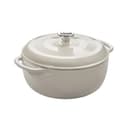
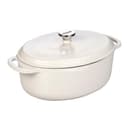
Round vs oval at a glance
Both columns below are Lodge’s published figures for two pots from the same Essential Enamel line, read off the two product pages on the same day. That is deliberately an apples-to-apples comparison — same enamel, same factory partners, same lid design — so that every difference in the table is caused by the shape and not by the brand.
| Published spec | Round (6 qt, EC6D) | Oval (7 qt, EC7OD13) |
|---|
| Length | 13.25 in | 15.56 in |
| Width | 11.6 in | 10.18 in |
| Height | 6.0 in | 12.43 in |
| Weight, empty | 13.52 lb | 16.36 lb |
| Capacity | 6 qt | 7 qt |
| Oven rating | 500°F | 500°F |
| Induction | Yes | Yes |
| Knob | Stainless steel | Stainless steel |
| Fridge storage | Stated safe | Stated safe |
| Grill or open fire | Excluded by Lodge | Excluded by Lodge |
| Made in | China or Vietnam | China or Vietnam |
Four rows differ and seven are identical. The shape changes the footprint, the weight and the price. It changes nothing about what the pot is made of or what it is cleared to do.
One note on the height figures, because they are not measuring the same thing: Lodge gives 6.0 inches for the round pot and 12.43 for the oval, which is a packaging dimension rather than a wall height on at least one of them — a 12.43-inch-tall 7-quart pot is not plausible as a cooking depth. We have reproduced both as published and we are not going to reconcile them by guessing which is which. If interior depth is the figure your purchase depends on, the number to trust is the cooking-surface height Lodge publishes separately on its spec data for that pot, which our Dutch oven size guide walks through.
Where round wins
1. It sits over a burner; an oval does not
This is the argument that decides the page. A gas or electric burner is round and roughly 6 to 9 inches across. The round pot’s 13.25-inch footprint is concentric with it: the heat enters the middle and spreads outward evenly in every direction. The oval’s 15.56 inches of length runs well past the edge of any domestic burner, so the two ends of the pot are heated by conduction through the iron rather than directly from the flame.
Cast iron is good at evening that out — that is the material’s whole reputation — but it is not magic, and the practical consequence is that an oval simmers hotter in the middle than at the ends. On induction it is worse rather than better, because an induction hob only heats the metal directly above the coil, which our guide to cast iron on glass and induction explains. Ovals are at their best in the oven, where heat arrives from all sides and the shape costs you nothing.
2. It weighs less for the same job
Lodge’s own figures: 13.52 lb round against 16.36 lb oval, empty. Fill either with 5 quarts of stew and you are adding roughly 10 more pounds, so the oval is a genuinely two-handed lift out of an oven at chest height. Weight is the single most common reason a Dutch oven ends up in a cupboard unused, and three pounds is not a rounding error at this scale — it is the difference between a pot you move casually and one you plan around.
3. It bakes bread; an oval mostly does not
A sourdough boule is a sphere that relaxes into a dome, and it wants a round wall at a roughly even distance all the way around so the oven spring pushes up rather than sideways. In an oval the dough spreads along the long axis and you get a flatter, elongated loaf. Our Dutch ovens for sourdough page ranks the pots built for this job, and nothing on it is oval. If bread is the main reason you are buying, round is not a preference — it is the requirement. The one oval exception is a purpose-made oval bread oven, a different product sold for bâtard-shaped loaves rather than boules.
4. It costs less, and the lid interchanges
Lodge lists the oval at $139.95 against $99.95 for the round, both before the discounts each carries at any given moment. Round is also the shape every maker builds its range around, which means more sizes, more colors, more stock, and far more chance of a replacement lid existing in five years. Ovals are produced in fewer sizes by fewer brands.
Where oval wins
1. Long food, which is more of a category than it sounds
A whole chicken is the obvious case, and it is why ovals exist. A bird is a solid object roughly 11 to 13 inches long, and a round 6-quart pot’s interior is narrower than its 13.25-inch outside footprint once you account for wall thickness. It usually goes in, but at an angle and with the legs against the wall. In a 15.56-inch oval it lies flat with room to baste around it.
The same applies to a rolled pork shoulder, a beef brisket end, short ribs laid in a row, a rack of lamb, and anything you want to brown on all four sides without wedging. Our Dutch ovens for roasting a chicken page goes through the lid-clearance problem in detail, including the honest caveat that a lid traps steam and steam stops browning — so the best skin comes off an uncovered roast regardless of the shape of the pot underneath it.
2. A narrow stovetop or a crowded oven
The oval is 1.4 inches narrower than the round pot. On a four-burner hob where a wide pot fouls the neighboring pan, or in an oven shared with a sheet tray, a narrow-and-long footprint can be the one that physically fits. It is a real consideration in a small kitchen and the only dimension on the table where the oval is the smaller object.
3. Serving
An oval pot reads as a platter and a round one reads as a saucepan, and both of these go to the table. If the pot is doing double duty as serveware for a roast, the oval is the better-looking object and it carves more conveniently. That is an aesthetic argument rather than a performance one, and it is a legitimate reason to choose a shape when everything else is equal.
The honest answer for most people
Buy the round pot, and buy it in 5 or 6 quarts. It handles every job an oval does except laying a long cut flat, it weighs less, it bakes bread, it sits properly on a burner and it costs less. Our enameled Dutch oven roundup ranks the field and our size guide works out which capacity suits your household.
Buy an oval if you roast whole birds or long cuts often enough to have noticed the problem, or if you already own a round pot and this is the second one. If you are buying an oval, the cheapest honest route is Lodge’s own Essential Enamel oval; the bare iron Bayou Classic oval roaster costs less again, with the trade-off that bare iron must be kept seasoned and must not store acidic leftovers. That maintenance is cheap but it is not optional, and the two shapes want different tools for it — steel chainmail is fine on bare iron and wrong on a glaze, which our cast iron accessories roundup sorts out. Our enameled vs bare comparison lays out that difference properly. Le Creuset and Staub both make ovals in several sizes, and they are the premium answer at four to five times the price.
One shape question worth separating from this one: an oval is not a substitute for a braiser, which is wide and shallow rather than long and deep. If what you actually want is a pan that fits eight chicken thighs in a single layer, the comparison you want is Dutch oven vs braiser, not round vs oval.