How we picked: four criteria, in this order
1. Shape against the job. This comes first because it is the only decision that cannot be undone by cooking technique. Deep and round for liquid; wide and shallow for anything that should brown in a single layer; oval for a long cut; legs for coals.
2. The flat bottom, not the quarts.Capacity is measured to the rim, so it tells you how much soup fits and nothing about how much meat browns at once. The number that matters is the flat disc at the base, and almost nobody publishes it. Lodge does — 6.87 inches on the round 6-quart — which is one of the reasons it leads this list.
3. What the maker will put in writing. An oven ceiling, a cooktop list, a care rule, a country of manufacture, a warranty. Pots that publish those are easier to own, and the gap between brands here is much wider than the gap in how they cook.
4. Price last, because in cast iron it is the least predictive thing on the page. Every pot above braises; what the money changes is finish, documentation and recourse, which is the argument we make in full on Dutch ovens under $100.
The five shapes, and what each one is for
The deep round pot
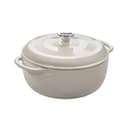
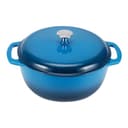
The default and the one most people should own. Tall walls hold a lot of liquid, the mass of iron keeps a braise steady instead of cycling with the burner, and a heavy lid traps enough steam to bake bread with a bakery crust. If you are only going to own one pot, own this one. Our Dutch oven roundup ranks the round pots against each other at every price, and the size guide works out which capacity.
The oval roaster
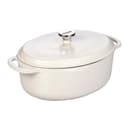
Same pot, stretched. An oval fits a chicken, a brisket or a long roast without wedging it, and takes up less width on a crowded stovetop. The trade is real and worth knowing before you buy: an oval base cannot sit squarely over a round burner, so searing in one is less even than in a round pot. Buy an oval because of what you cook in it, not because it looks better.
The shallow braiser
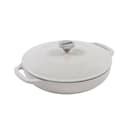
A braiser is a pot that gave up height for floor. That one change means eight chicken thighs brown in a single layer rather than stacking three deep and steaming each other, which is why cooks who sear before they braise own one. Liquid reduces faster in it, so it is the wrong pot for stock or a big soup.
The combo cooker and the double Dutch oven
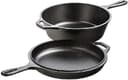
Two vessels pretending to be one: a deep pot whose lid inverts into a usable skillet. For a small kitchen it is the best value shape on this page, and for bread it is better than a deep pot because you load the dough onto a shallow base at counter height. Lodge publishes 12.85 lb for the 3.2-quart combo cooker and 12.37 lb for the 5-quart double Dutch oven, so neither is light.
The camp pot with legs
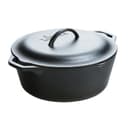
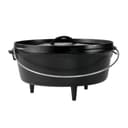
Built for a job the other four cannot do: standing over coals with more coals piled on a flanged lid, so heat arrives from above and below. The legs that make that work are exactly what makes it the wrong pot indoors, and Lodge says so itself. Do not buy one as your only pot.
Bare iron or enameled?
For a pot, buy enameled unless you have a specific reason not to. A pot spends its life full of liquid, often acidic, often for hours, which is the exact condition a young seasoning does worst in — and enamel means no seasoning to maintain, no reaction with tomato or wine, and leftovers that can sit in the fridge in the pot. Buy bare instead if you want the pot on a grill or in a fire, if you want it made in America (no enameled pot on this site qualifies), or if you want seven quarts for the price of a six-quart enameled one. The full trade-off is in enameled vs bare cast iron.
What a cast iron pot is not
It is not a skillet, and the two are not substitutes: a pot has walls for liquid and a pan has floor for searing, which is the whole of Dutch oven vs cast iron skillet. It is not a stockpot either — iron is heavy and holds heat, which is a liability when you want water at a hard rolling boil and an asset when you want a bare simmer for four hours (that comparison is here). And if what you actually want is a lidded dish to bake in and carry to the table, the shape has its own name and its own page: cast iron casserole dishes.
If you want a set rather than a pot
Autocomplete for “best cast iron pots” runs straight into “pots and pans”, and that is a different purchase: a pot and a skillet do unrelated jobs, and buying them bundled usually means accepting one piece you would not have chosen. Best cast iron cookware works out which pieces earn their space one at a time, and the cookware sets page covers the bundles where the math genuinely works.