Why enameled cast iron is out, in the makers’ own words
This is the part most pages get wrong by omission, so here is the evidence rather than the conclusion. Lodge publishes, on its Essential Enamel pages, that the pots are “Not made for use on a grill or over a fire”. It publishes the same line for its enameled skillet. That is one of the largest cast iron makers in the world explicitly excluding the use you are planning.
The mechanism is straightforward once you know what enamel is. It is glass, fired onto a cast iron shell at high temperature. Glass tolerates heat well and tolerates uneven, suddenheat badly, which is exactly what a live fire or a hot spot on a grate delivers. The failure is not usually dramatic; it is a hairline craze or a chip at the rim that spreads, and once the cooking surface is compromised there is no food-safe home repair — glass cannot be touched up. Our chipped enamel guide covers what to do if it has already happened.
Note what this rules out: not just the budget pots but Le Creuset and Staub too, at several hundred dollars each. If you take one thing from this page, let it be that the expensive pot is the worst choice for a smoker, not the best one. Bare iron is both cheaper and correct, and our enameled vs bare comparison explains the broader trade.
What we ranked these on
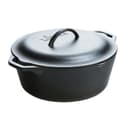
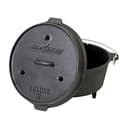
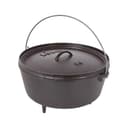
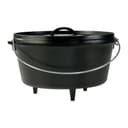
A flat bottom, first. A smoker or pellet grill cooks on a flat grate. A flat-bottomed pot sits on it; a three-legged camp oven balances on it and on some grates drops a leg between the bars. That one geometric fact is why the 7-quart outranks every camp oven here, even though the camp ovens are the ones marketed for fire.
An iron lid rather than glass, second.Lodge publishes an oven ceiling of 400°F for its tempered glass lids. Most smoking happens between 225 and 300°F so you are usually inside that, but a glass lid in a chamber with a hot spot is an avoidable risk for no gain. Every pick here comes with cast iron on top.
How you get it out, third.This is the criterion the spec sheets never address and every smoker cook learns the hard way. A full 7 or 8-quart cast iron pot coming out of a hot chamber is a two-handed lift at arm’s length over heat. Loop handles on both sides beat a single long handle here; a bail handle and a lid lifter beat both. Plan the exit before the pot goes in.
Capacity last. Bigger is not better in a smoker, because a half-full pot has a large exposed surface that dries out and scorches at the edges. Match the pot to the batch.
The pots, side by side
Every figure is the maker’s or the listing’s own. Blank means unpublished, not estimated.
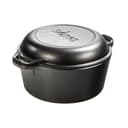
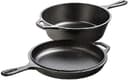
| Spec | Lodge 7 qt | Lodge Double Dutch 5 qt | Lodge Camp 5 qt | Camp Chef DO-12 |
|---|
| Finish | Bare cast iron | Bare cast iron | Bare cast iron | Bare cast iron |
| Bottom | Flat | Flat | Three legs | Three legs |
| Sits level on a grate | Yes | Yes | No — legs | No — legs |
| Lid | Heavy cast iron | Inverts into a 10.25 in skillet | Flanged, holds coals | Deep-dish, doubles as a skillet |
| Capacity | 7 qt | 5 qt | 5 qt | 12 in camp size |
| One-person lift when full | No | Usually | Yes | No |
| Lid thermometer channel | No | No | No | Yes, per the listing |
| Made in | USA | USA | USA | Not published |
How to actually use it in a smoker
Three things change versus an indoor braise, and none of them is difficult.
Lid on or off is a flavor dial, not a rule. Smoke flavor arrives by contact with the food, so a lidded pot in a smoker is mostly a braise that happens to be outdoors. If you want smoke in the dish, run the first hour uncovered and then lid it for the long braise. That order matters: smoke adheres best to a wet, cool surface early in the cook, and once the lid is on the pot is sealed from the chamber.
Low and slow is easier in iron than in anything else. Several pounds of cast iron hold a temperature through the swings a smoker goes through when you open the door or the pellet auger cycles. That thermal mass is the single best reason to braise in iron rather than a foil pan, and it is why the heaviest pot is usually the most forgiving one.
Expect the outside to go black, and let it.Smoke and soot build a dark layer on the outside of a bare pot. That is carbon on iron and it is cosmetic. Do not take a wire wheel to it — clean the cooking surface, dry the pot on heat, wipe a thin film of oil inside, and leave the outside alone. If the inside has suffered from a long acidic braise, our reseasoning guideis the fix, and Lodge’s own care rule is the short version: wash, dry, oil.
Who should read a different page
If your fire is a campfire with coals on the lid rather than a smoker with a grate, the legs become an advantage and you want our camp Dutch oven roundup instead. If you are cooking directly on the grill grates rather than in a pot, the right pages are cast iron skillets for camping and the grill and can you put cast iron on the grill. And if you want a general-purpose pot that lives on the stove and only occasionally goes outside, best bare cast iron Dutch ovens is the roundup to read.