How we chose a baking pan
1. Overall length, because a handle eats oven
A standard home oven cavity is tight enough that five inches of iron handle decides whether a pan turns or wedges. Lodge publishes the numbers that make this comparable. The Baker’s Skillet (part BW10BSK) is 12.81 inches long overall for a 10.25-inch pan; the 12-inch Dual Handle Pan (part 17L10SKL) is 14.56 inches overall for a 12-inch pan. A long-handled 10.25-inch skillet runs around 17 inches and a 12-inch around 19.
Two loop handles buy you those four to five inches. What you give up is leverage: no one-handed slide, no shake, no flip, and no way to invert a pan to turn out a cake without a second pair of mitts. For a pan that spends its life going into the oven and coming out to the table, that is the right trade. For a pan that also sears, it is not.
2. Published weight, loaded
You lift a baking pan when it is full and hot, often out of a low oven at arm’s length. Lodge publishes 4.14 lb for the Baker’s Skillet, 5.66 for the 10.25-inch classic, 6.61 for the 12-inch Dual Handle Pan and 7.69 for the 12-inch classic. Add a cobbler and you are carrying ten to twelve pounds on a bad angle.
It is worth being honest that this is where cast iron is genuinely worse than a ceramic dish, and why a lot of beautiful heavy pans end up unused. If weight is the thing stopping you, the Baker’s Skillet at 4.14 lb is the lightest full-size round pan on this site, and our lightweight roundup ranks the rest.
3. What the maker clears the pan for
This is the spec nobody checks and it changes how you bake. Several Lodge bakeware pieces — the wedge pan, the corn-stick pan, the muffin pan — carry the line “Oven safe, not recommended for stovetop use” in Lodge’s own feature list, which means you cannot preheat them on a burner the way cornbread recipes tell you to.
The Baker’s Skillet is a genuine middle case, and we would rather say so than tidy it up: its page does notcarry the bakeware warning, but it does not claim stovetop or induction use either, so our spec table reads “Not published” for induction rather than “Yes”. The classic skillets and the Dual Handle Pan are explicitly cleared by Lodge for any stovetop including induction, plus oven, grill or campfire. If your recipe depends on a screaming-hot preheated pan, pick one of those.
4. Oven temperature, and the one published ceiling
Lodge publishes nooven temperature ceiling for bare cast iron anywhere we have read, which is why we never quote one; the practical limits are your oven and your fat’s smoke point, not the iron. Enamel is different and does have a number: Lodge publishes a 500°F oven rating for its Essential Enamel skillet, and Staub states most of its pieces are oven safe to 500°F with the lid, with certain cocottes rated to 900°F without it.
The ceiling that catches people out is glass. Lodge publishes “Oven safe up to 400°F” for its tempered glass lids, which is below a lot of baking temperatures. Full detail on all of this is in can you put cast iron in the oven.
The picks in context
Lodge 10.25-inch Baker’s Skillet — the best overall
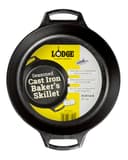
Built for the job: a 10.25-inch round pan, two loop handles, 12.81 x 10.31 x 2.0 inches and 4.14 lb by Lodge’s own figures, made in the USA, seasoned with 100% natural vegetable oil, made without PFAS, and covered by Lodge’s Made Right warranty at a $29.95 list price. For cornbread, cobbler, a skillet cookie or a round of focaccia, it is shorter, lighter and easier to serve from than any long-handled skillet.
Three honest limits. Only the outside edge of a round pone gets crust — the middle stays soft, which is precisely what a wedge pan fixes. Two loop handles mean two mitts and no leverage to invert it. And Lodge publishes no cooktop rating for it, so we cannot tell you it is burner-safe. (A curiosity rather than a fault: Amazon’s own third feature bullet for this pan reads “this cast iron wok features dual loop handles”, which is a copy-paste error on the listing.)
Lodge 10.25-inch Classic — the best do-everything
If you are going to own one cast iron pan and bake in it sometimes, own this. Lodge publishes 5.66 lb, US manufacture, pre-seasoning and compatibility with any stovetop including induction plus oven, grill and campfire — which means you can preheat it hard on a burner, pour in batter and get the sharp bottom crust that skillet cornbread is famous for. No dedicated baking pan can do that if its maker will not clear it for a hob.
The long handle is the cost: roughly 17 inches overall, which is the difference between turning in a small oven and not. It also puts all the weight out in front of you on the lift. Our cornbread recipe and skillet cookie recipe are both written around this pan.
Lodge 12-inch Dual Handle Pan — the best for pan pizza
Quietly the best pan-pizza vessel Lodge makes, and a very good baking pan generally. It has real skillet walls to hold an oiled crust, Lodge rates the line for any stovetop including induction plus oven, grill and campfire so you can crisp the base after baking, and losing the long handle takes about five inches off the footprint: 14.56 x 12.63 x 2.24 inches and 6.61 lb per the listing’s spec table.
Two loops means two mitts and no one-handed moves. The 12-inch measurement is the rim, so expect a pizza closer to 10.5 inches. And at 6.61 lb, all of it is out in front of you coming out of the oven. Our cast iron pizza recipe and the pizza pan roundup cover the flat-pan alternative.
Lodge 12-inch Classic — the best for a crowd
Forty per cent more cooking floor than the 10.25 for about two extra pounds — Lodge publishes 7.69 lb against 5.66 — which is the right trade when you are baking a cobbler for eight or a double batch of cornbread. Same American foundry, same pre-seasoning, same full heat-source list, so it preheats on the burner like the smaller one.
Nineteen inches of overall length is a lot of oven, and it already overhangs many standard burners, so a stovetop preheat needs patience to avoid a hot centre and cool rim. Not the pan to buy if you bake for two.
Lodge Combo Cooker — the best for bread
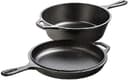
The one pick here that is not really a skillet, and the reason it earns a place: used upside down, the shallow 10.25-inch skillet becomes the base you load and score a loaf on, and the deep pot becomes the dome that traps steam. That is the cheapest genuinely excellent bread setup in cast iron, and it is two useful pans for the price of one.
At 3.2 quarts and 10.25 inches it suits round boules rather than long loaves, and it is bare cast iron, so it needs drying and oiling after washing. Our Dutch oven bread recipe and do you need a Dutch oven for sourdough both work through the method.
Lodge 11-inch Essential Enamel Skillet — the best no-seasoning option
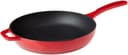
For bakers who want a pan they can put tomato, lemon, wine or a fruit filling in without thinking about seasoning. It is the only pick here with a published oven rating — 500°F — a matte black porcelain interior that browns like bare iron, induction compatibility, no PFAS, and a lifetime limited warranty. Lodge publishes 5.65 lb for it, where Amazon’s spec table for the red version (part EC11S43) says 7.67 lb; both figures are recorded rather than averaged.
Two caveats, both from Lodge’s own listing. Hand wash is recommended and metal utensils are not, and the pan is “not made for use on a grill or over a fire”. It is also not Tennessee iron: the listing states “Enamel Cast Iron made in China to Lodge specifications. All other Lodge Cast Iron Cookware made in USA”. If that matters to you, see the made-in-USA roundup.
Baking technique the pan cannot fix
Preheat the pan if your recipe says to, and only in a pan the maker clears for a burner.A preheated, greased skillet is what makes the crisp, fried bottom edge on skillet cornbread; batter poured into a cold pan gives you a soft base. Lodge clears its classic skillets and Dual Handle Pan for any stovetop including induction. It publishes no cooktop rating at all for the Baker’s Skillet, and an explicit “not recommended for stovetop use” for its wedge, corn-stick and muffin pans — so with those, preheat the pan empty in the oven instead.
Grease more than you think, and grease the sides. Cast iron releases baked goods well once seasoning is established and indifferently before then, and sugar is the hardest thing to get back off. Butter, shortening or bacon fat all work; a thin film of oil is enough for bread and not enough for a cookie.
Expect the edges to run ahead of the middle.Iron holds heat, so a cast iron bake browns at the rim faster than a tin one and keeps cooking after it leaves the oven. Pull cobblers and cookies a few minutes early and let carryover finish them in the pan — which is also why serving from the pan works so well. For the cleanup afterwards, our cleaning guide and why cast iron goes sticky cover the sugar-residue problem specifically.