The Seasoned Pan

The Best Dutch Ovens for Soup and Stew

The pots built for a long simmer, ranked on the one spec that decides a soup pot — whether the surface can take tomato and wine for three hours — plus cooking-floor width, capacity per eater and what a full pot weighs.

By Stephen V.Last updated How we pick

For almost everyone making soup, the right pot is Lodge’s 6-quart Essential Enamel Dutch oven, and the reason is a single line on Lodge’s own product page: the porcelain enameled surface stands up to acidic ingredients and can store leftovers in the fridge. Those are the two things a soup pot is asked to do that a searing pan is not — hold tomato, wine and stock for hours without the surface objecting, then go straight into the fridge with what is left.

This is the one category on this site where enameled cast iron is the default answer and bare iron is the compromise. That is a reversal of our usual position, and it comes from the food rather than the metal. A three-hour tomato and wine simmer is the single most demanding thing you can do to seasoning: acid dissolves the polymerized oil layer, the pot goes grey and patchy, and the soup picks up a metallic edge. Enamel is glass; it does not care.

Beyond that the picks are ranked on cooking-floor width (because every soup starts with aromatics browning in the bottom), capacity per eater, and what the pot weighs once it is full. We have not hands-on tested this cookware; here is exactly what we do instead. Every dimension below is the maker’s own published figure, and prices are checked live.

How this is funded:we earn a commission if you buy through our links, at no extra cost to you. It never changes which product we recommend, and we’ll tell you when we’d skip one. Full disclosure.

Quick picks

Ranked on materials, size, finish and buyer fit. Select a row to jump to the full write-up. We have not hands-on tested these pans — here is exactly what we do instead.

#ProductBest forPrice
1
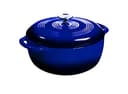
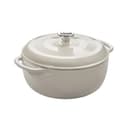
Lodge Essential Enamel Cast Iron Dutch Oven (6 qt)

Lodge Essential Enamel Cast Iron Dutch Oven (6 qt)

The value benchmark for enameled cast iron: the same braising, bread-baking and slow-cooking performance as the famous French names, at roughly a quarter of the price. This is the one to buy unless you specifically want the heirloom badge.

Best overall
$69.99 · View on Amazon

$89.9022% off

Price as of October 5, 2026. #ad How we’re funded

2
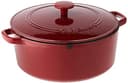
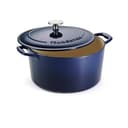
Tramontina Enameled Cast Iron Dutch Oven (6.5 qt)

Tramontina Enameled Cast Iron Dutch Oven (6.5 qt)

The enameled Dutch oven that gets recommended as the Le Creuset alternative more than any other: a generous 6.5 quarts, a light interior, and a price that undercuts the French pots dramatically.

Best budget
$62.96 · View on Amazon

Price as of October 5, 2026. #ad How we’re funded

3
Cuisinart Chef's Classic Enameled Dutch Oven (7 qt)

Cuisinart Chef's Classic Enameled Dutch Oven (7 qt)

A big 7-quart enameled pot for large families, big batches of chili, or a whole chicken with room to spare. Good mid-price value when you specifically need the extra capacity.

Best for big batches
$105.78 · View on Amazon

$164.9536% off

Price as of October 5, 2026. #ad How we’re funded

4
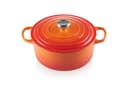
Le Creuset Signature Round Dutch Oven (5.5 qt)

Le Creuset Signature Round Dutch Oven (5.5 qt)

The heirloom standard: French-made, with a light sand-colored interior that's easy to read for browning, oversized handles that fit oven mitts, and a lifetime warranty. Superb — and priced accordingly.

Best buy-it-for-life
$299.00 · View on Amazon

$454.9534% off

Price as of October 5, 2026. #ad How we’re funded

5
Lodge Essential Enamel Dutch Oven (3 qt)

Lodge Essential Enamel Dutch Oven (3 qt)

The small enameled pot most people should buy. It is the same idea as Lodge's 6-quart value benchmark, shrunk to the size a one or two-person kitchen actually cooks in, and it costs a fraction of what the French makers charge for the same 3 quarts. Nothing about it is exciting, which is the point.

Best for one or two
$49.99 · View on Amazon

$59.9017% off

Price as of October 5, 2026. #ad How we’re funded

6
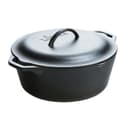
Lodge Cast Iron Dutch Oven (7 qt)

Lodge Cast Iron Dutch Oven (7 qt)

A big 7-quart bare cast iron pot with a matching iron lid — for stews, chili and larger loaves, at a price no enameled pot of this size gets near. Heavy, but that mass is exactly what holds a steady braise.

Best bare iron
$79.90 · View on Amazon

Price as of October 5, 2026. #ad How we’re funded

The picks in full

#1Best overall

Lodge Essential Enamel Cast Iron Dutch Oven (6 qt)

The value benchmark for enameled cast iron: the same braising, bread-baking and slow-cooking performance as the famous French names, at roughly a quarter of the price. This is the one to buy unless you specifically want the heirloom badge.

Strengths

  • Enamel needs no seasoning and handles acidic sauces like tomato and wine
  • 6 qt fits a big batch of stew, a roast, or a boule of bread
  • A fraction of the price of Le Creuset or Staub

Trade-offs

  • Enamel can chip if dropped or thermally shocked
  • Not made in France, if that matters to you
TypeEnameled cast iron
Size6 qt
SeasoningNone needed (enameled)
Induction-safeYes
Made inNot published
Best forMost people who want enameled cast iron

The details. Enameled inside and out, so it never needs seasoning and won't react with acidic food. Oven-safe with the lid; avoid dropping it or subjecting the enamel to sudden temperature swings. Hand washing preserves the finish.

Specs read from the product listing, on September 8, 2026. “Not published” means the brand does not state that figure.

#2Best budget

Tramontina Enameled Cast Iron Dutch Oven (6.5 qt)

The enameled Dutch oven that gets recommended as the Le Creuset alternative more than any other: a generous 6.5 quarts, a light interior, and a price that undercuts the French pots dramatically.

Strengths

  • 6.5 qt — roomy for big batches and larger loaves
  • Light interior enamel, easy to read for browning
  • Long-standing budget alternative to the French names

Trade-offs

  • Fit and finish isn't at the French-brand level
  • Enamel chips if mistreated, like all enameled cast iron
TypeEnameled cast iron
Size6.5 qt
SeasoningNone needed (enameled)
Induction-safeYes
Made inNot published
Best forA large, light-interior Dutch oven on a budget

The details. Enameled inside and out with a light interior; no seasoning, safe with acidic foods. A larger 6.5 qt capacity. Hand wash and avoid thermal shock to protect the enamel.

Specs read from the product listing, on July 19, 2026. “Not published” means the brand does not state that figure.

#3Best for big batches

Cuisinart Chef's Classic Enameled Dutch Oven (7 qt)

A big 7-quart enameled pot for large families, big batches of chili, or a whole chicken with room to spare. Good mid-price value when you specifically need the extra capacity.

Strengths

  • 7 qt handles large roasts and big-batch cooking
  • Enameled interior, induction-ready, oven-safe
  • Mid-price for the size

Trade-offs

  • 7 qt full of stew is heavy to lift
  • Bigger than one or two people need
TypeEnameled cast iron
Size7 qt
SeasoningNone needed (enameled)
Induction-safeYes
Made inNot published
Best forLarge batches and bigger households

The details. A large 7 qt enameled pot, oven-safe and induction-compatible. No seasoning needed. The capacity is the point; mind the weight when it's full.

Specs read from the product listing, on July 19, 2026. “Not published” means the brand does not state that figure.

#4Best buy-it-for-life

Le Creuset Signature Round Dutch Oven (5.5 qt)

The heirloom standard: French-made, with a light sand-colored interior that's easy to read for browning, oversized handles that fit oven mitts, and a lifetime warranty. Superb — and priced accordingly.

Strengths

  • Made in France with a lifetime warranty
  • Light interior enamel makes it easy to judge browning and fond
  • Large, mitt-friendly handles and a refined fit and finish

Trade-offs

  • Very expensive — you're paying for the name and finish
  • The light interior stains over time (it doesn't affect cooking)
TypeEnameled cast iron
Size5.5 qt
SeasoningNone needed (enameled)
Induction-safeYes
Made inFrance
Best forA buy-it-for-life enameled Dutch oven

The details. French-made enameled cast iron with a sand-colored interior and a lifetime warranty. No seasoning needed; the light interior shows stains but that's cosmetic. Hand wash to keep the enamel its best.

Specs read from the product listing, on July 19, 2026. “Not published” means the brand does not state that figure.

#5Best for one or two

Lodge Essential Enamel Dutch Oven (3 qt)

The small enameled pot most people should buy. It is the same idea as Lodge's 6-quart value benchmark, shrunk to the size a one or two-person kitchen actually cooks in, and it costs a fraction of what the French makers charge for the same 3 quarts. Nothing about it is exciting, which is the point.

Strengths

  • Enameled inside and out, so no seasoning and no problem with tomato or wine
  • 3 quarts is a genuinely small pot rather than a slightly smaller big one
  • Roughly a quarter of what a comparable French 3-quart costs

Trade-offs

  • Lodge states plainly that this line is made by partners in China or Vietnam, not in Tennessee like its bare iron
  • Lodge says it is not designed for a grill or an open fire, unlike the bare Lodge pots
  • Enamel chips if you drop it or shock it with cold water while hot
TypeEnameled cast iron
Size3 qt
SeasoningNone needed (enameled)
Induction-safeYes
Made inChina or Vietnam
Best forOne or two people who want an everyday enameled pot without the French price

The details. Lodge's own page for the 3 quart Essential Enamel gives the weight as 9.5 lb, the maximum oven temperature as 500°F, a matching lid with a stainless steel knob, and care as hand wash with no metal utensils. Lodge states the line is made by its partners in China or Vietnam and is not designed for grill or open-fire cooking. The Amazon listing publishes a heavier 10.56 lb and a 12.75 in overall width; the model code is EC3D32.

Specs read from the product listing, on September 3, 2026. “Not published” means the brand does not state that figure.

#6Best bare iron

Lodge Cast Iron Dutch Oven (7 qt)

A big 7-quart bare cast iron pot with a matching iron lid — for stews, chili and larger loaves, at a price no enameled pot of this size gets near. Heavy, but that mass is exactly what holds a steady braise.

Strengths

  • 7 qt for big batches and larger boules
  • Heavy iron lid holds heat and moisture in
  • American-made and inexpensive for the size

Trade-offs

  • Very heavy, especially full
  • Bare interior needs seasoning care with acidic braises
TypeBare cast iron
Size7 qt
Pre-seasonedYes
Induction-safeYes
Made inUSA
Best forLarge batches in bare cast iron

The details. Large bare cast iron pot with a heavy iron lid; the mass holds a steady braise. Pre-seasoned but the bare interior wants care with long acidic cooks until it's well seasoned. Dry and oil after washing.

Specs read from the product listing, on July 19, 2026. “Not published” means the brand does not state that figure.

How we chose these soup pots

1. Can the surface take acid for three hours?

This is the criterion that reorders the whole category, and it is the one almost nobody ranks on. Soup and stew are acidic and they are slow: tinned tomatoes, a glass of wine, a splash of vinegar at the end, two to four hours of contact with the pot. Seasoning is a polymerized oil layer, not a coating, and sustained acid breaks it down. The pot survives; the finish does not, and the food can pick up a metallic taste while it happens.

Lodge is explicit that its enamel is the answer to that: its 6-quart Essential Enamel page states the porcelain enameled surface stands up to acidic ingredients and can store leftovers in the fridge. Neither claim is available for bare iron — you should never refrigerate food in a bare pot, because a sealed humid box pressed against unsealed seasoning is how rust starts. Our enameled versus bare comparison covers the trade in full, and what not to cook in cast iron lists the acidic dishes this applies to.

2. Cooking-floor width, because soup starts with browning

Every soup worth making begins the same way: onions, carrots and celery sweating in fat, or meat browning in batches. That happens on the flat bottom of the pot, and quarts tell you nothing about how much flat bottom you get. A tall narrow pot with six quarts of volume steams its aromatics instead of browning them, and the flavour difference is larger than any other decision on this page.

Lodge publishes the numbers for its 6-quart: a 10.5-inch cooking surface width, a 6.87-inch flat bottom, 4.75 inches of cooking surface height, 13.56 inches handle to handle and 7.31 inches of total height with the knob. That flat-bottom figure is the one to compare against: it is the area where browning actually happens. Our Dutch oven size guide explains why a wide, shallow pot out-performs a tall one at the same capacity.

3. Capacity against the number of people you feed

Soup needs roughly a quart of finished volume per generous serving, plus headroom so a rolling simmer does not go over the rim. Six quarts is the size that covers the most households: four to six servings with room to spare, or a double batch to freeze. Five to five and a half quarts is right for two to four. Seven quarts is for genuinely big batches and for stock, where you want bones submerged.

Going smaller is a real option that people skip. Lodge publishes 9.5 pounds for its 3-quart Essential Enamel pot — a pot one person can lift full, which matters more than capacity if you cook for one or two. The small Dutch oven roundup makes that case properly, and the large Dutch oven roundup covers the 7-quart-and-up end.

4. The lid, and how hard it holds a simmer

A soup lid has one job: keep the liquid level stable over hours without you topping it up. A heavy, well-seated cast iron lid does that naturally. Staub goes further with self-basting spikes on the underside of its lid, so condensation drips back down rather than running to the rim — worth more in a stew, where you want the meat basted, than in a thin soup.

Check the knob if you finish anything in the oven. Lodge publishes a 500°F oven rating and a stainless steel knob for its 3-quart Essential Enamel pot. Staub’s knobs are rated to 464°F. Tramontina’s care page states that cast iron and enameled cast iron should be hand washed and that many pieces are oven safe, without publishing any temperature at all. Our oven temperature guide collects every published figure on this site.

The picks in context

Lodge 6-quart Essential Enamel — the best overall

The right size, the right surface, and the only pot here whose maker publishes the two facts that matter for soup. Lodge states the enameled surface stands up to acidic ingredients and can hold leftovers in the fridge, and publishes a 10.5-inch cooking surface with a 6.87-inch flat bottom — enough to brown a diced mirepoix in one layer rather than two batches. Six quarts feeds four to six with headroom.

Two honest gaps, both of them absences rather than faults. Lodge’s page for this pot publishes no weight, no oven temperature, no cooktop list, no care rules and no country of manufacture — all of which it does publish for the 3-quart from the same line, where it states 9.5 lb, 500°F, hand wash, no metal utensils, not for a grill or open fire, and manufacture by Lodge’s partners in China or Vietnam. We have not copied those figures across, because a different pot is a different part number.

Tramontina 6.5-quart — the best budget

The most pot for the least money, at a capacity slightly above the Lodge. It is the pick if you want a big enameled soup pot and the French price is not happening, and its light interior is genuinely useful for soup: you can see how dark a fond is getting and whether a stock is still cloudy, which a black matte interior hides.

What you give up is documentation. Tramontina’s own care page says cast iron and enameled cast iron should be hand washed and that many pieces are oven safe, with no temperature stated anywhere, and it publishes no origin or warranty for this pot. A pale interior also stains with turmeric, tomato and long stocks in a way a dark one does not. Our Tramontina review and Tramontina against Le Creuset go into both.

Cuisinart 7-quart — the best for big batches

Seven quarts is stock-pot territory, and that is what it is for: a chicken carcass fully submerged, a pot of chilli for a crowd, four batches of soup frozen in one afternoon. Per quart it is one of the better-value enameled pots on the site, and the extra capacity costs very little over a 6-quart.

The trade is one you feel every time you move it. Seven quarts of soup weighs over fourteen pounds on its own, before the pot, and the pot is not light — a full 7-quart is a two-handed carry and a genuinely awkward lift out of a low oven. Cuisinart publishes less specification detail than Lodge does, so several rows on our card for it read “Not published”.

Le Creuset 5.5-quart Signature — the best buy-it-for-life

If you make soup every week for the next thirty years, this is the pot that will still be doing it. Le Creuset publishes a full specification — something only it and Lodge reliably do in this category — it is made in France, and its light sand-coloured interior shows you exactly what is happening to a fond or a stock.

Five and a half quarts is the honest limit: it is a four-serving pot, not a batch-cooking pot, so a household of five will outgrow it. And it costs several times the Lodge for a soup that tastes the same. If the money is the question, it is worth reading Lodge against Le Creuset before deciding, and the enameled Dutch oven roundup ranks the whole ladder.

Lodge 3-quart Essential Enamel — the best for one or two

The pot most single people and couples should actually buy, and the one they usually skip in favour of something too big. Lodge publishes 9.5 pounds, a 500°F oven rating and a stainless steel knob, with hand washing and no metal utensils, and states it is not designed for a grill or open fire. Three quarts is two to three generous servings, and nine and a half pounds is a pot one person can lift full.

It genuinely cannot batch cook. There is no doubling a recipe in it, no freezing four portions, and no stock pot duty — a chicken carcass will not fit. If you ever cook for more than three people, buy the 6 quart and accept a heavier pot.

Lodge 7-quart bare cast iron — the best bare iron

Here for the people who want one pot for soup and for the grill or the fire, and for anyone who simply prefers bare iron. Lodge rates bare pots for the stovetop, oven, grill or campfire, makes them in the USA, seasons them with 100% natural vegetable oil, and seven quarts is a serious batch-cooking capacity at a budget price.

Read the caveat before you buy it for soup specifically. Bare iron is the wrong surface for long acidic cooking: a three-hour tomato simmer will dull the seasoning and can leave a metallic taste, and you must never refrigerate leftovers in it. It is also heavy — Lodge publishes 12.37 lb for its 5-quart Double Dutch Oven and 12.85 for the Combo Cooker, which sets the scale. For bare iron’s real strengths, see the bare cast iron pot roundup and frying pots, where hot fat actively improves the seasoning instead of stripping it.

What we left off, and why

Staub’s cocottes, for soup specifically.They are superb pots and they are optimised for the opposite job. The black matte interior Staub builds for browning hides the colour of a stock or a fond completely, and the self-basting lid spikes matter in a stew and do nothing in a thin soup. If you braise more than you simmer, buy one — Le Creuset against Staub settles that choice.

Camp Dutch ovens.Lodge’s legged pots make outstanding camp stew and Lodge states they are for outdoor use rather than indoor cooking. Three legs and a flanged lid built to hold coals are wrong on a hob. They have their own page: camping Dutch ovens.

Braisers.A braiser is wide and shallow by design, which is exactly wrong for soup — too much evaporation surface, too little depth. For a dish with a few inches of sauce it is the better vessel, and the Dutch oven versus braiser comparison explains the shape argument.

Getting more out of a soup pot

Brown in batches, with space.The flat bottom is finite, and crowding it drops the temperature until the meat steams instead of browning. Lodge’s 6.87-inch flat bottom on the 6-quart holds a surprising amount in one layer and not a pound and a half of diced beef. Two batches take four extra minutes and are worth every one of them.

Use the oven for the long part.A pot on a burner heats from one patch underneath, which is why soup catches and sticks when you stop stirring. The same pot in a 300°F oven is heated from every side, holds a bare simmer indefinitely, and needs no attention. Check the knob rating first: Lodge publishes 500°F for its 3-quart, Staub’s knobs are rated to 464°F, and Tramontina publishes no figure at all.

Cool it down before it goes in the fridge.Enamel lets you refrigerate in the pot — Lodge says so for its Essential Enamel surface — but a full, hot, heavy pot put straight into a fridge warms everything around it and takes hours to come down. Let it cool on the stove with the lid off, then refrigerate. In bare iron, transfer the soup to a container instead; our enamel cleaning guide covers the stains a long soup leaves behind.
Frequently asked questions

What size Dutch oven is best for soup?

Six quarts covers the most households: four to six generous servings with headroom for a rolling simmer, or a double batch to freeze. Allow roughly a quart of finished soup per serving. Five to five and a half quarts suits two to four people, three quarts suits one or two — Lodge publishes 9.5 lb for its 3-quart, which is a pot one person can lift full — and seven quarts is for genuinely big batches and for stock, where bones need to be submerged.

Is enameled or bare cast iron better for soup?

Enameled, and this is the one category where that is true. Soup and stew are acidic and slow, and sustained acid breaks down the polymerized oil layer that bare iron relies on — the pot survives, the seasoning dulls, and the food can pick up a metallic edge. Lodge states that its porcelain enameled surface stands up to acidic ingredients and can store leftovers in the fridge, neither of which is true of bare iron. Bare iron is the better fryer and the better fire pot.

Can you leave soup in a cast iron Dutch oven overnight?

In enamel, yes. Lodge states its Essential Enamel surface can store leftovers in the fridge, and because enamel is glass there is nothing for the food to react with. In bare cast iron, no — a lidded pot in the fridge holds moisture against unsealed seasoning, and acidic leftovers will strip the finish and start rust. Move soup out of a bare pot into a container, and let an enameled pot cool on the stove before it goes in the fridge.

Does the shape of a Dutch oven matter for soup?

More than the capacity does. Every soup starts with aromatics or meat browning on the flat bottom, and quarts tell you nothing about how much flat bottom you get — a tall narrow pot with six quarts of volume steams its vegetables instead of browning them. Compare the published floor instead: Lodge states a 10.5-inch cooking surface width and a 6.87-inch flat bottom on its 6-quart. Wide and shallow beats tall and narrow at the same capacity.

Can you make stock in a Dutch oven?

Yes, and a 7-quart is the size to do it in, because a chicken carcass needs to sit fully submerged. Enamel is the better surface for it: stock simmers for hours and often has vinegar or tomato in it, and a light-coloured interior lets you see how clear the liquid is staying. The limit is depth rather than the pot — if you make large volumes of stock regularly, a tall stock pot holds more per inch of stovetop, as our Dutch oven versus stock pot comparison explains.

Should you simmer soup on the stove or in the oven?

The oven, for anything that cooks longer than about forty minutes. A pot on a burner is heated from one patch underneath, which is why soup catches and sticks on the bottom when you stop stirring; the same pot at 300°F is heated from every side and holds a bare simmer with no attention at all. Check the lid knob first — Lodge publishes a 500°F rating for its 3-quart Essential Enamel pot, Staub rates its knobs to 464°F, and Tramontina publishes no oven temperature.

Will tomato soup damage a cast iron Dutch oven?

It will damage the seasoning on a bare pot, not the pot itself. Acid dissolves the polymerized oil layer, so a long tomato simmer leaves bare iron patchy and grey and can lend the soup a faint metallic taste. The fix is re-seasoning, which is free but tedious. Enamel is unaffected — Lodge states its porcelain enameled surface stands up to acidic ingredients — which is the single best reason to choose an enameled pot if soup is what you cook most.

Do you need a Dutch oven for soup, or will any pot do?

Any lidded pot makes soup, and a Dutch oven makes it better for two specific reasons. The heavy base browns aromatics and meat properly instead of scorching them on a thin hot spot, and the mass holds a steady low simmer for hours without the liquid level dropping. A thin stainless pot can do the second with attention and struggles with the first. If you already own a heavy-bottomed pot with a good lid, you do not need to buy anything.

Sources

  • Lodge Cast Iron — 6 Quart Essential Enamel Dutch Oven — Lodge's own page for the 6-quart Essential Enamel pot: 10.5 in cooking surface width, 13.56 in handle to handle, 6.87 in flat bottom, 4.75 in cooking surface height, 7.31 in total height with knob, 2 in knob; the porcelain enameled surface stands up to acidic ingredients and can store leftovers in the fridge. No weight, oven temperature, cooktop list, care rules or country of manufacture are published on this page (accessed September 18, 2026)
  • Lodge Cast Iron — 3 Quart Essential Enamel Dutch Oven — Lodge's own page for the small enameled pot: 9.5 lb, oven-safe to 500°F, matching lid with a stainless steel knob, hand wash with no metal utensils, not designed for a grill or open fire, and made by Lodge's partners in China or Vietnam (accessed September 3, 2026)
  • Lodge Cast Iron — Cast Iron Dutch Ovens — Lodge's dutch oven range and use/care information — including the 2 quart L2SP3, made in the USA with a cast iron lid, seasoned with 100% natural vegetable oil and usable on a stovetop, in an oven, on a grill or over a campfire (accessed July 19, 2026)
  • Le Creuset — Signature Round Dutch Oven — Le Creuset's official enameled cast iron dutch oven page and specs (accessed July 19, 2026)
  • Staub (Zwilling) — Cast Iron 5.5-qt Round Cocotte — Staub's official round cocotte page — self-basting lid, black matte enamel (accessed July 19, 2026)
  • Tramontina — Enameled Cast Iron Covered Round Dutch Oven — Tramontina's official enameled cast iron dutch oven page (accessed July 19, 2026)
  • Tramontina — Care Instructions — Tramontina's own care page: cast iron and enameled cast iron should be hand washed; much of its stainless and cast iron cookware is induction compatible; many pieces are oven safe (no temperatures given on the page) (accessed September 18, 2026)
  • Lodge Cast Iron — Cast Iron Double Dutch Oven — Lodge's own page for the 5-quart Double Dutch Oven: published weight 12.37 lb, 12.62 x 10.37 x 6.31 in, with the lid that doubles as a skillet (accessed September 18, 2026)
  • Lodge Cast Iron — Cast Iron Combo Cooker — Lodge's own page for the 3.2-quart Combo Cooker: published weight 12.85 lb, 16.56 x 10.5 x 4.56 in for the deep pot plus skillet lid (accessed September 18, 2026)
  • Lodge Cast Iron — Cleaning & Care — Lodge's official use & care guidance (a little soap is fine; dry and oil) (accessed July 19, 2026)

Keep reading