How we chose these pots for frying
1. Depth, and the half-full rule
Frying oil foams and climbs when food goes in, so the working rule is never to fill a pot past about halfway. That turns capacity into a depth question: a 7-quart pot gives you three or so quarts of oil with a safe margin above it, a 5-quart pot gives you two and a bit, and the 3.2-quart Combo Cooker is a shallow-fry and small-batch vessel. Deep, straight walls beat a wide, low braiser here, which is why our braisers do not appear.
2. Mass, from the makers’ own numbers
The heavier the pot, the steadier the oil. Lodge publishes 18.1 lb for its 7-quart bare Dutch oven, 12.37 lb for the 5-quart Double Dutch Oven and 12.85 lb for the Combo Cooker. Those figures decide the order at the top of this page, and they also tell you what you are signing up to lift: a 7-quart pot with three quarts of oil in it is a two-hands, two-mitts, nobody-in-the-way job.
3. Bare iron first, and why
Every argument in favor of enamel — no seasoning, tomato and wine, easy cleaning — is irrelevant at the fryer, and every argument against it applies. Oil at frying temperature is a seasoning treatment; the same session that would ask care of an enameled pot’s finish leaves a bare pot slicker than it started. Lodge states that its enameled line is not made for a grill or an open fire and wants hand washing with no metal utensils; its bare pots are rated for all of that. And a bare Lodge 7-quart costs a fraction of any enameled 7-quart. The enameled vs bare comparison covers the general case; frying is the special case where bare wins outright.
4. Where you fry
A big batch — a whole chicken’s worth, a fish fry, a turkey — is better done outside, on a burner or over coals, where the smell and the splatter belong. Only bare iron can go there, and only a camp oven is built for it: Lodge’s camp line has legs and a flanged lid and is explicitly rated for campfire and direct flame, and explicitly not for indoor use. That is why the 8-quart camp oven earns a place on a kitchen page.
5. The lid, which you will not use
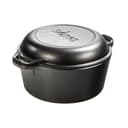
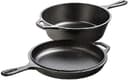
You never fry with a lid on; trapped steam softens the crust and condenses back into the oil. But the lid decides what else the pot is good for. The Double Dutch Oven’s lid is a 10.25-inch skillet and the Combo Cooker’s is the same idea, so both pots are two pans, and both are the sourdough favorites for the same reason.
The picks in one paragraph each
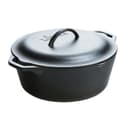
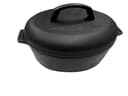
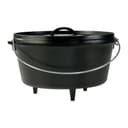
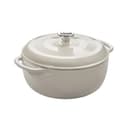
Lodge 7-quart Dutch oven is the fryer: 18.1 lb of American-made iron, deep enough for three quarts of oil with a safe margin, a heavy iron lid for its other life as a stew pot, and a price no enameled 7-quart approaches. Lodge Double Dutch Oven is the 5-quart answer at 12.37 lb, with a lid that is a real skillet; it fries a family batch and bakes a loaf. Lodge Combo Cooker is for small batches and shallow frying — a 3.2-quart pot plus a 10.25-inch skillet lid at 12.85 lb, and the cheapest two-pan set in cast iron. Bayou Classic 6-quart oval gives a long footprint for pieces that fight a round pot, in bare iron at a low price; its listing states no country of manufacture, so its card says so. Lodge 8-quart deep camp oven is the outdoor fryer, legs and all, and Lodge says not to use it indoors. Lodge 6-quart Essential Enamel is the enameled pot we would fry in: roomy, Lodge-rated to 500°F in the oven, no seasoning to worry about, and the value benchmark of its class.
Frying in cast iron without regret
Lodge’s own fried chicken recipe heats the oil to 350°F, and that number is a good anchor for most frying; a clip-on thermometer is the only accessory that matters. Bring the oil up slowly — thick iron takes time, and our preheating guide explains why patience is the whole trick. Fry in small batches so the temperature does not crash. Let the oil cool completely in the pot before you move it. Then wipe the bare pot out while the film is still warm and treat it as already oiled; a pot that has just fried does not need the after-wash wipe our cleaning guide describes, because it has had a better one. An enameled pot wants warm soapy water once the oil is out, and Lodge asks for hand washing and no metal utensils on its enamel; a light interior will show oil staining over time, which is cosmetic.
What we left off
The French enameled pots are superb braisers and we would not fry in a pot that costs that much when a bare Lodge does it better. Le Creuset’s light interior stains, by its own registry con; Staub’s dark matte interior is built for searing rather than for submersion. Both are ranked where they belong, in the enameled Dutch oven roundup. Small pots under 4 quarts are shallow-fry tools at best; the small Dutch oven roundup has them.