How we chose these camping skillets
1. The maker has to clear it for fire — in writing
This is the criterion that eliminates half the cast iron on the market, and it is not a judgement call. Lodge’s classic skillet page states the line is compatible with any stovetop including induction, plus oven, grill or campfire. Its Dutch oven page says the same for bare pots. Stargazer’s FAQ says its pans can be used on any cooking surface and are oven, grill and fire safe. Field goes further and publishes a journal post arguing a hot skillet on a grill sears better over the whole surface than the grates do, that charcoal and hardwood get hot enough to sear, and that keeping the drippings in the pan removes the flare-up risk.
Now the other side. Lodge’s own page for its Essential Enamel skillet says it is “not made for use on a grill or over a fire,” and its 3-quart Essential Enamel Dutch oven page says the pot is not designed for a grill or open fire. That is the maker ruling out its own product, not us ruling it out, and it applies to every enameled pan regardless of brand prestige. Enamel is glass fused to iron; uneven flame contact and thermal shock crack and chip it. Our enameled versus bare comparison covers the decision in full, and can you put cast iron on the grill collects every published statement.
2. Weight, because you carry it and then you lift it hot
Camping punishes weight twice: once in the car or on your back, and again when a pan full of food has to come off a fire. Lodge publishes the whole ladder — 1.94 lb at 6.5 inches, 3.44 at 8, 5.66 at 10.25, 7.69 at 12, 10.5 at 13.25 and 12.3 at 15 inches — and the Combo Cooker at 12.85 lb for the pot-plus-skillet pair.
Ten and a quarter inches is the sweet spot for two to four people: it feeds a family, it fits most camp grates and most two-burner stoves, and 5.66 pounds is a one-handed lift cold. Twelve inches is the right call for a group and the wrong call for a backpack. Above that you are into two-handed territory before any food goes in, which is why the 13.25 and 15-inch pans are not on this page.
3. Handles you can use with gloves on
A campfire heats the handle as hard as it heats the pan, and you will be wearing a glove or using a folded towel every single time. That changes what a good handle is. A long single handle gives you leverage and distance from the flame — Victoria’s advantage, and the reason it is on this page. Two short loop handles give you a balanced two-handed lift, which is what you want when the pan is full and the ground is uneven — Lodge’s dual-handle pan and the Combo Cooker.
What you want on top of either is the small helper handle opposite the main one, which Lodge casts into its 10.25-inch and larger classic skillets. It turns an awkward one-handed swing into a controlled two-handed move with no extra weight. Treat every handle as hot; cast iron conducts, and nothing in this category has a cool-touch grip.
The picks in context
Lodge classic 10.25-inch — the best overall
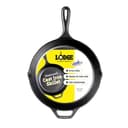
Everything a camp skillet needs and nothing it does not. Lodge publishes 5.66 lb, made in the USA, pre-seasoned with 100% natural vegetable oil, and rated by Lodge for stovetop, oven, grill or campfire. It has the helper handle, it costs very little, and the seasoning recovers from fire abuse with a wipe of oil and a hot twenty minutes.
The honest limits are size and ceremony. Ten and a quarter inches cooks for two to four, so a group of six will be cooking in shifts, and there is no lid, which means no braising and no bread. If either of those matters, the Combo Cooker below fixes it for a few dollars more.
Lodge Combo Cooker — the best two pans in one
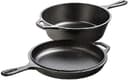
The smartest thing to pack if you can only pack one. It is a 3.2-quart deep pot whose lid is a 10.25-inch skillet, so one object does frying, simmering, braising and bread. Lodge publishes 12.85 lb for the pair at 16.56 x 10.5 x 4.56 inches. On a campsite the lid matters more than at home: it keeps ash and insects out, it holds heat on a windy evening, and it turns a grate into an oven.
It is the heaviest thing here, and 12.85 pounds in a pack is a decision, not a detail. Both halves are bare iron that want drying and oiling, which is more work at a sink you do not have. And the skillet-as-lid has two short loop handles rather than a long one, so it is less pleasant as a frying pan than a proper skillet.
Lodge 12-inch dual handle pan — the best for lifting off a grate
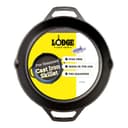
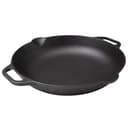
Two loop handles, no long arm sticking out. On a camp grate or a tailgate that is the difference between a controlled lift and a juggling act, and it means the pan sits in the middle of a fire ring instead of having its handle in the flames. The shallow shape is good for cornbread, skillet pizza, a full breakfast fry-up and anything you want to brown across the whole surface.
Two honest notes. Shallow walls mean liquid goes over the side on uneven ground, so it is a frying pan rather than a one-pot vessel. And dual loop handles always need two hands and two gloves — there is no one-handed option at all, which some people dislike more than they expect. It also doubles as our pick for pan pizza.
Lodge classic 12-inch — the best for a group
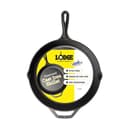
When you are feeding five or more, 10.25 inches stops being enough and cooking in shifts gets old on the second morning. Lodge publishes 7.69 lb for the 12-inch classic, same iron, same fire rating, same helper handle, roughly two pounds more to carry and about forty per cent more cooking floor.
The trade-off is that it is big in every direction: it will overhang a small camp stove, it needs a wide grate to sit level, and 7.69 pounds plus a pound of bacon is a genuine two-handed lift hot. If you are car camping, take it. If you are carrying everything, do not.
Victoria 13-inch — the best long handle
Victoria has cast iron in Medellín, Colombia since 1939, and its signature is a longer handle than the American makers use, with pans seasoned naturally in flaxseed oil. Over a fire that extra length is a practical safety feature: your hand is further from the heat and you get more leverage on a loaded pan. At 13 inches it is also the largest cooking surface here for the price.
Two caveats. A long handle over a fire ring puts the grip outside the heat but also makes the pan tippier on an uneven grate, so it wants a flat seat. And Victoria publishes less specification detail than Lodge does, so some rows on our card for it read “Not published” rather than being filled in from a guess. The Victoria review has the full picture.
Lodge square grill pan — the best over coals
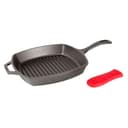
A different tool for the same trip. Ridges lift food out of the fat and give you grill marks, which is what people actually want from a fire, and the square shape fits more sausages or chops on a given grate than a round pan does. Lodge makes it in the USA and rates it like the rest of its bare iron.
The ridges are also the drawback: only the ridge tops touch the food, so you get marks rather than all-over browning, and cleaning between ridges with limited water is the worst washing-up job on the trip. Fat pools in the channels and will flare if you tip it into the fire. Our grill pan roundup ranks the category properly.
What we left off, and why
Every enameled pan, at every price. Lodge says its enameled skillet is not made for use on a grill or over a fire, and that its enameled pot is not designed for a grill or open flame. We are not going to recommend a product for a use its own maker excludes, and that excludes the Le Creuset and Staub pans this site rates highly elsewhere. Our enameled skillet roundup is for kitchens.
Camp Dutch ovens with legs.Lodge’s camp pots are superb and they are not skillets: three legs to sit over coals, a flanged lid to take coals on top, a steel bail handle, and Lodge states they are for outdoor use and not for indoor cooking. That is a genuinely different purchase, covered on the camping Dutch oven page.
The premium machined pans.Field and Stargazer both clear their pans for fire, and both are excellent. We left them off on cost rather than capability: a campfire scuffs seasoning, drops pans on rock and occasionally loses one, and a premium pan is a painful object to treat that way. If you want to take one anyway, you have the makers’ blessing — Field against Stargazer compares them.
Cooking cast iron over a fire without ruining it
Cook over coals, not flames. Flames are inconsistent, soot the outside of the pan and scorch whatever is touching the hot spot. Let the fire burn down and spread the embers, then cook on an even bed the way you would use a burner. A grate over coals is the most controllable camp setup there is.
Expect the seasoning to take a beating, and plan for it. Fire is hotter and less even than a stove, so bare iron comes home from a trip looking patchy and sometimes grey in spots. That is cosmetic. Dry the pan, wipe a thin film of oil over it and heat it until the oil just stops looking wet, and it is back. Our re-seasoning guide has the method, and which oil to use covers the fat to carry.
Never quench a hot pan in a cold creek.Thermal shock is the one way to actually crack cast iron, and Stargazer names it as the reason for its gentle-preheat rule. Let the pan cool to warm, scrape it out, wipe it, and give it the real clean at home. Carrying it home dirty and dry is far better than carrying it home wet — the rust guide exists mostly because of pans packed damp.