What we ranked these on
A flat iron disc is about as simple as cookware gets, so the ranking cannot be about cooking performance — every pan here is the same alloy at the same thickness class and will brown a chapati indistinguishably. What actually separates them is four things, in this order.
The handle, first, and not by a little. Flatbread is the one cook where you move the pan constantly: on the heat, off the heat, tilted over a flame to puff a roti, back down. A long handle you can grab bare-handed for a second is worth more here than it is on a skillet you set down once and leave. This is the single reason Victoria outranks Lodge on a page where Lodge is cheaper and American-made.
Published flat cooking surface, second.A pan sold as a 12-inch is not a 12-inch cooking surface, and the gap is where dosa disappointment comes from. Only one maker on this page publishes the flat figure outright — Victoria, with 10.5 inches of flat surface on its 12-inch comal. Treat every other “size” as a rim measurement, because that is what it is.
Weight, third.Mass is why cast iron holds its heat when a cold ball of dough lands on it, and it is also why your wrist objects after the eighth roti. The published figures that exist here range from 2.65 lb (Lodge’s 8-inch, its own figure) to 4.49 lb (Victoria’s 12-inch, its own figure) to the 20-inch Lodge plate, for which no weight appears on the pages we read.
What the maker will put in writing, fourth. Lodge publishes a cooktop list including induction, an explicit PFAS-free statement and a US origin. Victoria publishes a flat-surface dimension, its seasoning oil and a Colombian origin. Tramontina publishes temperature ceilings. Nobody here publishes a tawa.
The published figures, side by side
Every number below is the maker’s own except where the row says otherwise. Blank cells are not estimates — they are specs the maker does not publish, and we leave them blank rather than fill them.
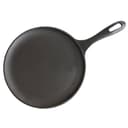
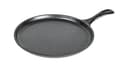
| Published spec | Victoria 10.5” comal | Lodge round griddle | Victoria 12” comal |
|---|
| Stated size | 10.5 in round | 10.5 in round (8 in also sold) | 12 in round |
| Flat cooking surface | Not published | Not published | 10.5 in (Victoria’s own figure) |
| Weight | Not published | 2.65 lb for the 8 in; no figure for the 10.5 in | 4.49 lb (Victoria) / 6 lb (Amazon) |
| Overall length | Not published | 13.25 in for the 8 in | 14.75 in (Victoria) / 19 in (Amazon) |
| Handle | Long cast iron, Victoria’s signature | Short cast stub | Long handle plus a helper loop |
| Factory seasoning | Flaxseed oil | “100% natural vegetable oil” | Three layers, non-GMO kosher flaxseed |
| Induction | Yes (cast iron is ferromagnetic) | Yes, Lodge states it | Yes, Victoria states it |
| Oven / grill / campfire | Bare iron, no published ceiling | All three, Lodge states it | All three, Victoria states it |
| Made in | Colombia | USA | Colombia |
| Maker’s care rule | Hand wash, dry, re-oil | “Hand wash, dry, oil.” | Warm water only, no soap, dry, re-oil |
That last row is the one disagreement between two makers of the same kind of pan. Lodge permits soap on seasoned cast iron on its care page. Victoria’s own instruction for the 12-inch comal is warm water only. Both pans are bare iron with a polymerized oil finish, so the physics is identical; what differs is how conservative the maker is willing to be in print. Our own read is that a little dish soap does not strip cured seasoning, and Lodge — the larger maker with more to lose — says so in writing.
Flat or concave: the one thing a spec sheet will not tell you
Traditional Indian tawas come in two shapes for two jobs. A concavetawa, dished slightly downward, is the roti and phulka pan — the dough sits in the shallow bowl, cooks on one face, and then gets moved onto an open flame to puff. A flat tawa is the dosa, chapati and paratha pan, where you want an unbroken plane you can spread batter across with the back of a ladle.
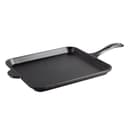
Every cast iron pan in this roundup is flat. That makes them good dosa and chapati pans and perfectly usable roti pans — you just puff the roti over the burner grate rather than in a dish. If the concave shape is specifically what you came for, we cannot honestly point you at one: we could not verify a concave cast iron tawa in live US stock from a maker that publishes specifications, and we are not going to name a pan we have not confirmed exists on the shelf.
The other distinction worth having: thickness beats diameter for dosa. A thin pan drops temperature the moment cold batter hits it, which is what makes a dosa pale and soft instead of lacy and crisp. All of these are cast iron at several pounds, which is the whole reason to buy iron over a coated aluminum tawa in the first place.
Seasoning a tawa, and the one habit that matters
Every pan here arrives pre-seasoned — Lodge with vegetable oil, Victoria with flaxseed — so you can cook on it the day it lands. What builds a tawa into a genuinely slick pan is the cooking itself: seasoning is polymerized oil bonding into the iron, and dry flatbread cooking lays down very little of it.
So the one habit worth forming on a flatbread pan specifically: finish a dry session by wiping on a film of oil while the pan is still warm. A tawa does more dry cooking than any other pan in the kitchen, and dry heat slowly polishes seasoning off rather than adding to it. America’s Test Kitchen’s test for how much oil is the right amount is the best one going: the surface should look matte, not shiny. A visible slick is how pans go sticky.
For the full routine, our seasoning guide and cleaning guide cover it, and the sticky-pan guide covers the one failure mode that over-oiling causes.
Who should skip this page
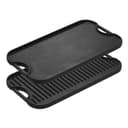
If you want grill marks rather than a flat plane, you want a grill pan, not a tawa. If you want a two-burner plate for pancakes and bacon as the primary job, the comparison you want is our cast iron griddle roundup, where the same Lodge plates are ranked on breakfast rather than flatbread. If you are buying for pizza, the pizza pan roundup ranks on oven behavior instead. And if it is a deep bowl for curry you actually need, our cast iron wok and kadai roundup is the right page.