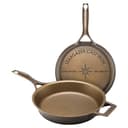
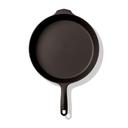
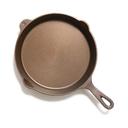
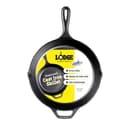
The Stargazer 12-inch skillet is the closest alternative to a Smithey for most people: machined smooth after casting, made in Allentown, Pennsylvania, lifetime warranty, 45-day trial — and Stargazer publishes 6.5 lb against Smithey’s published 8.7 lb at the same 12-inch rim, at a $175 list against Smithey’s $220. It is for the buyer who wants the polished-interior experience and would rather have the lighter pan. The budget pick is the 10.25-inch Lodge Classic, which costs roughly a tenth as much, is also American-made, and browns food the same way — it just arrives pebbled instead of polished.
First, what you are actually shopping for. Smithey publishes this about its No. 12, in its own words: a 12-inch top diameter, a 10.5-inch cooking surface, 2.2 inches deep, “+/- 8.7 lbs”, a “satin-smooth, polished finish”, pre-seasoning with “2-3 coats of pure grape seed oil” and “no chemical coatings of any kind”, “US Made”, designed to work on everything “from gas and fire to induction and electric”, that it will not scratch a stovetop, that you can use soap on it, a $220 price and a lifetime guarantee. Its FAQ adds the memorable line about heat: “Your oven can’t get too hot for a Smithey.” It does not publish an oven ceiling, a dishwasher position or a utensil policy.
That list is the specification to match, and it is worth saying that it is a good pan — nothing below is an argument that it is not. Two of the four alternatives are American foundries publishing the same polished surface and the same lifetime terms for less money, one publishes considerably more detail than Smithey does, and one costs a tenth as much and cooks the same. We have no live, verified retail listing for a Smithey pan, so there is no price or buy link for it anywhere on this site — the same position we take on vintage brands. Prices below are live and stamped as of November 7, 2026; we own none of these pans and have run no tests, which this page explains.
What a polished interior actually changes
Release, early on. A machined surface starts closer to non-stick than an as-cast pebbled one, so eggs behave better in week one. It does not brown better: fond is a function of mass and heat, and all of these pans have both. The useful way to read the premium is as a timeline rather than a quality ladder — smooth on day one costs money, smooth by month six costs patience. Our Lodge vs Smithey comparison runs that argument at the full price spread, and Smithey vs Stargazer is the head-to-head against the top pick here.
Weight is where the alternatives win
Put the published figures side by side and a pattern appears. Smithey: 8.7 lb at a 12-inch rim. Stargazer: 6.5 lb at a 12-inch rim. Field No. 10: 6 lb at 11-5/8 inches. Lancaster No. 8: about 4 lb at 10.5 inches. Lodge Classic: 5.66 lb at 10.25 and 7.69 lb at 12. The boutique makers pour thinner castings, and Smithey’s is the heaviest of the polished pans on its own numbers. If you are leaving Lodge behind because of the weight, that is worth knowing before you spend $220 — and the lightweight skillets page ranks the whole field on it.
Warranty and trial terms, compared on what is published
Smithey publishes a lifetime guarantee whose text promises defective cookware will be replaced and cookware that fails after honest and normal use will be repaired or replaced. Stargazer publishes a lifetime warranty plus a 45-day trial with free returns; Field publishes a lifetime warranty plus a 45-day trial with easy returns. Lancaster’s range page says “with our lifetime warranty” and links to terms it does not reproduce. All four are serious; the two with a stated trial period are the ones that let you find out whether a heavy pan suits you without owning it forever.
What none of them publishes
An oven temperature ceiling. Smithey’s FAQ answers it with a sentence rather than a number; Stargazer and Field publish no ceiling either; Lodge does not publish one for bare iron. For bare cast iron that is the correct answer rather than an omission — there is no coating to fail — but it is worth noticing that this is the one spec the whole category treats as unnecessary, and the enamelled pans all state. Our oven guide covers what that means in practice.
If the pan is not the point
Some of the appeal of a Smithey is that it is a nice object, and that is a legitimate thing to buy. If that is the real motivation, the pan to compare against is not a cheaper polished skillet but Finex— an octagonal American pan with a coiled stainless handle — and the US-made skillets page ranks every American foundry we cover. For the brand verdict on Smithey itself, read our Smithey review, which this page does not repeat.