The Seasoned Pan

The Best Budget Dutch Ovens

The cheapest Dutch ovens that still braise, bake bread and slow-cook properly — enameled and bare — and which value pot to buy first.

By Stephen V.Last updated How we pick

A Dutch oven is the one pot that does the low, slow, covered cooking a skillet can’t: braises, stews, big-batch chili, a pot roast, and a round loaf of bread with a hard, crackling crust. The catch is that the pots everyone photographs cost as much as a week of groceries, which leaves a lot of people assuming a good one is out of reach. It isn’t. The braising, the bread and the slow cooking a Dutch oven is for all come from two dull facts — a lot of iron and a heavy, well-fitting lid — and iron is cheap. A heavy pot with a heavy lid holds a steady, even braise whether it says Le Creuset or Amazon Basics on the box.

What a budget pot actually costs you is finish, warranty and the badge, not the cooking. That is the honest heart of this page. We sorted the cheapest buyable Dutch ovens by the four things that decide which one suits you: enameled or bare cast iron, capacity, what the low price gives up, and how much care you are willing to do— because bare iron and acidic sauces need a little thought that enamel doesn’t. We haven’t hands-on tested these pots; here is exactly what we do instead. Prices are checked live, and quoted only as bands — roughly what you’ll pay, not a number that’s stale by the time you read it.

How this is funded:we earn a commission if you buy through our links, at no extra cost to you. It never changes which product we recommend, and we’ll tell you when we’d skip one. Full disclosure.

Quick picks

Ranked on materials, size, finish and buyer fit. Select a row to jump to the full write-up. We have not hands-on tested these pans — here is exactly what we do instead.

#ProductBest forPrice
1
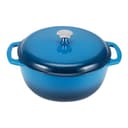
Amazon Basics Enameled Cast Iron Dutch Oven (6 qt)

Amazon Basics Enameled Cast Iron Dutch Oven (6 qt)

The cheapest way into enameled cast iron. It braises and bakes bread like any enameled pot — you give up finish quality and warranty, not core function. A sensible first enameled Dutch oven.

Cheapest enameled
$48.67 · View on Amazon

Price as of August 7, 2026. #ad How we’re funded

2
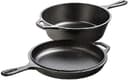
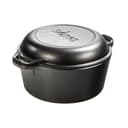
Lodge Cast Iron Double Dutch Oven (5 qt)

Lodge Cast Iron Double Dutch Oven (5 qt)

Two pans in one: a 5-quart pot plus a lid that flips over to become a 10.25-inch skillet. It's a favorite for sourdough because the shallow lid-as-base makes loading a loaf easy, and it's a fraction of an enameled pot's price.

Best budget bare (two-in-one)
$59.90 · View on Amazon

Price as of August 7, 2026. #ad How we’re funded

3
Lodge Cast Iron Combo Cooker (3.2 qt)

Lodge Cast Iron Combo Cooker (3.2 qt)

The bread-baker's secret: a deep pot plus a 10.25-inch skillet lid, used upside down so you bake the loaf on the shallow skillet and cover it with the deep pot. Easy to load, easy to score, and cheap. The single best-value sourdough vessel.

Best budget for bread
$59.90 · View on Amazon

Price as of August 7, 2026. #ad How we’re funded

4
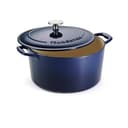
Tramontina Enameled Cast Iron Dutch Oven (6.5 qt)

Tramontina Enameled Cast Iron Dutch Oven (6.5 qt)

The enameled Dutch oven that gets recommended as the Le Creuset alternative more than any other: a generous 6.5 quarts, a light interior, and a price that undercuts the French pots dramatically.

Best value step-up
$99.95 · View on Amazon

Price as of August 7, 2026. #ad How we’re funded

5
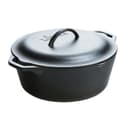
Lodge Cast Iron Dutch Oven (7 qt)

Lodge Cast Iron Dutch Oven (7 qt)

A big 7-quart bare cast iron pot with a matching iron lid — for stews, chili and larger loaves, at a price no enameled pot of this size gets near. Heavy, but that mass is exactly what holds a steady braise.

Best budget large
$79.90 · View on Amazon

Price as of August 7, 2026. #ad How we’re funded

6
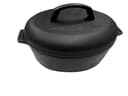
Bayou Classic Cast Iron Oval Roaster (6 qt)

Bayou Classic Cast Iron Oval Roaster (6 qt)

An oval bare cast iron roaster — the shape that fits a whole chicken, a roast, or a long cut better than a round pot. A well-priced specialist if roasting is what you do most.

Best budget roaster
$55.99 · View on Amazon

Price as of August 7, 2026. #ad How we’re funded

The picks in full

#1Cheapest enameled

Amazon Basics Enameled Cast Iron Dutch Oven (6 qt)

The cheapest way into enameled cast iron. It braises and bakes bread like any enameled pot — you give up finish quality and warranty, not core function. A sensible first enameled Dutch oven.

Strengths

  • Among the lowest prices for 6 qt of enameled cast iron
  • No seasoning needed, safe with acidic sauces
  • Does the core braise-and-bake job perfectly well

Trade-offs

  • Basic finish and no meaningful warranty
  • Enamel durability is a step below the premium brands
TypeEnameled cast iron
Size6 qt
SeasoningNone needed (enameled)
Induction-safeYes
Made inNot published
Best forThe lowest-cost enameled Dutch oven

The details. Budget enameled cast iron, 6 qt, no seasoning required. Care is the same as any enameled pot: hand wash, avoid thermal shock, don't drop it.

Specs read from the product listing, on July 19, 2026. “Not published” means the brand does not state that figure.

#2Best budget bare (two-in-one)

Lodge Cast Iron Double Dutch Oven (5 qt)

Two pans in one: a 5-quart pot plus a lid that flips over to become a 10.25-inch skillet. It's a favorite for sourdough because the shallow lid-as-base makes loading a loaf easy, and it's a fraction of an enameled pot's price.

Strengths

  • Lid doubles as a 10.25" skillet — genuinely two pans
  • Shallow base makes loading and scoring bread easy
  • American-made bare cast iron at a low price

Trade-offs

  • Bare interior needs seasoning care, unlike enamel
  • No long handle — it's a two-hands, loop-handle pot
TypeBare cast iron
Size5 qt
Pre-seasonedYes
Induction-safeYes
Made inUSA
Best forSourdough bakers and anyone wanting two pans in one

The details. The lid inverts into a 10.25" skillet, and the shallow pan makes a low-sided base for loading dough. Bare cast iron: pre-seasoned, but dry and oil it after washing, and avoid long-simmered acidic sauces until well seasoned.

Specs read from the product listing, on July 19, 2026. “Not published” means the brand does not state that figure.

#3Best budget for bread

Lodge Cast Iron Combo Cooker (3.2 qt)

The bread-baker's secret: a deep pot plus a 10.25-inch skillet lid, used upside down so you bake the loaf on the shallow skillet and cover it with the deep pot. Easy to load, easy to score, and cheap. The single best-value sourdough vessel.

Strengths

  • Skillet-as-base makes loading and scoring a loaf effortless
  • Two useful pans for the price of one cheap skillet
  • American-made bare cast iron

Trade-offs

  • At 3.2 qt / 10.25" it suits round boules, not long loaves
  • Bare cast iron needs drying and oiling after washing
TypeBare cast iron
Size3.2 qt
Pre-seasonedYes
Induction-safeYes
Made inUSA
Best forSourdough and no-knead bread on a budget

The details. A deep pot plus a 10.25" skillet lid. Bakers invert it — loaf on the shallow skillet, deep pot as the dome — so loading and scoring are easy. Pre-seasoned bare cast iron; standard wash-dry-oil care.

Specs read from the product listing, on July 19, 2026. “Not published” means the brand does not state that figure.

#4Best value step-up

Tramontina Enameled Cast Iron Dutch Oven (6.5 qt)

The enameled Dutch oven that gets recommended as the Le Creuset alternative more than any other: a generous 6.5 quarts, a light interior, and a price that undercuts the French pots dramatically.

Strengths

  • 6.5 qt — roomy for big batches and larger loaves
  • Light interior enamel, easy to read for browning
  • Long-standing budget alternative to the French names

Trade-offs

  • Fit and finish isn't at the French-brand level
  • Enamel chips if mistreated, like all enameled cast iron
TypeEnameled cast iron
Size6.5 qt
SeasoningNone needed (enameled)
Induction-safeYes
Made inNot published
Best forA large, light-interior Dutch oven on a budget

The details. Enameled inside and out with a light interior; no seasoning, safe with acidic foods. A larger 6.5 qt capacity. Hand wash and avoid thermal shock to protect the enamel.

Specs read from the product listing, on July 19, 2026. “Not published” means the brand does not state that figure.

#5Best budget large

Lodge Cast Iron Dutch Oven (7 qt)

A big 7-quart bare cast iron pot with a matching iron lid — for stews, chili and larger loaves, at a price no enameled pot of this size gets near. Heavy, but that mass is exactly what holds a steady braise.

Strengths

  • 7 qt for big batches and larger boules
  • Heavy iron lid holds heat and moisture in
  • American-made and inexpensive for the size

Trade-offs

  • Very heavy, especially full
  • Bare interior needs seasoning care with acidic braises
TypeBare cast iron
Size7 qt
Pre-seasonedYes
Induction-safeYes
Made inUSA
Best forLarge batches in bare cast iron

The details. Large bare cast iron pot with a heavy iron lid; the mass holds a steady braise. Pre-seasoned but the bare interior wants care with long acidic cooks until it's well seasoned. Dry and oil after washing.

Specs read from the product listing, on July 19, 2026. “Not published” means the brand does not state that figure.

#6Best budget roaster

Bayou Classic Cast Iron Oval Roaster (6 qt)

An oval bare cast iron roaster — the shape that fits a whole chicken, a roast, or a long cut better than a round pot. A well-priced specialist if roasting is what you do most.

Strengths

  • Oval shape fits a chicken or roast that a round pot cramps
  • Heavy iron lid for moisture retention
  • Inexpensive for a large roaster

Trade-offs

  • Oval shape is less versatile for soups and stews
  • Bare interior needs the usual seasoning care
TypeBare cast iron
Size6 qt oval
Pre-seasonedYes
Induction-safeYes
Made inNot published
Best forRoasting whole birds and longer cuts

The details. An oval roaster with an iron lid; the oval footprint suits whole birds and long roasts. Pre-seasoned bare cast iron with the standard wash-dry-oil care.

Specs read from the product listing, on July 19, 2026. “Not published” means the brand does not state that figure.

How we chose these budget Dutch ovens

Every Dutch oven listing promises even heat, superior retention and heirloom durability, so the marketing copy is no help at all in telling a $50 pot from a $400 one. The differences that actually change your day are plainer than that, and those are what we ranked on.

1. Enameled or bare — the budget really does split here

This is the first fork, and on a budget it matters more than it does higher up the market. Enameled pots (the Amazon Basics and the Tramontina here) have a glassy coating fired onto the iron: no seasoning ever, soap is fine, and you can simmer a tomato or wine sauce for hours without a second thought. Barecast iron (the Lodge pots and the Bayou Classic roaster) is raw iron with a baked-on layer of oil for a surface — cheaper for the same mass, tougher if you drop it, but it wants drying and a wipe of oil after every wash. At the budget end you can buy either for roughly the same money, so the choice is genuinely about how you cook and how much fuss you’ll tolerate, not about price. Our full enameled vs bare cast iron comparison walks through the trade-off across a whole kitchen.

2. What a cheap pot gives up — and what it doesn’t

Be clear about the trade, because it is easy to oversell in both directions. A budget pot gives up finish (the enamel is thinner and plainer, the light interiors stain sooner, the handles are less generous), it gives up warranty (a Le Creuset carries a lifetime guarantee; most cheap pots carry very little), and it gives up the name, which is worth real money to some people and nothing to others. What it does notgive up is the core job. A heavy budget pot with a tight lid braises a short rib and bakes a boule as well as a pot costing five times as much, because that job is physics, not branding. If a review tells you a cheap Dutch oven can’t cook, be skeptical; if it tells you a cheap one feels and lasts exactly like the French pots, be skeptical of that too.

3. Size: buy for the batch, not the label

Capacity is where people over- and under-buy. A 5-to-6-quart pot is the everyday size for most households — a stew for four with leftovers, a standard boule, a chicken with room. Go to 7 quarts (the big Lodge here) only if you routinely cook for a crowd or freeze in bulk, and know that a 7-quart pot full of braise is genuinely heavy to move. The combo cooker at the small end is a special case: it is a bread and one-or-two-serving pot, not a family stewpot. Buy the size that matches the meals you actually make, not the biggest one on the shelf, because iron you don’t fill is just weight you have to store and lift.

4. Acidic food and bare iron

One real difference deserves its own line. Long, hot simmers of acidic food — tomato sauce, a wine braise, a chili with a lot of tomato — can strip a little seasoning off bare cast iron and pick up a faint metallic edge, especially while the pot is young and the seasoning is still thin. It is not dangerous and it is not permanent; a well-seasoned old pot shrugs it off, and you re-oil and move on. But if most of what you cook is a Sunday tomato ragu, an enameled pot is the more relaxed choice, and that is exactly why the enameled picks lead this list. For bread, where there’s no acid and the loaf never touches wet sauce, bare iron has no such caveat at all — see our guide to the best Dutch ovens for sourdough.

5. Lids, handles and the details that wear on you

The parts you touch every time are where budget pots most often cut corners, so they’re worth a look before you buy. A heavy, well-fitting lid is doing real work — it traps the steam that braises, so a lid that sits flush and has some weight to it matters more than almost any headline number. Handles are the other everyday detail: a pot needs loop handles big enough to grab with an oven mitt on, and the cheapest pots sometimes cast them a little small, which turns a hot lift into a fumble. On enameled pots, check what the lid knob is rated to — some budget knobs cap the oven temperature lower than the pot itself, which quietly limits how hot you can bake bread. None of these are dealbreakers, but they’re the differences you feel on the hundredth use rather than the first, and they’re a fair part of what the extra money buys higher up the market.

How to get the most out of a budget Dutch oven

A cheap pot rewards the same technique as an expensive one, and most disappointment comes from a couple of avoidable habits rather than the pot.

Preheat gently, then leave the lid on

Cast iron is slow to heat and slow to let go, which is the whole point of it for braising. Bring the pot up on medium rather than blasting it on high, sear in batches so you don’t crowd and steam the meat, then get the liquid in, the lid on, and the pot into a low oven. The tight lid is what traps the moisture that does the actual braising; every time you lift it to peek you let that heat and steam out, so resist. This is true of a $50 pot and a $400 pot alike.

For bread, use the shallow-base trick

The two bare Lodge picks — the double Dutch oven and the combo cooker — are loved by bakers for one reason: you can flip them so the shallow half becomes the base. Loading a wet, sticky dough into a deep pot means reaching down into a screaming-hot vessel; loading it onto a shallow skillet base and then lowering the deep half over the top as a lid is far easier and safer, and scoring the loaf is simple with room to work. A standard deep pot bakes great bread too, but the shallow-base pots make the handling painless, and they cost a fraction of a dedicated bread cloche.

Care that keeps a cheap pot going for years

Enameled budget pots want gentle treatment to earn their keep: hand wash them, skip the metal scourers that scratch the glass, and never shock the hot enamel under a cold tap, because thermal shock is what cracks a cheap coating. Bare iron wants the opposite kind of attention — wash it, dry it fully (a minute back on the warm burner does it), and wipe on the thinnest film of oil so it doesn’t rust. Neither routine is hard, and the payoff is that a $50 pot treated well outlives an expensive one treated carelessly. Our cast iron cleaning guide covers both surfaces in detail.

Use it for far more than braising

A Dutch oven is quietly the most versatile pot in the kitchen, and a budget one is no exception — which is a large part of why one is worth the money even at the low end. The same heavy pot that braises a short rib will hold a steady, gentle heat for a batch of chili or a pot of beans, sit in a low oven as a hands-off slow cooker, deep-fry a small batch of chicken because the mass keeps the oil temperature stable when the cold food goes in, and bake a no-knead loaf that needs nothing but a bowl and time. You’re not paying for a single-trick pan, so pick the size and finish that suits the widest range of what you cook, not just the one dish you had in mind at the checkout.

The mistakes that end a cheap pot early

Budget pots don’t usually fail from cooking; they fail from a couple of avoidable habits. The big one for enamel is thermal shock — taking a screaming-hot pot straight to a cold tap, or dropping frozen food into a ripping-hot empty pot — which can craze or chip a thinner coating far more readily than it would a thick premium one. Metal utensils and steel wool scratch the glass over time, so a wooden or silicone spoon and a soft brush are worth the small discipline. For bare iron, the only real killer is water left standing, which rusts it; dry it properly and the pot is essentially indestructible. Treat a $50 pot with the care you’d give a good knife and it will outlast a premium pot that’s abused.

Who should skip these and save for a Le Creuset

Not everyone should buy the cheapest pot that works, and it would be dishonest to pretend otherwise. If you will keep this pot for thirty years, use it several times a week, and want it to look as good on the table as it cooks on the stove, the finish and the lifetime warranty of a premium French pot are a genuine value rather than a vanity — the enamel is thicker, the light interior reads browning beautifully, the handles fit oven mitts, and if the coating ever fails the company replaces the pot. If that is you, don’t buy a placeholder you’ll want to upgrade; save a little longer and read our Le Creuset brand guideinstead. For everyone else — first-time buyers, occasional braisers, bread bakers, anyone outfitting a kitchen on a real budget — the pots on this page do the job the famous ones do, and the money you save buys a lot of short ribs.

The short version

If you want the least fuss, buy one of the enameled pots and cook whatever you like in it — acidic sauces included — with soap-and-water cleanup and no seasoning to think about. If you want the lowest price and don’t mind a wipe of oil after washing, buy bare Lodge iron; it’s the value leader, especially at the larger sizes. If bread is the reason you’re here, a shallow-base Lodge is the best-value baking vessel there is. And if you’ll keep this pot for decades and want it to look the part on the table, don’t buy a placeholder you’ll only replace — save a little longer for the French pot. Every option on this page does the actual cooking; the only real question is how you want to live with it.
Frequently asked questions

Are cheap Dutch ovens actually any good?

For cooking, yes. The braising, stewing and bread-baking a Dutch oven is made for come from a heavy pot and a tight lid, and that mass is cheap — a budget pot does that core job as well as a premium one. What you give up at the low end is finish quality, a long warranty and the brand name, not the cooking itself.

Enameled or bare cast iron on a budget?

Buy enameled (the Amazon Basics or Tramontina here) if you cook a lot of acidic, tomato- or wine-based dishes and want zero seasoning maintenance and soap-and-water cleanup. Buy bare cast iron (the Lodge pots) if you want the lowest price, a pot that shrugs off drops, or a shallow-base pot for bread — just be ready to dry and oil it after each wash.

What size budget Dutch oven should I buy?

A 5-to-6-quart pot suits most households — a stew for four with leftovers, a standard boule, or a chicken. Step up to 7 quarts only if you regularly cook for a crowd or batch-freeze, and remember a 7-quart pot full of braise is heavy to lift. The small combo cooker is a bread and one-or-two-serving pot, not a family stewpot.

Can you bake sourdough in a budget Dutch oven?

Yes, and some of the best bread vessels are cheap. The bare Lodge double Dutch oven and combo cooker are baker favorites because you can flip them so the shallow half is the base, which makes loading and scoring a wet dough far easier than reaching into a deep pot. Bread involves no acidic liquid, so bare iron has no downside there.

Is it safe to cook tomato sauce in a bare cast iron Dutch oven?

It's safe, but long, hot simmers of acidic food can strip a little seasoning and pick up a faint metallic taste, especially while the pot is new and the seasoning is thin. A well-used, well-seasoned pot handles it fine, and you just re-oil afterward. If most of what you cook is acidic, an enameled pot is the more relaxed choice.

Is it worth spending more on a Le Creuset or Staub instead?

It's worth it if you'll use the pot for decades, want it to look as good as it cooks, and value a lifetime warranty and thicker, better enamel — those are real advantages, not just a badge. If you're a first-time buyer, an occasional braiser, or outfitting a kitchen cheaply, the pots on this page cook the same and leave money in your pocket.

Sources

Keep reading