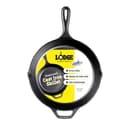
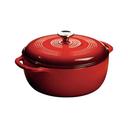
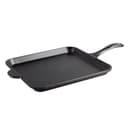
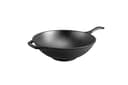
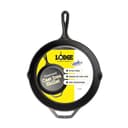
The cast iron you should keep off an induction hob
This is the part most “cast iron works on induction” articles skip, and it is published rather than inferred. Lodge states “oven safe, not recommended for stovetop use” for its bakeware — the 15-inch pizza pan, the 15.5 x 10.5-inch baking pan, the wedge pan and the muffin pan. They are cast iron, they are ferrous, an induction hob will happily couple with them, and the maker still says no. The reason is thermal: those pans are broad and thin relative to a skillet, they are designed for the even ambient heat of an oven, and a coil heating one patch of a wide thin casting is a recipe for warping and for scorched batter over the coil with raw batter at the edges. Our product pages carry that as a hard flag rather than a footnote.
Two more to leave alone. Camp Dutch ovens with legs cannot sit flat on glass at all, and Lodge says they are not for indoor use. Any piece with a silicone or wooden component near the base — a handle sleeve, a wooden underliner, a fajita tray — belongs on the table, not the hob. Cuisinel’s own care page caps its silicone handle covers at 350°F, which a hob exceeds easily.
How to buy cast iron for induction: four checks
1. Base diameter against coil diameter, not rim against coil. A “12-inch” skillet has sloped sides; its flat floor is usually about two inches narrower than its rim. Match the floor to the coil. A floor smaller than the coil is the one arrangement that genuinely risks the hob, because the uncovered ring of coil heats glass with nothing above it to pull heat away. Most hobs will refuse to start if the pan is far too small, and will simply run hot if it is slightly too small.
2. Flatness. Solid cast iron does not warp in normal use, but cast bases vary at the factory, and a rocking pan on induction gives you an air gap, which is a cold spot. Put the pan on a glass surface and press one edge; if it rocks, return it.
3. Weight, and how you will move it. On gas, weight is a wrist problem. On induction, weight is a glass problem: the hob surface is a ceramic panel, and the published failure mode is impact and point loading, not heat. Place, never drop; slide, never drag. This is also the one argument for a lighter machined pan that has nothing to do with your wrist.
4. Enamel or bare, for a reason that is specific to glass.Bare cast iron’s underside is slightly abrasive; enamel is a smooth hard glaze. On a ceramic hob that is a real difference over years of sliding pans around, and it is the only context on this site where we would nudge someone toward enamel for a reason other than acid or convenience. Enameled vs bare cast iron has the rest of that trade.
Why induction suits cast iron better than gas does
Two reasons worth knowing before you spend anything. Coupling efficiency.An induction coil deposits its energy in the base of the pan itself, so nearly all of it ends up in the iron; a gas flame sends a large fraction around the pan and into the room. A heavy cast iron base is the ideal recipient, because its mass then spreads that energy sideways and evens out the coil pattern — which is exactly the weakness of a thin pan on induction.
Control at the bottom of the range.Cast iron’s standing complaint is that it is slow to respond. Induction’s standing complaint is that cheap thin pans respond too fast and scorch. Put them together and each cancels a little of the other: an induction hob can hold a cast iron pan at a genuinely low, even temperature in a way a gas burner’s smallest flame cannot, which is why eggs and sauces behave better on this combination than most people expect. Cast iron for eggs covers that technique.
If your hob is radiant glass rather than induction
Different page, genuinely different advice. Radiant glass-ceramic hobs heat an element under the glass and then transfer heat upward, so pan flatness matters even more, the hob stays dangerously hot after you turn it off, and several manufacturers warn specifically against dragging heavy cookware. Best cast iron skillets for glass top stoves is written for that case, and our guide to cast iron on glass and induction covers the handling rules for both without ranking anything. If you cook on gas, best cast iron skillets for gas stoves inverts most of the advice on this page.