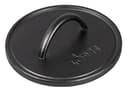
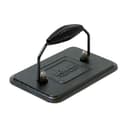
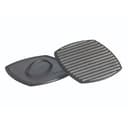
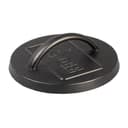
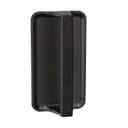
The four Lodge presses at a glance
Every number in this table is published by Lodge on the product page for that press. Nothing is estimated, averaged or converted. Read the weight column first and the name column last.
| Press | Face | Weight | Height | Surface |
|---|
| Round grill press (L8RFIP) | 8.0 in round | 3.5 lb | 1.94 in | Flat |
| Panini press (LPP3) | 8.31 in square | 3.95 lb | 1.5 in | Ridged |
| Grill press (LGP3) | 6.75 x 4.5 in | 2.64 lb | 3.5 in | Flat, hammered base |
| Burger press (L6BP) | 6.3 in round | 1.72 lb | 2.0 in | Flat |
The spread is more than two to one from lightest to heaviest, and the name of each product tells you almost nothing about where it sits. That is the entire reason this page exists.
How we chose these presses
1. Published weight, because the press supplies the force
Everything a press does comes from mass. You can lean on a light press to make up the difference, but then you are controlling the pressure with your arm over a 400°F pan, and the contact you get is whatever your wrist happens to deliver. Mass is consistent; arms are not. Lodge publishes 3.95 lb for the panini press, 3.5 lb for the 8-inch round, 2.64 lb for the rectangular grill press and 1.72 lb for the burger press.
Where weight matters most is bacon and smash burgers, because both jobs are about defeating a curl. Bacon contracts as the fat renders and lifts itself off the pan; a patty springs back the instant you stop pushing. Three and a half pounds sitting still beats two pounds being leaned on. Where weight matters leastis a sandwich, which is compressible and needs only enough force to hold the bread on the iron — so the heaviest press being the sandwich press is a slight waste of its best quality.
2. Contact area, and whether it fits inside your pan
Width decides how many passes a job takes, and it also decides whether the press can go in a skillet at all. A cast iron skillet has sloped walls, so the flat floor is noticeably narrower than the rim diameter the pan is sold under — something our skillet size guide covers in detail. An 8-inch press in a 10.25-inch skillet will touch the walls before it touches the floor.
That is the practical split between the top two picks. The 8-inch round press is the better tool on a flat surface — a griddle, a 12-inch pan, or the hot plate of a grill. The 6.75 x 4.5 inch rectangular press is the one that drops cleanly into a 10-inch skillet, which is the pan most people own. If you are pressing chicken thighs or chops in your everyday skillet, the smaller footprint is the right buy even though it weighs less.
3. Flat or ridged — these are not the same product
Lodge’s panini press is “designed with raised grill ridges” to put “the perfect sear and delicious grill marks on your favorite sandwiches”. That is a precise claim and it is true: ridges are the only way to get panini lines across bread without a dedicated sandwich machine. But ridges reduce the contact patch to the ridge tops, so the same press on a rasher of bacon presses three stripes and leaves the rest of it free to curl.
So: ridged for sandwiches and for marking vegetables and chicken where the stripes are the point; flat for everything where even contact is the point. If grill marks are what you are chasing on meat rather than bread, the pan matters more than the press — that is the job of a ridged cast iron grill pan, where the ridges are under the food and get the heat.
4. Handle height, because this is the one safety spec
A press puts your hand directly over a pan that is hotter than an oven, with rendering fat underneath it. The distance between the iron and your knuckles is a real spec, and Lodge publishes it as overall height: 3.5 inches for the rectangular grill press with its coil handle, 2.0 for the burger press, 1.94 for the 8-inch round and just 1.5 for the panini press.
The coil handle on the LGP3 is the design that takes this seriously — a spiral of steel is a long thermal path with a lot of surface area to shed heat, and the 3.5-inch overall height holds your hand nearly twice as far above the food as the panini press does. None of these handles is insulated, and none of the four pages states a handle temperature, so treat every press as hot after a minute of contact and keep a dry towel to hand. The silicone sleeves in our accessories roundup are shaped for skillet handles, not press handles, and Lodge states they are not intended for use during cooking in any case.
5. What the maker publishes at all
Four of the five picks are Lodge, and that is not brand loyalty — it is that Lodge publishes a full spec sheet for every press it sells, including the California AB 1200 disclosure, the care routine and the country of manufacture. The fifth pick, the Blackstone griddle press, is here because a 10-inch-long press is a genuinely different and useful shape for a flat-top, and nothing in Lodge’s range is that long. But Blackstone publishes no weight for it that we could reach, and on a product that is nothing but weight that absence is a real gap rather than a formality. It is ranked last for exactly that reason.
Two further presses were looked at and not registered. Cuisinart sells a 10 x 10 inch XL cast iron press, which is the biggest flat press we found in stock, but its own listing title advertises a “Nonstick” surface on cast iron — a claim that sits badly against the way seasoning works, and one no reachable Cuisinart spec page explains. Several unbranded smash presses with wooden handles are cheaper than every pick here and publish nothing at all beyond a diameter. Both are named rather than quietly dropped, so you know they were considered.
How to use a cast iron press without ruining anything
Preheat the press with the pan, not separately. A cold press on hot food is a heat sink: it pulls temperature out of the surface it is supposed to be holding food against, and the first thirty seconds of the sear are lost warming the iron up. Set it in the pan or on the griddle while you preheat, then lift it with a towel when the food goes in. Our preheating guide has the timings.
Press once, early, and briefly. On a smash burger the press goes on the moment the ball of beef hits the iron and comes off within about ten seconds, before any crust has formed. Pressing later squeezes out rendered fat and juice and takes the crust with it. On bacon the press can stay longer, because the goal there is to hold flat through the whole render rather than to deform anything.
Treat it like a pan afterwards.All four Lodge presses are bare seasoned iron, and Lodge’s care line for every one of them is the same three words it uses for skillets: hand wash, dry, oil. A press spends its working life face-down in fat, so it seasons beautifully if you dry it properly and rusts quickly if you leave it in the sink. The routine is in our cleaning guide, and if one has already been left wet, the rust guide covers the fix.
Do not use one to flatten a steak.A press holds food in contact; it does not tenderise. Pressing a thick cut squeezes out the juice you paid for, and a steak wants the opposite treatment — a heavy pan, a hard sear and no interference, which is what the steak skillet roundup is about. The presses here are for thin things: burgers, bacon, sandwiches, chicken thighs, halloumi, flattened chicken breast.
So which press should you buy?
For most people, one press is enough and it is the 8-inch round: the widest flat face and 3.5 published pounds, usually for the lowest price of the four. Buy the rectangular grill pressinstead if you will mostly work inside a 10-inch skillet or if handle clearance is what worries you — its 3.5-inch height is the best in the category. Buy the panini press as well, not instead, if you make sandwiches; it is the only ridged one and no flat press substitutes.
The burger press is the right pick in exactly one case: you want the smallest and lightest press that will fit a small pan, and 1.72 pounds is a feature rather than a shortfall. And the Blackstone is the pick if you cook on a flat-top griddle, where ten inches of length covers a row of bacon in one press and no round shape is as useful.
If you do not own a press at all and want to know whether the job needs one, the honest answer is that a second skillet works. Set a smaller cast iron pan on top of the food — a 6.5 or 8-inch skillet weighs about as much as any press here and costs about the same, while also being a pan. Several of the presses are better shaped for the job and none of them is better value than a spare pan you already own.