How we chose these cornbread pans
Cornbread asks almost nothing of a pan thermally. There is no sear to hold, no braise to keep at a simmer, no two-hour bake to ride out. Batter goes into a hot pan at 400 to 425°F and comes out twenty minutes later. That removes most of the criteria we use on the main skillet roundup— mass, wall thickness, handle leverage — and leaves a much shorter list, none of which the listings lead with.
1. The shape, because the shape is the crust
Every pan here bakes the same batter. What differs is how much of that batter touches iron. Run it as a ratio and the ranking falls out on its own:
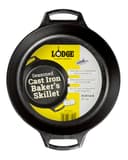
- A 10-inch round— skillet or baker’s skillet — gives you one browned bottom and one browned rim. Cut into eight wedges, the two center pieces have no crust on any vertical face at all.
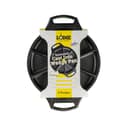
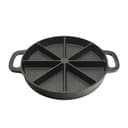
- A wedge pan molds those same eight portions individually, so each one browns on its bottom and both long sides. This is the biggest single jump in crust available, which is why the wedge pan takes the top pick.
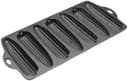
- A corn-stick pan goes further still: seven small ears with a ridged surface and a very high surface-area-to-volume ratio. Almost all crust. Also almost all dry by the next morning, which is the honest trade.
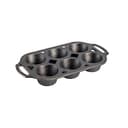
- A muffin pangoes the other way. Deep wells mean a tall, soft, steamy center and crust only around the outside — less crust than a wedge pan, more than a skillet, and the easiest of the lot to serve, freeze and reheat.
Pick the shape first. Every pan below is a competent piece of cast iron, so the brand argument matters far less here than it does on the skillet brands page.
2. Whether the maker will let it near a burner
This is the finding worth knowing before you buy, and it is stated plainly by Lodge and nobody else. Lodge’s wedge pan, cornstick pan, muffin pan and mini cake pan all carry the same line in their feature lists: “Oven safe, not recommended for stovetop use.”Lodge’s skillets carry the opposite line — compatible with any stovetop including induction, plus oven, grill and campfire. These molded pans are thinner, flatter castings than a skillet and Lodge is not willing to stand behind them over a concentrated burner.
That is why three entries below show Induction-safe: No in their spec tables. The iron is magnetic; the maker simply does not want the pan there. And it matters less than you would think for this particular job, because the classic cornbread technique preheats the pan in the oven, not on a burner — which is exactly how our cornbread recipe is written. If you are used to melting bacon fat on a burner before the batter goes in, that is the one habit you will have to move into the oven.
The Lodge Baker’s Skillet is the odd one out and we have reported it exactly as published: its page carries neither the bakeware warning nor a stovetop endorsement, so its induction row reads Not publishedrather than Yes or No. We are not going to resolve a maker’s silence into a permission.
3. Who publishes a spec, and who publishes nothing
Shaped cast iron bakeware is a category full of anonymous listings, and the gap in documentation is wider here than in any other product class on this site. Lodge publishes a dimension, a weight, a care routine, a country of manufacture and a warranty for every pan in its bakeware line. The Old Mountain corn-stick pan publishes a warranty and one sentence. The Stansport wedge pan publishes dimensions on the listing and has no maker’s page at all — searches on stansport.com for both “wedge pan” and “cast iron” returned nothing on the day we looked.
We have not treated that absence as disqualifying, because a $19 wedge pan that arrives seasoned and bakes cornbread is a reasonable thing to buy. We have treated it as a fact to state. Where a maker publishes nothing, the spec table below says Not published rather than filling the row with a plausible number.
4. Weight and overall length, because these pans live in the oven
Every published weight here lands between 2.9 and 4.92 pounds — light, for cast iron. A 10.25-inch Lodge Classic skillet is 5.66 pounds by Lodge’s own figure, so the Baker’s Skillet at 4.14 pounds is the rare cast iron pan that is genuinely easier to handle than the thing it replaces. If weight is the reason you avoid cast iron, this is one of the few corners of the category that does not ask much of you, and our lightweight skillet roundup covers the rest.
Length matters more. Lodge’s cornstick pan is 14.13 inches long and its wedge pan 11.69; the Baker’s Skillet is 12.81 inches handle to handle against roughly 17 for a long-handled 10.25-inch skillet. In a compact or apartment oven, that difference is the difference between turning the pan halfway through and not. Every pan on this page uses two loop handles rather than one long one, so plan on two mitts and two hands, always.
One weight figure we will not repeat: Amazon’s spec table lists the Lodge wedge pan at 1.55 pounds. That cannot be true of a cast iron casting nearly a foot across. Lodge publishes 4.86 pounds, and that is the number in the table below.
5. Seasoning, and what cornbread batter does to it
All six pans arrive pre-seasoned, which is not the same as arriving non-stick. Molded pans have far more internal corner than a skillet does — the point of a wedge well is a sharp angle — and corners are where factory seasoning is thinnest and where batter welds itself on. A new wedge or corn-stick pan will stick more on its first two or three bakes than any skillet you have used, and then stop.
The fix is not a special product. It is fat in the well before the batter goes in, a genuinely hot pan so the batter sets on contact rather than soaking in, and a few bakes to build the film. Our seasoning guide has the full method if you want to run a couple of rounds of oil through a new pan before its first cornbread, and the sticky cast iron guide covers the most common thing people do wrong afterwards.
The pans, one by one
Lodge 8-Well Wedge Pan — the best overall
If you are buying one cornbread pan, buy this shape. Eight molded wedges turn a single pone into eight portions that are crust on three faces, and they come out of the pan looking like the cornbread people picture rather than like a novelty. It is the only shaped pan here that still serves the way skillet cornbread serves — wedges, in the middle of the table — while roughly tripling the browned surface.
Lodge publishes the whole spec: 11.69 by 8.94 by 1.19 inches, 4.86 pounds, cast and seasoned in South Pittsburg, Tennessee, made without PFAS, covered by the Made Right warranty. The costs are the shape itself. Eight portions is eight portions, with no way to cut a bigger slice for someone who wants one, and nothing else in your kitchen bakes neatly in a wedge mold. And Lodge’s own instruction keeps it off the burner, so the pan and the fat both preheat in the oven.
Lodge 10.25-inch Baker’s Skillet — the best round pone
The pick for anyone who wants the traditional round cornbread and is not interested in molds. It is the familiar 10.25-inch circle, cut into wedges at the table, with two changes from a normal skillet that both help in an oven: it weighs 4.14 pounds instead of 5.66, and its two loop handles bring it to 12.81 inches overall instead of roughly 17. In a small oven that is the whole argument.
What you are giving up is the crust that the rest of this page exists for. A round pone browns on the bottom and around the rim, and the middle two wedges are soft on every vertical face. You also give up the long handle, which is more useful than it sounds for sliding a pan out far enough to pour batter into it safely. Lodge publishes no cooktop rating for this pan in either direction, and we have left that row honest rather than assuming.
Old Mountain 7-Impression Cornbread Pan — the best corn-stick pan
Corn sticks are the highest-crust cornbread there is: seven small ridged ears, each one almost entirely browned surface, made for dunking in chili and greens and bean soup. This is the in-stock way to get that shape. It is small, it is light at a listed 2.9 pounds, and it publishes a limited warranty against manufacturing defects — the only warranty on this page outside Lodge.
It publishes very little else. The listing carries exactly one feature bullet, no country of manufacture, no oven temperature and no cooktop rating, and we found no maker’s page to check any of it against. The buy box was held by a third-party seller rather than by Amazon on the day we looked, which is worth a glance before you order. And corn sticks stale fast: all that surface area that makes them good on the first evening makes them dry by the second.
Lodge 6-Well Muffin Pan — the best for corn muffins
The most useful pan here in a kitchen that does not bake cornbread every week. Six deep wells make corn muffins that portion, freeze and reheat better than any slab does, and the same pan handles blueberry muffins, popovers, Yorkshire puddings and baked egg cups the rest of the year. Lodge publishes 12.69 by 7.06 by 1.56 inches and 4.92 pounds, and it carries the same US manufacture and warranty as the wedge pan.
The deduction is the one the shape guarantees: a deep well has a lot of interior and comparatively little edge, so a corn muffin is softer and less crusty than a wedge. Six is also a small batch — a twelve-cup steel tin costs a fraction of this and does twice the work, and if that is your honest use case, buy the steel tin. Lodge’s bakeware warning applies here too: oven only.
Stansport 8-Wedge Pan — the best budget wedge pan
The sensible pick if you are not yet sure the wedge shape earns a place in your cupboard. It is the same eight-well idea as the Lodge in a slightly smaller casting — 10.75 by 8.6 inches against 11.69 by 8.94 — for appreciably less money, pre-seasoned, and sold and shipped by Amazon itself rather than by a marketplace seller.
What you give up is verification. Stansport’s own website has no page for this pan; searching it for both “wedge pan” and “cast iron” returned nothing. So there is no warranty, no stated country of manufacture, no oven rating and no maker’s spec sheet to check the listing’s numbers against. That absence is a finding rather than a complaint — for a first shaped pan that costs less than a bag of good cornmeal and a pound of butter, it may be exactly the right trade, and the Lodge is still there if you end up using it weekly.
Lodge 10.25-inch Classic Skillet — the best pan you may already own
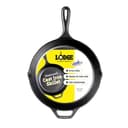
We would be selling you something you do not need if we left this off. The single most common cornbread pan in American kitchens is a plain 10.25-inch Lodge skillet, it is the pan our own recipe is written for, and it makes genuinely excellent cornbread. It is also rated for every heat source, so it is the one pan on this page you can preheat on a burner with bacon fat in it if that is how you were taught.
Its limits are the ones this page is about. One browned face per slice, a soft middle, and a 5.66-pound casting with a long handle that wants more oven than the molded pans do. If you already own one, make cornbread in it this weekend before you buy anything above — that is the cheapest way to find out whether more crust is a thing you actually want. The budget skillet roundup covers this pan in its day job, and the skillet size guide explains why a 10.25-inch pan bakes a roughly 9-inch pone.
The pan Lodge makes that you could not buy on Amazon
Lodge’s own 6-impression Cornstick Pan (part BW6CRN) is the best-known corn-stick pan in the country, and on September 24, 2026 it returned “Currently unavailable” on Amazon while sitting in stock on Lodge’s own store at $24.90. We have not featured it above, because this site does not rank pans you cannot buy through the merchant we can actually send you to.
It is worth knowing about anyway. Lodge publishes 14.13 by 6.0 by 1.13 inches and 4.37 pounds for it, with the same seasoning, the same PFAS- free manufacture, the same Made Right warranty and the same oven-only instruction as the wedge pan. If you want corn sticks from a maker with a published spec sheet and a warranty, it is available direct from Lodge — we earn nothing from telling you that, which is rather the point. If you want them today, from Amazon, the Old Mountain pan above is the one in stock.
Two other pans were dropped at verification and are named here rather than quietly omitted. A budget 7-corncob pan sold under the Classic Cuisine name is in stock and cheap, but its listing claims use on the stovetop, induction, a grill and a campfire — claims no maker with a spec sheet makes for a thin molded casting — and it publishes no weight, no origin and no warranty. And a house-brand wedge pan advertises a “nonstick coating” on cast iron while also telling you to season it, which are two different products described in one bullet list.
Do you need a cornbread pan at all?
For a lot of people, no, and it is worth saying so on a page that makes money when you buy one. If you own a 10 or 12-inch cast iron skillet and you make cornbread a few times a winter, that skillet is already the answer and a shaped pan is a preference rather than a capability.
A dedicated pan earns its shelf in three situations. You genuinely prefer crust to crumb, in which case a wedge or corn-stick pan is a real and permanent improvement that no technique in a skillet will match. You want portions that serve themselves — for a crowd, a potluck, a freezer. Or you want the corn-stick shape specifically, which is a regional tradition and not something a skillet can fake. If none of those is you, keep the money and spend the afternoon on your seasoning instead.
Getting a clean release every time
Molded pans stick more than skillets for a simple geometric reason: more corners, more contact, less room to get a spatula in. Three things do almost all the work.
Preheat the pan empty.Put it in as the oven comes up to 400 to 425°F and give it ten minutes at temperature. Batter poured into a merely warm mold soaks into the surface before it sets, and that is what welds. Batter that hisses on contact releases.
Fat in every well, not a wipe over the top. Bacon drippings, butter or a neutral oil, brushed into the corners of each well while the pan is hot. On a corn-stick pan in particular, the ridges are the whole point and they are also where a dry spot will grab.
Turn them out while warm.Give the pan five minutes out of the oven, then invert it over a board. Cornbread left to cool all the way in an iron mold sweats, softens and sticks — the opposite of what you bought the pan for. Afterwards treat it like any bare cast iron: scrape while warm, hot water and a brush, dry it fully, wipe on a thin film of oil. Our cleaning guide has the full routine, and a stiff brush beats any scrubber for getting into the corners of a mold.