How we chose these egg pans
Three criteria, in this order. They are deliberately not the criteria a steak pan is judged on — mass and heat retention, the two things that make cast iron famous, are actively unhelpful here.
1. How smooth the cooking surface is
An egg white is liquid protein. It flows into whatever texture the iron has and then sets there, which is why a pan with visible casting grain holds an egg more firmly than a pan without. Two makers on this page address that directly and publish how: Stargazer states that its cooking surface is machined smooth after casting, and Field mills its pans to the same end. Lodge does not machine its classic pans, which is a real part of why they cost a fraction as much.
Lodge’s answer is seasoning rather than machining. Its Blacklockline is triple seasoned at the factory with 100% natural vegetable oil, and the Chef Collection’s selling point is the wall shape rather than the floor. In practice a well-seasoned sand-cast Lodge cooks eggs perfectly well — the seasoning fills the texture over time. A machined pan just starts closer to that state. Our seasoning guide is the cheaper route to the same place.
2. Size, because the pan should match the eggs
This is the criterion people get wrong most often. Two eggs in a 12-inch pan spread into a thin sheet, cook through before the white sets properly at the edge, and leave three quarters of the pan heating empty air — which is where the smoke comes from. Two eggs want roughly six to eight inches of floor.
Lodge publishes a per-size spec table that makes the trade-off concrete: 1.94 lb at 6.5 inches, 3.44 lb at 8, 5.66 lb at 10.25 and 7.69 lb at 12. Field publishes 7 inches of cooking area on its 8 3/8-inch No. 6 and 8 3/4 inches on the 10 1/4-inch No. 8 — a reminder that the number on the box is the rim, not the floor. Our skillet size guide has the full arithmetic, and the small skillet roundup ranks the little pans on their own terms.
3. Weight you can lift one-handed, mid-cook
Cooking an egg well involves moving the pan: tilting butter into a corner, rocking to spread a scramble, sliding an omelette onto a plate. You do that one-handed, with the other hand holding a spatula, while the food is actively cooking. A pan you need two hands for cannot be cooked with that way.
Every pick on this page is under five pounds by the maker’s own figure, and four of the six are under 3.5. Lodge’s Blacklock 10.25-inch is the heaviest at 4.61 lb — the same weight as the Chef Collection 10-inch, and a pound lighter than the classic 10.25-inch at 5.66. If weight is the thing standing between you and using cast iron at breakfast, the lightweight roundup ranks the whole range on published weight alone.
The picks in context
Lodge Chef Collection 8-inch — the best overall
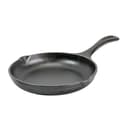
The wall shape is why this wins. Lodge describes the Chef Collection as having spatula-friendly sloped sidewalls, an ergonomic handle and two pour spouts, and publishes 3.17 lb for the 8-inch. A sloped wall is the difference between lifting an egg out and scraping it out; the pour spouts matter more than they sound, because brown butter and bacon fat both end up being poured.
What you give up: it is sand-cast like the classic line, so the floor is not machined, and Lodge publishes no oven temperature ceiling for bare iron, which is fine in practice but means the pan’s limits are not documented. At 8 inches it will cook three eggs and not four.
Field Company No. 6 — the best cooking surface
The pan for people who want the problem engineered away. Field publishes 3 pounds and 7 inches of cooking area on an 8 3/8-inch pan — lighter than Lodge’s 8-inch classic despite being slightly wider — with a milled surface, a lifetime warranty, and a FAQ that recommends preheating at low to medium heat for up to five minutes, which is the gentle start eggs want anyway.
The honest case against it is price: it costs several times the Lodge, and it cooks eggs better by a margin most people would call small once their Lodge is properly seasoned. Field also says never put it in the dishwasher. Our Field Company review covers the line, and Field against Stargazer compares the two machined-smooth makers directly.
Lodge classic 8-inch — the best budget
The pan most people should actually buy, and the reason this page exists at a sensible price. Lodge publishes 3.44 lb for the 8-inch classic, made in the USA, seasoned with 100% natural vegetable oil, and rated for any stovetop including induction plus the oven, a grill or a campfire. It costs less than a takeaway breakfast.
The trade is the surface. Out of the box the floor has casting texture, and eggs will stick on it more than they will on a milled pan until the seasoning builds. That takes weeks of normal cooking, not a project — but it is real, and the first few breakfasts are worse than they will be. Start with bacon, not eggs.
Lodge 6.5-inch — the best for one or two eggs
At 1.94 lb published, this is the lightest pan on the page by a wide margin and the only one you can hold out at arm’s length to slide an egg onto toast. For a single fried egg, a two-egg omelette or a one-person scramble it is the correct size, and it comes up to temperature in a couple of minutes rather than ten.
It is also genuinely limited. One egg, maybe two. No room to move food around, and nothing else fits alongside — no bacon, no toast, no mushrooms. It is a second pan rather than a first one, which is worth saying before you buy it as your only skillet.
Lodge Blacklock 10.25-inch — the best full-size pan
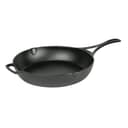
If you want eggs out of the same pan that does everything else, this is the one. Lodge publishes 4.61 lb at 10.25 inches — a pound lighter than the classic at the same size — with triple seasoning and an extended raised handle Lodge says stays cooler longer. That handle is the detail: it is the pan you can pick up mid-cook without reaching for a towel.
Thin walls are the trade. A lighter casting holds less heat, so it dips further when cold food lands in it, which matters for steak and does not matter for eggs. It also costs noticeably more than the classic. The Blacklock versus Classic comparison lays out the whole decision on Lodge’s own numbers.
Victoria 8-inch — the best handle
Victoria is a family-owned Colombian foundry, making cast iron in Medellín since 1939, and the thing it does differently is the handle: longer than a Lodge’s, which keeps your hand further from the heat and makes a one-handed tilt easier. Its pans are naturally seasoned with flaxseed oil.
A long handle on a small pan is a real ergonomic win and a real storage annoyance — it will not nest neatly, and it sticks out of a drawer. Victoria publishes less specification detail than Lodge does, so several figures on our card for it stay “Not published” rather than being filled in from somewhere else.
What we left off, and why
Every enameled skillet. Enamel is glass, it is smooth, and people reasonably assume it must be good for eggs. It is not: a glazed surface cannot build seasoning, so it never gets more egg-friendly than the day you bought it, where a bare pan improves every month. Lodge also says metal utensils are not recommended on its enameled skillet, which rules out the thin metal spatula this job wants. Our enameled skillet roundup explains what enamel is actually for.
Pans of 12 inches and up. Lodge publishes 7.69 lb at 12 inches and 10.5 lb at 13.25. Both are excellent pans and both are the wrong shape for two eggs. If you own one already, use the small burner and accept that the eggs will spread.
“Non-stick cast iron.” Several house-brand pans advertise a nonstick coating on cast iron while also telling you to season them, which are two incompatible claims. We do not rank cookware whose own listing contradicts itself, and none of these publishes a spec sheet to check a claim against.
Technique does more than the pan
Worth saying on a page that earns a commission. A properly seasoned budget Lodge, preheated gently and given enough fat, cooks eggs nobody could distinguish from eggs out of a pan ten times the price. The makers agree on the preheat: Stargazer says low for 5 to 10 minutes before turning the heat up, Field says low to medium for up to 5 minutes. Eggs want the bottom of that range — medium-low, butter melted and foaming but not browning.
The other half is fat and patience. Use more butter or oil than feels necessary, let it get hot before the egg goes in, and leave the egg alone until the white has set. An egg that is stuck at 20 seconds will often release on its own at 90. Our preheating guide has the timings, and why cast iron goes sticky covers the seasoning fault that makes everything stick, eggs first.