Should you buy an enameled skillet at all?
Honestly, a lot of people should not, and it is worth settling that before comparing brands. For the jobs a skillet does most — searing a steak, frying eggs, cornbread, a pan of roasted vegetables — a bare $25 Lodge does the same work with no practical oven ceiling, goes on a grill or a campfire, shrugs off metal utensils and drops, and costs less than any pan on this page. If you already own a seasoned skillet and it is not giving you trouble, enamel buys you very little.
The cases where an enameled skillet genuinely earns its place are narrower and clearer. You cook a lot of acidic food in a pan — tomato-based sauces, wine reductions, anything finished with citrus — and you are tired of nursing seasoning through it. You will not keep up a dry-and-oil routine and you know it. You want a pan that can be scrubbed with soap and, in one case here, run through the dishwasher. Or you want the color on the stove, which is a perfectly good reason as long as you call it that. If one of those is you, read on. If none is, put the money into a better bare skillet and a enameled potfor the acidic braises instead — that pairing covers more ground than an enameled skillet does.
How we chose these enameled skillets
Enamel changes which specifications matter. Seasoning and surface texture drop out entirely. Three things that barely register on a bare pan — the interior finish, the oven rating and the care rules — become the whole decision. Here is the order we weighed them in.
1. Black matte interior, not light sand
Enameled Dutch ovens mostly come with a pale, sand-colored interior, because in a pot you want to see the fond building under a braise. A skillet is a different tool. It gets hotter, drier and more abused, and a pale enamel interior in a skillet stains fast and shows every scorch mark. Every maker on this page that states an interior finish states a dark one: Lodge calls it matte black porcelain, Le Creuset calls it black satin enamel that develops a patina, Staub calls it a textured black matte enamel, and Tramontina calls it matte black porcelain-enamel. That is not a coincidence; the dark, slightly textured interior is the closest an enameled surface gets to the release and browning of seasoned iron.
The two budget pans state only “porcelain enamel interior” with no color, and we have not guessed one. The practical consequence of a dark interior is that you judge browning by sound, smell and time rather than by eye — a fair trade in a skillet, where you can lift a corner and look.
2. The oven rating, and whether anyone states it
Bare cast iron has no meaningful oven limit. Enamel does, because the glass coating and the pan are two different materials expanding at two different rates, and a maker’s stated ceiling is the temperature it is willing to warrant. Four of the six pans here state 500°F: Lodge, Le Creuset, Staub and Crock-Pot. Tramontina states 450°F for its lidded skillet, the lowest here and low enough to rule out a hot pizza finish or a broiler. Cuisinart states no temperature at all on its listing, which we record as a finding rather than fill in from another product.
One number matters more than the pan’s: Le Creuset and Staub both rate their pans to 500°F and Lodge does the same, but if a pan comes with a lid, the knob is usually the real ceiling. Tramontina’s lid has a cast stainless steel knob, which is why 450°F applies to the set. If you bake a skillet cookie at 350°F this never matters. If you sear at 500°F and finish under the broiler, it decides the purchase.
3. Published weight, and the disagreements
Enamel adds a little weight to the iron, and enameled skillets are often sold with a helper handle rather than a long one, which changes how the weight carries. So the published number matters — and in this category it is unusually unreliable. Lodge says its 11-inch pan is 5.65 pounds; Amazon’s spec table for the same pan says 7.67. Le Creuset’s dealer sheet says 6 pounds 14 ounces for the 11.75-inch, and Amazon says 6.8, which at least agrees. Staub publishes no weight at all. Amazon’s listing for the Cuisinart says one pound, which is impossible for a 10-inch cast iron pan.
Where a maker and a retailer disagree we give you both and tell you which to plan for. Where a figure is plainly a listing error we say so and treat the weight as unpublished. What we never do is average two sources into a number nobody published.
4. The care rules, because they differ more than you would think
“Enameled means easy” is only partly true. The makers here split three ways. Le Creuset’s dealer sheet rates the Signature skillet for the dishwasher andfor metal utensils. Staub says dishwasher safe with hand washing recommended. Lodge says hand wash and no metal utensils, and Tramontina says hand-wash only. The Cuisinart listing says dishwasher safe; the Crock-Pot listing says nothing. Since “no seasoning” is the main reason to buy enamel, how much other care the maker then asks of you is a real differentiator, and it tracks the price closely.
5. Where it is made, when anyone will say
Country of manufacture is unevenly disclosed and worth knowing. Le Creuset and Staub state France. Lodge states, to its credit and in plain words on the listing, that its Essential Enamel line is made in China to Lodge specifications while all other Lodge cast iron is made in the USA. Tramontina’s own page says made in China. The Cuisinart and Crock-Pot listings state nothing, and the spec table reads Not published for both.
6. Actually in stock, from a seller we can name
Every pan here was verified live on the day this page was written as a buyable, in-stock listing whose title matched the brand and model we describe. Five of the six were sold by Amazon itself; the Staub was in stock but its buy box belonged to a third-party retailer, which we say on the card rather than hide. Several pans we wanted to include failed this test — they are listed under what we left off below.
The pans, one by one
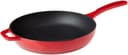
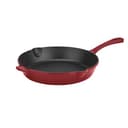
Lodge Essential Enamel 11-inch — the best overall
The straightforward answer for most people, and the pan that gives you the most of what enamel is for at the least cost. The interior is matte black porcelain, so it browns and releases much like seasoned iron without any of the routine; Lodge rates it to 500°F, safe on every stovetop including induction, and covers it with the same Made Right warranty as its bare pans. Lodge also publishes the full spec on its own page — 16.95 inches long including the handles, 11.0 wide, 1.75 high and 5.65 pounds — which is more than any other maker at this price manages.
Three honest caveats, all from Lodge rather than from us. This is not the Tennessee-made iron the brand is famous for: the listing says in so many words that the enamel line is made in China to Lodge specifications. The care rules are stricter than the “no seasoning” headline suggests — hand wash, no metal utensils, and “not made for use on a grill or over a fire.” And the weight is disputed: Lodge says 5.65 pounds while Amazon’s spec table says 7.67. Plan for the heavier figure and be pleasantly surprised. None of that changes what it does on a stove, which is everything an enameled skillet needs to do at roughly a quarter of what the French pans cost.
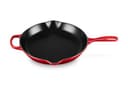
Le Creuset Signature 11.75-inch — the best premium pan
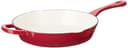
The enameled skillet with the fewest rules, and the one to buy if what you want from enamel is to stop thinking about the pan. The authorized-dealer spec sheet — cited because Le Creuset’s own site refused our fetch — rates it for the dishwasher and for metal utensils, on top of the black satin interior that develops a patina, a 500°F oven rating, induction, a lifetime warranty and French manufacture. It is also the only pan here with a published base diameter, 9.62 inches, which is the largest flat cooking floor on the page, and at 6 pounds 14 ounces it is light for its size.
The costs are the familiar Le Creuset costs. It is several times the price of the Lodge for a pan that browns no better, because an enameled skillet’s cooking physics does not change with the name on the handle. It is only 1.75 inches deep and comes without a lid, which makes it a searing and sautéing pan rather than a braising pan — if you want to finish a dish under cover, look at the Tramontina below or a proper braiser. And like every enameled pan it is capped at 500°F and will chip if dropped or shocked cold. What you are buying is the care regime and the warranty, and for a pan that will live on the stove for decades that is a defensible thing to buy.
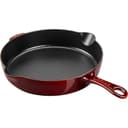
Staub 11-inch Traditional Deep Skillet — the best for browning
If the skillet exists to sear, this is the one. Staub’s interior is a textured black matte enamel that the maker says is there for browning, and the sides are taller than on any other open pan here, which is why Staub calls it a deep skillet: it will take a shallow braise or a pan sauce without slopping. Side pouring spouts, a smooth enamel bottom for every stovetop including induction, 500°F in the oven, dishwasher safe with hand washing recommended, made in France, and a limited lifetime warranty are all on Staub’s own page.
Three things to weigh. Staub publishes no weight, base diameter or height, so the only weight anywhere is Amazon’s 6-pound figure and the spec table says Not publishedwhere the maker is silent. The black textured interior that makes it a good searing pan also hides the fond, so browning is judged by smell, sound and time rather than by eye. And on the day we checked, the Grenadine listing’s buy box belonged to a third-party retailer rather than Amazon itself, while the graphite version was in stock at the same price — check who is selling before you click, because a French pan at this price deserves a seller you can return it to.
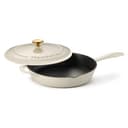
Tramontina Bestow 12-inch with lid — the best with a lid
The only pan here that ships with a cast iron lid, and that single fact makes it a different kind of purchase. Under the lid are self-basting condensation ridges that drip moisture back onto the food, so a 12-inch skillet becomes a shallow braiser for chicken thighs, a pan of beans or a covered finish for a thick chop. Add the helper handle, the pouring lips and a matte black porcelain-enamel interior, all on Tramontina’s own page, and it is the most versatile pan on this list for a mid-range price. It was in stock, sold by Amazon itself, in several colors when we checked.
The trade-offs are real. Tramontina rates it to 450°F, the lowest oven ceiling on this page and a hard limit for anyone who sears hot and finishes under the broiler. Tramontina says hand-wash only. Amazon’s spec table gives 15.26 pounds for pan and lid together, and Tramontina publishes no weight or dimensions at all, so you cannot check that figure against the maker. It is made in China, and Tramontina’s own site showed the Cobalt version sold out when we visited — the Latte, Sunrise and Cactus colors were the ones in stock on Amazon. If the lid is the point, none of that is a deal-breaker; if you would never use the lid, the Lodge is the better open pan for less.
Cuisinart Chef’s Classic 10-inch — the best budget 10-inch
The cheapest route into a 10-inch enameled skillet from a brand with a real warranty. The listing states a porcelain enamel interior that does not affect flavors or absorb odors, wide cast iron handles, dishwasher-safe cleanup and Cuisinart’s limited lifetime warranty, and it was in stock and sold by Amazon itself when we checked. Ten inches is the right size for two people, and at this price it is a sensible way to find out whether an enameled skillet earns a place in your kitchen before spending more.
You are buying on less information than with any other pan here, and we would rather say so than pad the card. The listing publishes no oven-safe temperature, so the ceiling is unknown. Its stated weight of one pound is plainly a listing error, so weight is treated as unpublished. It states no country of manufacture. One feature bullet mentions an “oven safe knob,” which an open fry pan does not have — read the spec table, not the marketing copy. And Cuisinart’s own product page answered every fetch we tried with a bot-protection challenge, so nothing here comes from the maker. If you need a published oven rating, spend the little extra on the Lodge.
Crock-Pot Artisan 12-inch — the best budget 12-inch
The least expensive 12-inch enameled skillet we could verify in stock, and the listing states more than most budget pans do: oven-safe to 500°F, use on gas, electric, ceramic and induction cooktops, and a weight of 8.5 pounds. It was sold by Amazon itself when we checked. For a big pan to fry a family breakfast in, or to see whether you like cooking on enamel at all, that is a lot of skillet for the money.
Know what you are buying. Crock-Pot here is a licensed name; the manufacturer on the listing is Gibson, and Gibson Homewares’ own Crock-Pot enameled cast iron page listed Dutch ovens, a braiser and an everyday pan but not this skillet on the day we visited, which makes its future uncertain. The listing publishes no warranty and no country of manufacture. And its dimensions field reads 20 by 13 by 16.5 inches, which describes a carton rather than a skillet, so we have not repeated any dimension from it. It is a pan to buy on price, and the price is honest.
Enameled skillet or enameled braiser?
These two overlap more than the names suggest, and if you are shopping for the Tramontina you are already in the middle of the overlap. A braiser is a wide, shallow enameled pot with a lid and two loop handles, usually 3.5 to 5 quarts; an enameled skillet is an open pan with a long handle and, sometimes, a helper handle. The braiser wins for anything that starts with a sear and finishes under a lid with liquid. The skillet wins for anything you flip, toss or pour from, and for oven finishes where a long handle is easier to grab.
If you own neither and cook a lot of covered dishes, our braiser roundup is probably the better page, and the Dutch oven vs braiser comparison works through the shapes. If you own a Dutch oven already, the open skillet is the more useful addition.
Living with an enameled skillet
The routine is easier than bare iron and less forgiving in two specific ways. First, heat. Enamel does not like being preheated empty on high, and it does not like going from a hot burner into cold water; both stress the glass against the iron and are how chips and crazing start. Preheat on medium with a little fat in the pan, and let it cool before washing. Second, utensils. Only the Le Creuset here is rated for metal; assume wood or silicone on the rest unless the maker says otherwise.
Cleaning is soap and water, always. The dark interiors on these pans build a patina of their own that looks a little like seasoning and is nothing to scrub off. For stains and stuck-on food, our guide to cleaning enameled cast iron has the gentle methods, and if you want the material explained from the beginning, what enameled cast iron actually is is the place to start. One thing you never do is season it. If the enamel is intact there is nothing for oil to bond to, and if it is chipped through to bare iron, the pan has a problem seasoning will not fix.
What we left off, and why
A few pans that turn up on every enameled-skillet search are not here, and it is fairer to say why than to pretend they do not exist. The Hamilton Beach 12-inch is a licensed name sold through a third-party importer, states a 400°F ceiling — the lowest we saw — and has no maker’s page to check a single claim against. Le Creuset’s 10.25-inch Signature skillet is a fine pan, but most of its color variants showed low stock on the day we checked and the 11.75-inch was the size sold by Amazon itself in quantity. Staub’s 12-inch fry pan showed one unit left. A wave of house-brand 10-inch pans priced under the Cuisinart — Tastedeli, Firequince, Maldira and others — had no maker’s site, no warranty and no published temperature, and one budget pan with that profile is enough. Tramontina’s 10-inch lidded skillet is a good pan, but it is the same design as the 12-inch above and a second Tramontina would have added nothing. And Lodge’s USA Enamel line — the one enameled cast iron Lodge makes in Tennessee — deserves a mention because readers ask: on the day we checked, that collection held a 4.5-quart Dutch oven and an 11-inch grill pan, not an open skillet, and it is sold direct rather than on Amazon, so there was nothing to rank. If stock on any of these normalizes, or Lodge adds a US-made enameled skillet, we will revisit.