How we chose these brands
Cast iron marketing leans hard on words that sound like performance — “superior heat retention,” “even cooking,” “restaurant quality” — and are really just properties of iron itself. Every pan on this page has them. So we ignored the copy and ranked on the handful of things that actually change from one brand to the next.
1. They mostly cook the same — so weight is the first real difference
A thicker, heavier casting holds more heat, which helps a long, hard sear and steadies a pan against a cold steak. A thinner, lighter casting is easier to lift one-handed, easier to flip an omelet in, and far less punishing to store overhead. This is a genuine trade-off, not a quality gap. A standard Lodge is heavy; that mass is a feature when you are searing and a nuisance when you are washing it. The lighter brands — Field, Lodge’s own Blacklock line, and to a degree Stargazer — pour a thinner wall to cut that weight, and you feel it the moment you pick one up.
2. Surface: as-cast texture versus a machined-smooth finish
Budget pans (Lodge, Victoria) leave the cooking surface with the slightly pebbled texture it has straight out of the sand mold. Premium American makers (Stargazer, Field, Finex) machine or polish that surface smooth, so food releases more readily from day one. It matters most for eggs and delicate fish. But an as-cast pan is not stuck rough forever — every layer of seasoning you build fills the texture in, and a well-used Lodge slicks up until the practical difference shrinks to almost nothing. You are paying to have that head start on day one instead of earning it over a year of cooking.
3. Handles — the part your hand actually notices
A classic Lodge has a short, straight handle that runs hot and gives you little leverage on a full pan. Longer, angled handles (Victoria’s, Stargazer’s) balance a loaded skillet better and stay cooler further from the food; Finex goes furthest with a stainless-and-brass coil that genuinely stays touchable longer than solid iron. A helper handle on the far side turns a heavy pan from a wrestle into a two-handed lift. None of this changes how the pan cooks — it changes whether you reach for it.
4. Where it’s made — and whether that matters to you
Lodge, Stargazer, Field, Finex and Smithey are all made in the USA; Victoria casts in Colombia; the cheapest imports don’t always say. Country of origin is not a cooking spec — a well-made Colombian Victoria outcooks a badly stored anything — but if buying American matters to you, it narrows the field, and it is one of the things the boutique price is partly buying. A sixth American name worth knowing if weight is your priority is Lancaster, which casts thinner than almost anyone.
5. Price, said plainly
A classic Lodge is the budget benchmark the whole category is measured against. Victoria costs a little more for a better handle. Lodge’s Blacklock is roughly double a standard Lodge for a lighter, smoother pan under the same easygoing care. The American boutiques — Stargazer, Field, Finex — run several times a Lodge, and Finex can approach French enameled money for a bare skillet. Every one of those steps up buys weight, finish, handle or looks. Not one of them buys a better sear.
The brands, one by one
Lodge — the one to buy first
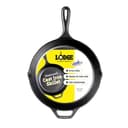
Lodge is the default, and deservedly so. It is American-made, pre-seasoned, cheap enough to buy in several sizes without agonizing, and effectively indestructible — stovetop to a hot oven to a campfire. Its two honest drawbacks are the ones every budget cast iron shares: it is heavy, so one-handed flipping is a workout, and the as-cast surface is pebbled rather than glassy, so it needs a few months of cooking to slick up. Neither is a reason to spend more before you have lived with one. If you buy a single pan off this page, make it the classic Lodge in a ten-inch size — it roasts a chicken, bakes cornbread and sears two steaks, and it costs about what the boutiques charge for shipping.
Stargazer — the smooth surface, done right
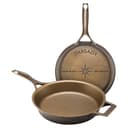
Stargazer is the pick when you want a machined-smooth cooking surface and a handle that was clearly designed by someone who has carried a hot pan. It is made in the USA, cast a touch lighter and cleaner than a Lodge, with a long, angled handle that stays cooler and no pour-spout gaps to interrupt the rim. What you are paying for is finish and feel: it is several times the price of a Lodge that, a year in, cooks the same. The standard model also skips a helper handle, which you notice on a big, full pan. Worth it if a smooth surface and a good handle are what you actually care about; skippable if you just want to cook.
Field Company — lightweight, vintage-smooth
Field pours a thin, light casting and polishes the surface satin-smooth, chasing the feel of pre-war Griswold and Wagner pans rather than modern Lodge. The result is genuinely lighter and slicker than mass-market iron, and the small No. 6 — the one we point to here — is a lovely egg-and-one-serving pan. The catch is exactly that: it is a premium price for a small skillet, and an eight-inch pan is too little to be your only one. Buy Field because you want the lightest, smoothest bare-iron feel available and will happily own it alongside a bigger pan, not as a do-everything skillet.
Finex — the heirloom object
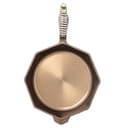
Finex is the most distinctive pan in cast iron: a patented octagon with a pour spout at every corner, a machined-and-polished cooking surface, and a springy stainless-and-brass handle that stays cool far longer than solid iron. It is now a Lodge-owned American brand, and it is genuinely beautiful. It is also the clearest illustration of this page’s whole point — it costs roughly ten times a classic Lodge and does not sear or bake one bit better. The brass-topped handle is heavy, the full pan is a two-hands lift, and small-batch production means availability comes and goes. Buy Finex if you want an object to keep for life and will pay for design; do not buy it expecting better food.
Lodge Blacklock — the lighter Lodge
If the one thing stopping you from loving cast iron is the weight, Lodge’s Blacklock line is the most sensible answer on this page. It is cast thinner than the standard Lodge to drop real weight, triple-seasoned at the factory so it starts smoother and more release-ready, and still American-made under the same easygoing care. It splits the difference between the cheapest Lodge and a boutique pan: roughly double a classic Lodge, but a fraction of Stargazer or Finex. The trade-offs are small and honest — you pay about twice the classic price, and the thinner walls hold a little less heat for a long, hard sear. For most people who find a normal Lodge too heavy, this beats jumping straight to the boutiques.
Victoria — the best budget handle
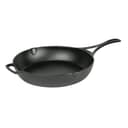
Victoria is the value brand with the grown-up handle. It is cast in Colombia, pre-seasoned with flaxseed oil, and its standout feature is a longer, angled handle that balances a full pan far better than a same-size Lodge’s stubby grip — for only a little more money. The surface is as-cast and textured like any budget pan, and the long handle means it won’t tuck into a small oven as neatly as a loop-handled pan. But if you want the most comfortable skillet just above the cheapest tier, and you don’t care whether your pan is American-made, Victoria is the smart budget upgrade.
Smithey — the polished heirloom you can’t buy here
Smithey belongs in any brand conversation: hand-poured in Charleston and polished to a mirror-smooth interior, it is one of the most beautiful production cast iron pans made, and it sits right alongside Finex and Field at the top of the market. We can’t make it a ranked pick on this page for one simple reason — Smithey sells largely direct and isn’t reliably stocked on Amazon, so there is often no live, buyable listing to link. That is a purchasing quirk, not a knock on the pan. If a polished-smooth heirloom is what you’re after, read our full Smithey review and the head-to-head in Lodge vs Smithey— the short version is that it is superb, priced like it, and buys you exactly the finish-and-feel premium this whole page is about.
So which brand should you buy?
For almost everyone, in this order: buy a classic Lodgefirst and cook on it hard for a year. If the weight is the only thing you dislike, step up to Blacklock, or at the budget end take Victoria for its better handle. If a machined-smooth surface and a comfortable handle genuinely matter to you — and you have the budget — Stargazer is the best all-round boutique buy, with Field the pick for a light little pan and Finex or Smithey for an heirloom you want to display as much as use. What you should not do is start at the top. The expensive brands are a reward for knowing you love cast iron, not a shortcut to cooking better with it.
Who should skip the boutique brands entirely
If you are buying your first cast iron pan, skip them. Spend the least you comfortably can, learn how the pan behaves, and let it build its own seasoning — a broken-in budget pan releases food better than a brand-new boutique one. Skip them, too, if you already own a Lodge that is doing everything you ask; a second pan in a different size (see the full skillet roundup) will change your cooking more than the same size in a fancier brand. The boutiques are worth it when a specific, known frustration — too heavy, too rough, handle too hot — is what’s stopping you, and you would rather pay to fix it than cook your way past it. Browse every brand we’ve written up in our brand reviews before you spend.