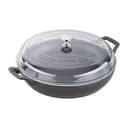
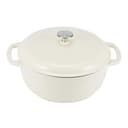
How we picked: five criteria, in this order
These are deliberately not the criteria we use on the braiser roundup, because a braiser is judged on searing and simmering on a hob and a casserole dish is judged on getting from the oven to the table.
1. Can you carry it full? Two loop handles sized for oven mitts, not one long stovetop handle. This is the criterion people discover too late: a dish you cannot lift safely out of a hot oven with gloves on is a dish you stop using.
2. A published oven ceiling — including the knob.Baked dishes live between 325°F and 425°F, and a broiler finish goes much higher. Lodge publishes 500°F for the pots in this line that state one and Staub publishes 500°F with the lid; Tramontina publishes no oven temperature at all. Check the knob separately, because a plated or plastic knob is sometimes rated well below the body of the dish.
3. Floor area over depth. A casserole wants width, not height. Width means the top browns, the edges catch, and a portion comes out in one piece. Depth means a hot column that is still cold in the middle when the top is done.
4. An interior you can read. A light enamel interior shows you how far the base has browned. A dark matte interior is built for searing and hides it. For a dish that mostly bakes, light wins; for one that sears first, dark has a real argument.
5. Published weight, treated as a cost.Unlike a pot that lives on the hob, a casserole dish gets carried twice per meal. Every figure above is the maker’s or the listing’s, never ours, and where two sources disagree we print both.
When ceramic is the better buy
Most of what Americans call a casserole — a baked pasta, a gratin, a scalloped-potato dish, a breakfast bake — never touches a stovetop. For those, a ceramic or glass dish is lighter, cheaper, dishwasher-friendly and completely adequate: the oven is doing all the work and the dish is just holding the food. Cast iron is worth the weight and the money in two situations.
You want to brown first.Sausage, onions, a flour-dusted piece of meat — doing that in the same vessel you bake in saves a pan and keeps every bit of fond in the dish. No ceramic dish will take a hob burner.
You want the food hot at the table. Iron holds heat for a long time after it leaves the oven, which is why a cast iron dish is still steaming when a ceramic one has gone lukewarm. That is a serving advantage, not a cooking one, and whether it is worth fifteen pounds of weight is a fair question to answer honestly before you buy.
Enameled, not bare — and this one is not a close call
Casseroles are the exact food bare cast iron handles worst: tomato, wine, dairy and long cooking times. Enamel means no reaction, no seasoning routine, soap is fine, and the dish can go into the fridge with the leftovers still in it, which Lodge rates its enameled interiors for and does not rate bare iron for. Every pick above is enameled for that reason. If you are weighing the materials generally, enameled vs bare cast iron has the whole argument, and is enameled cast iron safe covers the lead-and-cadmium question that comes up most.
Size: how much dish do you actually need?
Roughly three quarts for two people, four quarts for a family of four, and seven quarts only if you regularly cook for six or more. The failure mode runs in the direction people do not expect: a dish that is too large spreads the food thin, so the edges scorch and dry before the middle is set. Our Dutch oven size guide works through the published interior figures, and the small pots page covers the under-five-quart end in more detail.
Care, in the makers’ own words
All four brands here say hand wash, and only Staub volunteers that its enamel is dishwasher safe before recommending you wash it by hand anyway. Lodge adds no metal utensils and no grill or open fire for its enameled line. Staub’s care page is the most specific document in the category: silicone or wooden utensils where possible, no knives inside the vessel, and specifically no striking metal against the rim, because impact rather than wear is what chips enamel. It also notes that dull, cloudy or rainbow-colored enamel is mineral or detergent residue and does not indicate damage — which saves a lot of people an unnecessary return. If a dish does chip, our chipped enamel guide covers what that means and when to stop using it, and how to clean enameled cast iron covers the staining.
Where this page sits
If you want the shape ranked as a stovetop pan rather than a baking dish, read the braiser roundup. If you want the deep lidded pot, read the Dutch oven roundup. And if you are not sure which object you are shopping for at all, best cast iron pots lays out the five shapes with one pick each.