How we chose, and what “made in USA” has to mean
1. The maker has to say it, on a page we can cite
Every pan on this list has US manufacture published by the maker on its own product page or FAQ — not inferred from a flag graphic on a listing, and not taken from a retailer’s marketing copy. Lodge states it for its Classic, Blacklock and Chef Collection lines. Stargazer, Field and Finex all state it for their skillets. That is the whole bar, and it is a bar a surprising amount of “American heritage” cookware does not clear.
Where a maker is silent, we say so rather than guessing. Victoria casts in Colombia and says so, which is why its otherwise excellent long-handled pans are not on this page — they are on the budget roundup instead, where price is what is being ranked. Several of the cheapest pans on Amazon publish no country at all, and an unstated origin is not an American one.
2. Published weight, because weight decides whether a pan gets used
Lodge publishes a full per-size ladder for the classic line: 1.94 lb at 6.5 inches, 3.44 at 8, 5.66 at 10.25, 7.69 at 12, 10.5 at 13.25 and 12.3 at 15 inches. That table is the most useful thing any maker in this category publishes, because it tells you where a pan stops being a pan you reach for and starts being one you have to plan around.
The lighter American options are documented too. Lodge publishes 4.61 lb for the 10.25-inch Blacklock against 5.66 for the classic, and 17.38 inches of overall length. Its Chef Collection publishes 4.61 lb at 10 inches with sloped, spatula-friendly sidewalls. Field publishes 3 lb for the No. 6 with 7 inches of cooking area, and 4.5 lb for the No. 8 with 8.75 inches. Stargazer publishes 6.5 lb for the 12-inch with a 9.4-inch cooking surface and 21.5 inches of total length. Our lightweight roundup ranks the whole field on those numbers.
3. Finish: as-cast against machined
This is the real split inside American cast iron, and it has nothing to do with where the pan was poured. Lodge leaves the sand-cast texture on the cooking surface; it fills in with seasoning over months of use and ends up slick. Stargazer machines its surface smooth after casting and says so in its FAQ. Field pours a thinner casting and polishes the floor. Finex machines and polishes, then adds a stainless-and-brass spring handle.
A machined pan releases food sooner. It does not sear better, hold heat better or last longer, and the gap narrows every month you cook in the cheap one. If that distinction is what you are actually shopping for rather than origin, read the brand roundup and Lodge against Field before you spend.
4. What the maker will stand behind
Lodge publishes its Made Right warranty across its US-made lines. Field states a lifetime warranty in its FAQ and that you should never put the pan in a dishwasher. Stargazer’s site listed a lifetime warranty with free US shipping and returns when we read it, and its FAQ is explicit that dishwasher damage is excluded. Those are the terms that make a $155 skillet defensible; a pan with no published warranty is just a cheaper pan.
The picks in context
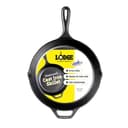
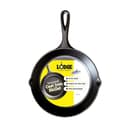
Lodge 10.25-inch Classic — the best overall
Sand-cast in South Pittsburg, Tennessee, pre-seasoned with vegetable oil, made without PFAS, and rated by Lodge for any stovetop including induction plus the oven, grill or campfire. At a published 5.66 lb it is heavy enough to hold a sear when cold food lands in it and light enough to wash one-handed, and it is the size that feeds two to four people. Nothing else here does more of what cast iron is for, for less money.
The honest trade is the finish. The cooking surface is pebbled as cast, which means eggs stick more in month one than they will in month twelve, and the handle is short by modern standards. If either bothers you, the two pans below address exactly those complaints — for five to six times the price.
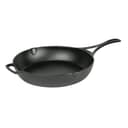
Lodge Blacklock 10.25-inch — the best lightweight
The same American foundry, a thinner casting and triple factory seasoning. Lodge publishes 4.61 lb against 5.66 for the classic of the same diameter, an extended raised handle it says stays cooler longer, and the same heat-source list. A pound of difference does not read like much written down; in the hand, flipping a full pan, it is the difference between a pan you use on a Tuesday and one you do not.
It costs roughly double the classic, and the thinner walls hold slightly less heat for a long hard sear — a real trade if steak is your main use. Our Blacklock against classic comparison runs the two side by side on Lodge’s own figures.
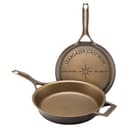
Stargazer 12-inch — the best large
An American maker that machines the cooking surface smooth after casting and designs the handle to run cooler, with the specs to back the price: Stargazer publishes a 9.4-inch cooking surface, 21.5 inches of total length, 3.4 quarts of capacity and 6.5 lb for the 12-inch. Its FAQ clears the pan for gas, electric coil, glass, ceramic, induction and the grill, and recommends a low five-to-ten-minute preheat to avoid thermal shock.
Two things to know. Twenty-one and a half inches of total length is a lot of oven to turn in, so measure before you buy. And the pan costs several times a classic Lodge that ultimately cooks the same — you are buying the surface and the handle. Stargazer against Lodge is the page to read if that is the decision in front of you.
Field Company No. 6 — the best small heirloom
A thin, light, polished American pan in the pre-war tradition. Field publishes 3 lb for the No. 6 with 7 inches of cooking area, states its pans work on glass-top electric and induction, recommends a low-to-medium preheat of up to five minutes, endorses grill and live-fire cooking, and gives a lifetime warranty — while telling you plainly never to put it in a dishwasher.
Three pounds and seven inches of floor makes this an egg-and-one-serving pan, not a main skillet, and it is priced like a main skillet. Buy it as the second pan it genuinely is — the egg roundupexplains why small and light wins that specific job — or step up to the No. 8 at a published 4.5 lb with 8.75 inches of cooking area.
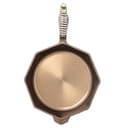
Finex 12-inch — the best splurge
The most distinctive object in American cast iron: a patented octagon with a pour spout at every corner, a machined and polished cooking surface, pre-seasoning with organic flaxseed oil, a handcrafted stainless-and-brass spring handle designed to stay cooler than solid iron, and 100% US construction free of PFAS and PTFE. It is now part of Lodge, and it is beautiful.
It also costs roughly ten times a classic Lodge and does not sear or bake any better. The brass-topped handle is heavy, the full pan is a two-hands lift, and Finex is made in small batches so availability comes and goes. Buy it because you want the object. Our Finex review is the longer argument.
Lodge 8-inch Classic — the best second pan
The cheapest way to own two American pans instead of one. Lodge publishes 3.44 lb for it, which is why it is the pan that actually gets used on a weeknight for two eggs, a grilled cheese or a single portion — jobs a 10.25-inch pan does badly because three quarters of the iron is heating empty air. Same Tennessee foundry, same care, a fraction of the money.
It is too small to be your only skillet, and the short handle sits close to the burner on a pan this size, so it heats up fast. Keep a mitt nearby. Our how-many-skillets guide makes the case for this exact pairing.
What we left off, and why
Every enameled pan.Lodge’s Essential Enamel listing states the enamel line is made in China to Lodge specifications while all other Lodge cast iron is made in the USA, and Lodge’s Essential Enamel Dutch ovens are made by its partners in China or Vietnam. Lodge does run a separate USA Enamel line, which describes itself as the only colorful enameled cast iron made in the United States — but on the day we checked it held a 4.5-quart Dutch oven and an 11-inch grill pan, no open skillet, and it is sold direct rather than through Amazon. So there is no American-made enameled skillet to recommend here. The enameled skillet roundup covers the imported ones honestly.
Victoria.Cast in Colombia, pre-seasoned with flaxseed oil, with a longer handle than a same-size Lodge, and genuinely good value — just not American. We would rather say that than quietly include it. See the Victoria review.
Vintage Griswold and Wagner. American, superb, and not something we can price or stock-check, because every one is a used object with its own condition. If that is the route you want, the Griswold and Wagner pages explain what to look for, and how to identify vintage cast iron shows you how to read a pan before you pay for it.
Is American-made cast iron actually better?
Not inherently, and it is worth being clear about that. Iron is iron; a well-cast pan from any foundry with a decent surface and a sane handle will cook the same food. What a published US origin gets you is traceability — a named factory, a stated warranty, and a company that answers for the pan — plus, for some buyers, a reason unrelated to cooking that is perfectly legitimate on its own terms.
The practical reason to care is narrower and more interesting. In this one category, the American options are also the cheapest options. A Tennessee-made Lodge undercuts almost every imported pan on the shelf while publishing more specification detail than any of them. You very rarely get to choose origin without paying for it; here you do.