How we chose these large skillets
Every pan here is big enough to do the job a big pan is for. What separates them is duller than the marketing suggests — how much of that size you can actually use, how much you will curse the weight, and whether your stove can heat the thing evenly. Those are what we ranked on.
1. Usable cooking area, not the headline size
A skillet’s stated size is measured across the top rim, and the flat cooking floor is always smaller because the walls flare outward. A pan with lower, more sloped sides (like Lodge’s Chef Collection) turns more of its width into usable floor and makes it far easier to slide a spatula under food at the edge; a pan with tall, straight walls looks the same size on the box but gives you less room to actually cook and flip. When we say “large,” we mean usable floor for searing, not the number on the label.
2. Weight and handling — big iron gets heavy fast
Cast iron is heavy, and every extra inch adds a surprising amount. The largest pan here, Lodge’s Chef Collection at a full 13.25-inch footprint, is genuinely heavy and hot-handle, two-hands-to-lift territory when it is full — that is not a defect, it is the honest cost of the size. Weight is where handles earn their keep: a long, balanced handle (Victoria, Stargazer) or a helper handle on the far side makes a loaded big pan manageable, while a short, stubby grip on a full twelve-incher is a wrestle. If you have any doubt about lifting a heavy pan off the stove one-handed, weight and handle should outrank finish in your choice.
3. Burner fit and even heating
This is the one most people miss. Cast iron is slow to spread heat sideways, so a pan much wider than the flame under it develops a hot bullseye in the middle and cool edges — exactly the opposite of what you want for an even sear. A twelve-inch pan already overhangs many standard burners; the 13.25-inch Chef needs a big burner or patient preheating to come up to an even temperature. Give any large pan a few extra minutes on medium before you cook, and if your stove runs small, a twelve-inch pan will heat more evenly than the biggest one on this page.
4. One big pan, or two mid-sized ones?
A single large skillet is the right tool for a full batch cooked at once. But two medium pans give you something a big one can’t: two temperatures and two jobs at the same time — onions softening in one while a steak sears in the other — and each is lighter to lift and easier to store. If you cook for a crowd in one go, buy the big pan. If you cook a couple of components at once, two mid-sized pans often beat one large one, and neither fights your burner for even heat. Our skillet size guide compares the sizes side by side, and the small skillet roundup covers the little pans that pair well with a big one.
5. Finish and handle — they matter more on a big pan
The differences between a budget pan and a boutique one — a machined-smooth surface, a longer or cooler-running handle — count for more at this size than in a small skillet. A rough as-cast surface is more area to season in before it slicks up, and a short, hot handle is far harder to manage on a big, heavy pan than on a light one. That is why a long-handled budget pan like the Victoria, or a smooth premium pan like the Stargazer or Finex, can be worth the step up specifically when you are buying large — the size amplifies both the surface you cook on and the handle you carry. As always, though, none of it makes the pan sear better; it makes the big pan easier and nicer to use.
The large skillets, one by one
Lodge Chef Collection — the best large overall
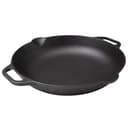
Lodge’s cooking-focused line and the biggest pan here, a full 13.25-inch footprint with lower, more sloped sides than a classic Lodge and a smoother cast finish, built for everyday sauteing and easy spatula access. The large surface sears a full batch without crowding, the sloped walls make tossing and sliding food off far easier, and it is American-made and pre-seasoned like the rest of the range. The honest cautions are the size’s own cost: at 13.25 inches it is genuinely heavy and a two-hands, hot-handle lift when full, and it is too big for a single small burner to heat evenly. Give it a big burner and it is the best large everyday pan on this list.
Stargazer 12-inch — the best smooth large pan
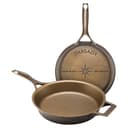
The large pan for cooks who want a machined-smooth surface and a comfortable handle. Stargazer’s cooking surface is machined smooth so it slicks up sooner, the long angled handle is more comfortable and runs cooler than a stubby one, and it is made in the USA with a lighter, cleaner casting than the budget pans. The trade-offs are the boutique ones: it costs several times a classic Lodge that ultimately cooks the same, and the standard model has no helper handle for a heavy, full twelve-inch pan — something you notice more at this size than in a small skillet. Worth it if surface and feel matter to you; skippable if you just want the biggest sear for the least money.
Victoria 13-inch — the best large budget with a long handle
The value large skillet with a proper long handle: pre-seasoned with flaxseed oil, cast in Colombia, and a real step up in comfort from Lodge’s shorter grip — for only a little more than the cheapest pans. On a big pan, that longer handle matters most; it balances a loaded thirteen-incher far better than a stubby one. The surface is as-cast and textured like most budget pans, and the long handle means it won’t fit a small oven as neatly. But if you want a large pan that is genuinely easier to steer full, without paying boutique money, this is the budget pick.
Finex 12-inch — the best large heirloom
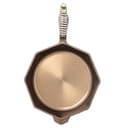
The large pan to buy when you want an object as much as a tool: a patented octagon with a pour spout at every corner, a machined-and-polished cooking surface that releases food like a broken-in vintage pan, and a stainless-and-brass coil handle that stays cool far longer than solid iron. It is a Lodge-owned American brand and it is gorgeous. It is also the priciest way to buy this much iron — roughly ten times a classic Lodge, and it does not sear or bake any better — the brass-topped handle is heavy, the full pan is a two-hands lift, and small-batch production means availability comes and goes. Buy it for finish and design, not for a better result.
Utopia 12-inch — the cheapest large skillet
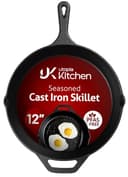
About the cheapest usable twelve-inch cast iron skillet on the shelf. It cooks like any bare cast iron once you season it in, and it is a low-risk way to find out whether a large pan is even something you reach for. Expect a rougher casting and factory seasoning than a name-brand pan, and note the country of manufacture isn’t clearly stated. But it is pre-seasoned, ready to use with a quick rinse, and has the same stovetop-to-oven versatility as pricier pans. The pick when you want maximum size for minimum spend and don’t mind a rougher finish that smooths out with use.
Cuisinel 12-inch — the best large with a lid and accessories
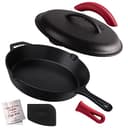
More a starter bundle than a single pan: a twelve-inch skillet plus a lid, a silicone handle cover and a pan scraper — exactly the extras a first-time cast iron cook keeps reaching for. The handle cover takes the fear out of the always-hot handle, the lid turns the pan into a shallow braiser or a cover for keeping food warm, and the scraper handles stuck-on bits without soap. The pan itself is budget-import quality rather than heirloom, and the lid adds weight and storage bulk on top of an already-heavy large pan. Good value once you count the accessories, and the most beginner-friendly big pan here.
When a smaller skillet is the smarter buy
A large pan is not the right first pan for everyone. If you mostly cook for one or two, a big skillet spends most of its life half-empty, which wastes heat and makes it harder to build a good sear on the little you are cooking — a ten-inch pan is the more useful everyday size, and our budget skillet picks point to the ones worth owning. If weight is a concern, remember that every large pan on this page is heavy full, and a mid-sized skillet you can lift one-handed will get used far more than a big one you dread carrying. And if your stove runs small, a twelve-inch pan will heat more evenly than the biggest one here. Buy large when you genuinely cook big batches; otherwise a smaller pan is usually the one you will actually reach for. If the big batch you have in mind is steak, our best skillets for steak ranks these pans on the mass and cooking floor a sear depends on.
Seasoning and caring for a big pan
A large skillet is more surface to keep seasoned, but the routine is identical to any bare cast iron: hand wash it, dry it fully — easiest back on a warm burner — and wipe on a thin film of oil before it goes away. A little dish soap is fine on modern seasoning. The one extra thing size adds is that a big pan takes longer to heat through and to cool, so preheat it patiently and let it cool before washing to avoid warping from thermal shock. If the seasoning ever goes patchy across that larger floor, our seasoning guide walks through rebuilding it evenly. Done right, a big pan outlasts you.