How we picked: four criteria, in this order
1. It has to actually be six quarts. This sounds trivial and it is the reason the list is five pots rather than twelve. Our registry holds seven-quart pots that get recommended into this search constantly, and they are on best large Dutch ovens where they belong. A 6.5-quart earns a place here because half a quart is inside the tolerance a recipe cares about; a 7-quart does not, because the extra inch of diameter changes how much liquid you need to cover a joint.
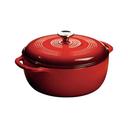
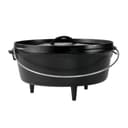
2. The flat bottom, not the quarts. Capacity is measured to the rim, so it tells you how much soup fits and nothing about how much meat browns at once. Lodge is the only maker in this group that publishes the figure: a 6.87-inch flat bottomunder a 10.5-inch cooking surface on a 13.25-inch pot. That gap between 6.87 and 10.5 inches is the sloped wall, and it is why a “six-quart” pot browns about as much meat in one layer as a 7-inch skillet. If browning is most of your cooking, best Dutch ovens for braising is built entirely around that distinction.
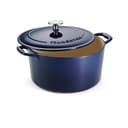
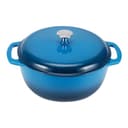
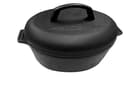
3. What the maker publishes, treated as part of the product. Lodge publishes a weight, an oven ceiling, a cooktop list, a care rule and a country of manufacture. Tramontina publishes a care instruction and no temperature. Amazon Basics and Bayou Classic publish almost nothing. We record that difference rather than smoothing it over, because the pot with no published oven ceiling is the pot you have to guess about at 475°F.
4. The environment the maker allows. Lodge rates bare iron for a stovetop, an oven, a grill or a campfire, and rules out a grill and a fire for its enameled line in the same breath. That single sentence decides this purchase for anyone who owns a fire pit, before price enters the conversation.
Why six quarts, and when it is the wrong answer
The rule is two-thirds to three-quarters full at the end of cooking. A half-empty pot dries food out and scorches the rim of the liquid; an over-filled one boils instead of simmering and will not brown anything. Six quarts lands in that window for a four-to-six-portion batch, a 4–5 lb chicken with vegetables, or a 900 g round of sourdough — which is why recipe writers default to it and why most pot ranges put their best colors and their best documentation on this size.
It is the wrong answer in two situations. If you cook for one or two and mostly make side dishes and single loaves, six quarts is a heavy object you will resent lifting, and the small Dutch ovens under 5 quartsare the better shelf — a 3-quart pot full is a better pot than a 6-quart pot a quarter full. If you batch-cook for a freezer or feed seven, go up: the 7-quart-and-up pots cost very little more, because capacity is the cheapest thing you can buy in cast iron.
Enamel or bare iron, at this exact capacity
At six quarts the material choice is sharper than it is anywhere else, because this is the capacity people use for long, wet, acidic cooking — tomato, wine, stock, dairy, four hours at a time. That is the single hardest thing you can do to a young seasoning, and it is the strongest practical argument for paying for enamel. Three of the five pots here are enameled for exactly that reason.
Bare iron wins on two things instead, and both are real: it is rated for fire and a grill where enamel is not, and it is cheaper per quart. It also will not chip, which is the one failure mode enamel has that iron does not. Enameled vs bare cast iron works the trade through properly, and is cast iron worth it is the page for anyone still deciding whether to own one of these at all.
Three checks before you buy a 6-quart pot
Weigh it empty, in your head. Lodge publishes 13.52 lb for the round 6-quart and 16.36 lb for the 7-quart oval from the same line. Add four pounds of stew and you are lifting a 17-pound pot out of a hot oven with mitts on. If that sounds like too much, the honest fix is a smaller pot rather than a braver one.
Find the oven ceiling before you need it.Lodge states 500°F for this line. Tramontina states no temperature anywhere we could read. A great many no-knead bread recipes start at 475°F, which is exactly where an unpublished ceiling becomes your problem rather than the maker’s.
Check the knob separately from the pot. On enameled pots the lid knob is often rated lower than the body, and it is usually the one component a maker will sell you a spare of. Lodge puts a stainless knob on this line, which removes the question; a phenolic knob does not.
If six quarts is not quite your number
Below it: small Dutch ovens under 5 quarts ranks on cooking floor rather than volume, because at 2 to 4 quarts the floor is what runs out first. Above it: large Dutch ovens, 7-quart and up. If the constraint is money rather than capacity, both under $100 and under $50 answer that directly, and they reach different conclusions about what the next hundred dollars adds. If you are buying your first pot ever, start at best Dutch ovens for beginners.