How we chose these camp dutch ovens
1. Legs and a flanged lid, or it is not a camp oven
This is the whole category definition. Three legs lift the pot above the coals so air can reach them and the base heats evenly; a flanged lid holds a layer of coals on top so the pot bakes rather than just simmers. A flat-bottomed, domed-lid pot sold as “campfire ready” is a kitchen dutch oven that can survive a fire, which is not the same thing. Every pick here has both features.
2. Size, measured in people rather than quarts
Camp ovens are sold in both quarts and inches, which makes comparison annoying. Roughly: a 4-quart (10-inch) feeds two to four, a 6-quart (12-inch) feeds four to six, an 8-quart feeds eight to ten, and the 10-quart-plus ovens are for organized groups. Buying too big is the standard mistake — a half-empty camp oven scorches at the base, burns through more charcoal, and has to be carried by two people.
3. Depth, if you are baking
“Deep” camp ovens have taller walls for the same diameter. For stews and chili it hardly matters; for bread, cobbler and anything that rises, the headroom between the food and the lid is what stops the top browning before the middle cooks. If you expect to bake in it, deep is worth choosing.
4. Weight you will actually lift, over fire
Cast iron is heavy, and a camp oven has to be lifted full, often with a lid covered in live coals, often in the dark. A 4-quart is a one-person job. An 8-quart full of stew is genuinely a two-person lift, and that is worth thinking about before you buy the biggest one in the range.
5. What comes in the box
A lid lifter is not an accessory, it is the tool that lets you check food without tipping ash into it. A bail handle (the steel swing handle) is standard on good ovens and lets you hang the pot or lift it with a hook. A bag keeps soot off everything else in the car. Most ovens include none of these; one pick here includes two.
The camp dutch ovens, one by one
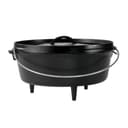
Lodge 6-quart Camp Dutch Oven — the best overall
The default camp oven, and the size most people should buy. Six quarts feeds four to six comfortably, which covers the majority of camping trips, and it is the size the largest number of camp recipes and coal charts are written around. It has the standard Lodge camp build — three legs, a steel bail handle, a flanged lid — it is American-made and seasoned with vegetable oil, and it is effectively indestructible. The trade-offs are the honest ones for the category: the legs make it awkward on a flat stovetop, and it is heavier and more specialized than the pot you keep in the kitchen.
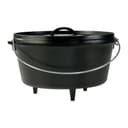
Lodge 4-quart Deep Camp Dutch Oven — the best for two
The size we would actually recommend to a couple, and the one that gets left behind in favor of something bigger and then regretted. Four quarts feeds two to four, needs meaningfully fewer coals to bring up to temperature, and — the part that matters at a campsite — you can lift it full, on your own, without help. The deep profile also gives you headroom for a cobbler or a small loaf. Its limits are real: four quarts fills fast, and it is still a serious chunk of iron to carry any distance.
Lodge 8-quart Deep Camp Dutch Oven — the best for groups
The group-cooking size. Eight deep quarts is chili for ten, a couple of dozen biscuits, or a whole chicken with vegetables packed around it, and the extra depth is what lets you cook a stew with dumplings without the lid sitting on the food. Same American-made build as its siblings. Buy it for a scout troop, a family reunion or a group camp — and be clear-eyed that lifting it off the fire full is a two-person job, and that using it for two people wastes fuel and scorches the base.
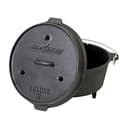
Camp Chef DO-12 — the best for cooking from recipes
The classic 12-inch from an outdoor-cooking specialist, and worth knowing about because of a quiet practical advantage: most published camp dutch oven recipes, and almost every charcoal-briquette chart, are written for a 12-inch oven. Cooking from a book is simply easier when your pot is the size the book assumes. It arrives pre-seasoned and ready to use. The listing does not state a country of manufacture, which is a real difference from the Lodge ovens if that matters to you, and it handles like any 12-inch camp oven — heavy, two hands, a lid lifter strongly advised.
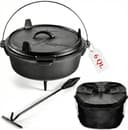
Uno Casa 6-quart kit — the best starter kit
The value pick, and the sensible way to start if you are buying your first camp oven rather than adding to a collection. It is a 6-quart oven that arrives with a lid lifter and a carry bag, which are the two things you would otherwise buy separately and the two things people most often forget. The lifter in particular changes the experience: taking a coal-covered lid off a hot oven without one is the single most annoying part of camp cooking. It is an import casting with no stated origin, and the factory seasoning is thinner than Lodge’s, so run a couple of fatty cooks through it — or add a coat using our seasoning guide— before a big trip.
How to cook with coals
Camp dutch oven cooking sounds like a dark art and is mostly one principle: more coals on the lid than underneath. Heat rises, so a pot with most of its coals on top behaves like an oven, while a pot with most of them underneath behaves like a hotplate — which is exactly how the bottom of a cobbler burns while the top stays raw. A rough two-thirds on the lid, one-third below is the split camp cooks pass around as a starting point for baking, moving toward an even split, or heat-heavy underneath, for a stew or a chili you want to keep at a simmer.
Treat any coal count you read, including that split, as a place to begin rather than a temperature reading. Briquette size, wind, air temperature and how long the coals have been burning all move the result, which is why experienced camp cooks watch and listen to the pot instead of counting.
The other habits matter as much as the ratio. Rotate the oven a third of a turn every ten to fifteen minutes and rotate the lid the opposite way, so no hot spot ever sits in the same place. Lift the lid as little as you can, and lift it level so ash does not tip in. And plan to add fresh coals through a long cook, because briquettes fade steadily rather than holding their heat to the end.
Can you use a camp dutch oven at home (and a kitchen one at camp)?
In a home oven, a camp dutch oven works — it just sits on its legs on the rack and takes up more height than you would like. On a stovetop it is a poor fit: the legs make it unstable and hold the base off the burner. Lodge is explicit that its camp ovens are for campfire and direct flame and not for indoor use, and that is worth respecting, not least because cooking with charcoal indoors is a carbon monoxide risk rather than a cookware question.
The reverse also disappoints. A flat-bottomed kitchen dutch oven will survive a campfire, but it settles down into the coals and smothers them, and its domed lid will not hold coals on top, so you lose the oven effect entirely. If you only ever cook outdoors occasionally, a flat-bottomed pot on a grate over the fire is a reasonable compromise; if camp cooking is a real part of your year, buy the pot built for it. Our bare cast iron dutch oven roundup covers the kitchen side of the range.
Care after a fire is different
Camp cooking is harder on iron than a kitchen is, mostly because of water and time. The routine: scrape the pot out while it is still warm, use hot water and a stiff brush or a chainmail scrubber, and get it bone dry — easiest done by putting it back over the dying fire for a few minutes. Then a thin film of oil inside and out, including the legs and the lid rim, which are the places rust starts.
Storage is the other half. Do not clamp the lid down on a cold pot for a month; trapped moisture is how a perfectly good oven arrives at the next trip orange. Store it with the lid ajar or a folded paper towel in the gap, out of a damp shed if you can. If it does rust, it is entirely recoverable — our rust removal guide walks through bringing one back, and our storage guide covers keeping it from happening again.