The Seasoned Pan

The Best Cast Iron Kettles and Teapots

Six verified in stock, ranked on what the lining is, what the usable capacity really is, and whether the seller will tell you to boil water in it. Most "cast iron kettles" are enamel-lined teapots — and several say so in their own instructions.

By Stephen V.Last updated How we pick

Decide first whether you want to brew tea or boil water, because almost nothing in this category does both. Search “cast iron kettle” and what comes back is mostly tetsubin-style teapots with an enamel lining and a stainless infuser — beautiful, easy to look after, and sold with instructions that quietly tell you not to boil in them. Velaze’s listing is the frankest: “it is recommended not to fill more than 500ml of water, otherwise the water will overflow when boiling, it is best to pour the water into the teapot after boiling.” That is a teapot describing itself.

If you want a kettle in the literal sense — a vessel that sits on a flame and brings water to a boil — you want bare iron inside, and there is exactly one on this page that says so on its own title: Iwachu’s Type 7 tetsubin, “No Enamel, Direct Fire”, with a published country of manufacture. Bare iron plus water also means the same rust discipline as a cast iron skillet: dry it every time, never leave it standing full.

Below: the five things that actually separate these pots, then the six we could verify as live and buyable, each with the capacity, weight and compatibility its listing publishes and nothing it does not. We have not hands-on tested them; here is exactly what we do instead. Prices are checked live, and the honest answer for most people is the cheap enamel-lined pot rather than the expensive one.

How this is funded:we earn a commission if you buy through our links, at no extra cost to you. It never changes which product we recommend, and we’ll tell you when we’d skip one. Full disclosure.

Quick picks

Ranked on materials, size, finish and buyer fit. Select a row to jump to the full write-up. We have not hands-on tested these pans — here is exactly what we do instead.

#ProductBest forPrice
1
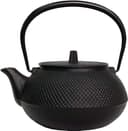
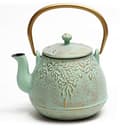
TOPTIER Japanese Cast Iron Teapot, 32 oz

TOPTIER Japanese Cast Iron Teapot, 32 oz

The pot most people are actually looking for when they search for a cast iron kettle: an enamel-lined tetsubin with a removable stainless infuser, light enough to pour one-handed and cheap enough to find out whether you like brewing this way. Read its own capacity line before you buy — the listing says 32 oz full, 25 oz for heating.

Best overall
$29.97 · View on Amazon

Price as of October 30, 2026. #ad How we’re funded

2
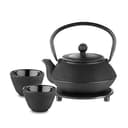
Velaze Cast Iron Teapot Set, 23 oz (pot, trivet, 2 cups)

Velaze Cast Iron Teapot Set, 23 oz (pot, trivet, 2 cups)

The complete purchase for one or two people — pot, cast iron trivet and two 2 oz iron cups in one box — and the most honest listing in the category about what these pots are. Its own instruction is to boil the water elsewhere and pour it in, which is the single most useful sentence anyone selling a "cast iron kettle" has written.

Best complete set
$39.99 · View on Amazon

Price as of October 30, 2026. #ad How we’re funded

3
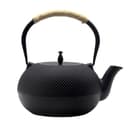
Iwachu Type 7 New Arare Tetsubin, 0.8 L (No Enamel)

Iwachu Type 7 New Arare Tetsubin, 0.8 L (No Enamel)

The only kettle here that is a kettle. Its own title says "No Enamel, Direct Fire" — bare iron inside, made to sit on a flame and boil water, with a published country of manufacture and the Nambu ironware name behind it. It also means you own a rust-management job, same as a skillet: empty it and dry it every time.

Best true kettle
$148.74 · View on Amazon

$158.756% off

Price as of October 30, 2026. #ad How we’re funded

4
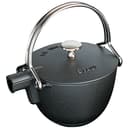
Staub Cast Iron 1-qt Round Tea Kettle

Staub Cast Iron 1-qt Round Tea Kettle

The only kettle in the category with a real foundry, a real product page and a real warranty behind it — enameled inside and out, made in France, flat enamel base rated for every stovetop including induction. You are paying roughly eight times the no-name price for documentation, finish and recourse, not for better tea.

Best documented
$249.95 · View on Amazon

Price as of October 30, 2026. #ad How we’re funded

5
YJX Cast Iron Teapot, 60.9 oz (1,800 ml)

YJX Cast Iron Teapot, 60.9 oz (1,800 ml)

The size most of these pots are not: 1,800 ml, published at 5 lb empty, enough for a table of four to six without a second brew. Buy it for capacity and the hobnail look, and ignore the health claims on the listing — an enamel lining is exactly what stops iron reaching the water.

Best for a crowd
$62.56 · View on Amazon

$68.008% off

Price as of October 30, 2026. #ad How we’re funded

6
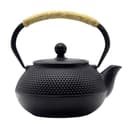
SECHUDO Tetsubin Cast Iron Teapot, 27.1 oz

SECHUDO Tetsubin Cast Iron Teapot, 27.1 oz

The small, cheap, honest one. Under two cups of usable capacity, published at 3.09 lb, and the only budget listing in the category that bothers to tell you which heat sources it is for — induction, electric, charcoal and gas, and not a microwave. If you brew for one, this is the right size and the right money.

Best for one
$30.58 · View on Amazon

$32.386% off

Price as of October 30, 2026. #ad How we’re funded

The picks in full

#1Best overall

TOPTIER Japanese Cast Iron Teapot, 32 oz

The pot most people are actually looking for when they search for a cast iron kettle: an enamel-lined tetsubin with a removable stainless infuser, light enough to pour one-handed and cheap enough to find out whether you like brewing this way. Read its own capacity line before you buy — the listing says 32 oz full, 25 oz for heating.

Strengths

  • Fully enameled interior, so there is no seasoning and no rust routine
  • Removable 18/10 stainless infuser, which is what makes it a teapot rather than a kettle
  • The listing publishes an honest usable capacity (25 oz) below the headline 32 oz

Trade-offs

  • The listing's own instruction is "small fire is suggested" — this is not a hard-boil kettle
  • No published origin, no warranty terms and no reachable maker page
  • Its spec table claims 2.4 x 2.4 x 1.9 in for a 32-ounce pot, which cannot be right
TypeEnameled cast iron
Size32 oz full / 25 oz heating
SeasoningNone needed (enameled)
Induction-safeNot published
Made inNot published
Best forBrewing and serving loose-leaf tea for two or three people

The details. The listing publishes a "FULL-LOAD CAPACITY: 32 oz / 950 ml" against a "RECOMMENDED BOILING CAPACITY: 25 oz / 750 ml", a 2 lb weight, a 1-quart size class, a "fully enameled interior", an 18/10 stainless removable infuser, a fold-down handle, and care instructions of "Dishwashing detergent is not recommended. Simply clean it with water is enough" plus "Stovetop safe, the small fire is suggested". It states no country of manufacture, no warranty and no induction claim, and its dimension table (2.4 x 2.4 x 1.86 in) is self-evidently wrong for a 32-ounce pot, so size is recorded from the capacity lines and the dimensions are not repeated as fact.

Specs read from the product listing, on October 29, 2026. “Not published” means the brand does not state that figure.

#2Best complete set

Velaze Cast Iron Teapot Set, 23 oz (pot, trivet, 2 cups)

The complete purchase for one or two people — pot, cast iron trivet and two 2 oz iron cups in one box — and the most honest listing in the category about what these pots are. Its own instruction is to boil the water elsewhere and pour it in, which is the single most useful sentence anyone selling a "cast iron kettle" has written.

Strengths

  • Pot, cast iron trivet and two iron cups in one box — nothing else to buy
  • "Fully enameled interior" is stated outright, which half this category never says
  • The listing publishes an honest fill limit (500 ml of a 700 ml pot) instead of hiding it

Trade-offs

  • Its own advice is to boil water in something else and pour it in — so it is a teapot, not a kettle
  • No published weight, no origin, no warranty and no cooktop list
  • The same listing claims the pot "could break down the elements of Fe2+" while advertising the enamel that prevents it
TypeEnameled cast iron
Size23 oz (700 ml), 500 ml fill limit
SeasoningNone needed (enameled)
Induction-safeNot published
Made inNot published
Best forA tea ritual for one or two, set down on a table and left there

The details. The listing publishes a capacity of "700ml/23oz", a three-item count (teapot, cast iron trivet, two 2 oz cast iron cups), a "fully enameled interior" that "helps to prevent the build-up of rust and oxidation", a detachable stainless infuser, a hammered exterior, 6.2 x 6.2 x 5.9 in, and the category's frankest instruction: "it is recommended not to fill more than 500ml of water, otherwise the water will overflow when boiling, it is best to pour the water into the teapot after boiling". It publishes NO weight, no country of manufacture, no warranty and no cooktop list. Its claim that the pot "could break down the elements of Fe2+, replenish the iron requirement of our body" is recorded as a seller claim, not a fact — the same bullet set advertises the enamel lining that sits between the iron and the water.

Specs read from the product listing, on October 29, 2026. “Not published” means the brand does not state that figure.

#3Best true kettle

Iwachu Type 7 New Arare Tetsubin, 0.8 L (No Enamel)

The only kettle here that is a kettle. Its own title says "No Enamel, Direct Fire" — bare iron inside, made to sit on a flame and boil water, with a published country of manufacture and the Nambu ironware name behind it. It also means you own a rust-management job, same as a skillet: empty it and dry it every time.

Strengths

  • Bare interior, stated on the listing as "No Enamel, Direct Fire" — the genuine article
  • "Country of Manufacture: Japan" is published, which nothing else in the category states
  • Published 3.53 lb at 0.8 L: heavy enough to hold heat off the burner

Trade-offs

  • Bare iron plus water means rust if you leave it standing wet, every single time
  • Several times the price of the enamel-lined pots it sits beside in search results
  • No published warranty, no care sheet and no reachable English maker page
TypeBare cast iron
Size0.8 L (27 oz)
Pre-seasonedNot published
Induction-safeNot published
Made inJapan
Best forBoiling water over a real flame, and tasting the difference bare iron makes

The details. The listing publishes "No Enamel, Direct Fire", "Nambu Ironware", a material of "Cast iron (Interior/Exterior: Black baked processing), tea strainer, stainless steel", a stainless tea strainer as the included accessory, "Country of Manufacture: Japan", 0.8 L, 7.1 x 5.9 x 6.7 in and 3.53 lb, under part number 11884. It states no warranty, no care instructions and no cooktop list — "direct fire" is the only heat guidance given — so induction compatibility reads "Not published" rather than carrying an assumption, and "black baked processing" is reproduced as the maker's phrase rather than translated into a seasoning claim.

Specs read from the product listing, on October 29, 2026. “Not published” means the brand does not state that figure.

#4Best documented

Staub Cast Iron 1-qt Round Tea Kettle

The only kettle in the category with a real foundry, a real product page and a real warranty behind it — enameled inside and out, made in France, flat enamel base rated for every stovetop including induction. You are paying roughly eight times the no-name price for documentation, finish and recourse, not for better tea.

Strengths

  • Staub publishes "Made in France", induction compatibility and a limited lifetime warranty
  • "Smooth enamel bottom works on all stovetops" — the only published cooktop guarantee here
  • Enameled inside and out, so neither the water nor the shelf life depends on your care routine

Trade-offs

  • By far the most expensive kettle in the category, and the tea is not better for it
  • Staub's page publishes no weight and no dimensions at all
  • Its Amazon bullets are generic Staub cookware copy — "Rough texture results in exceptional browning" describes a Dutch oven, not a kettle
TypeEnameled cast iron
Size1 qt
SeasoningNone needed (enameled)
Induction-safeYes
Made inFrance
Best forA kettle that lives on the hob and has a maker you can hold to account

The details. Staub's own page publishes "Enameled cast iron teapot for brewing and boiling in style", "Textured black matte enamel interior ensures exceptional heat retention and distribution", "Smooth enamel bottom works on all stovetops, including induction", "Oven safe to 500°F", "Dishwasher safe", "Enameled interior requires no seasoning", "Made in France", "A limited lifetime warranty for all our products" and a $249.99 list price, but no weight and no dimensions. The Amazon listing for the same part number (1650023) adds 6.54 x 4.72 x 7.09 in, 6.39 lb and "Lifetime Warranty Against Manufacturer'S Defects", and also carries Staub's generic enameled-cookware bullets, one of which ("Rough texture results in exceptional browning") cannot be describing a kettle. Capacity is published as 1 qt by Staub US and as 1.1 l / 1.22 qt on Zwilling's listings for the same kettle in other colors; the 1 qt figure on this listing is the one recorded.

Specs read from the product listing, on October 29, 2026. “Not published” means the brand does not state that figure.

#5Best for a crowd

YJX Cast Iron Teapot, 60.9 oz (1,800 ml)

The size most of these pots are not: 1,800 ml, published at 5 lb empty, enough for a table of four to six without a second brew. Buy it for capacity and the hobnail look, and ignore the health claims on the listing — an enamel lining is exactly what stops iron reaching the water.

Strengths

  • 60.9 oz published capacity, roughly double the category standard
  • Enameled interior, so a pot this size is still a wipe-and-dry job
  • Published 5 lb empty weight, which is why it holds heat through a long sitting

Trade-offs

  • Its own listing claims the pot "can improve the water quality by releasing iron ions" — an enamel lining prevents that
  • 5 lb empty plus nearly 4 lb of water is a two-handed pour
  • No origin, no warranty and no maker page of any kind
TypeEnameled cast iron
Size60.9 oz (1,800 ml)
SeasoningNone needed (enameled)
Induction-safeNot published
Made inNot published
Best forServing four to six people from one pot

The details. The listing publishes a full-load capacity of "60.9oz / 1800 ml", "Serve for 4-6people", a "fully enameled interior", a hobnail exterior pattern, a stainless infuser, 8.15 x 7.87 x 9.06 in, 5 lb and a 1.9-quart size class. It states no country of manufacture, no warranty beyond "contact us through Amazon Email", and no cooktop list. It also makes repeated health claims — the pot "can improve water quality and replenish the iron element to human body" and "could break down the element of Fe2+" — which are recorded here as claims the seller makes and not as facts: the enamel lining the same listing advertises sits between the iron and the water.

Specs read from the product listing, on October 29, 2026. “Not published” means the brand does not state that figure.

#6Best for one

SECHUDO Tetsubin Cast Iron Teapot, 27.1 oz

The small, cheap, honest one. Under two cups of usable capacity, published at 3.09 lb, and the only budget listing in the category that bothers to tell you which heat sources it is for — induction, electric, charcoal and gas, and not a microwave. If you brew for one, this is the right size and the right money.

Strengths

  • The only budget listing here that publishes a cooktop list, induction included
  • Enameled interior, which the listing correctly says "can prevent it rusting better"
  • Published 3.09 lb and 6.5 x 6.3 x 7.09 in — small enough to leave on the hob

Trade-offs

  • 27.1 oz full is two mugs, not a pot for guests
  • The "improve water quality" claim is marketing, not a published specification
  • No origin, no warranty and no maker page
TypeEnameled cast iron
Size27.1 oz (800 ml)
SeasoningNone needed (enameled)
Induction-safeYes
Made inNot published
Best forBrewing for one or two without a pot you have to lift with both hands

The details. The listing publishes a full-load capacity of "27.1 oz /800 ml", an enameled interior that "can prevent it rusting better and clean it easier", a removable stainless mesh infuser, 6.5 x 6.3 x 7.09 in, 3.09 lb, a 0.8-quart size class, and an explicit heat-source list: "it can be heated by induction cooker, electric burner, charcoal, gas, etc.(NOT USED ON MICROWAVE)". It states no country of manufacture and no warranty. Its claim that the pot "can improve water quality" is not a published specification and is treated here as marketing.

Specs read from the product listing, on October 29, 2026. “Not published” means the brand does not state that figure.

How to choose a cast iron kettle

This is a category where the product name and the product are two different things, so the criteria below are mostly about reading the listing properly rather than comparing numbers.

1. Enamel-lined or bare iron — the whole decision

Every pot on this page is cast iron on the outside. What matters is what is on the inside, and the category splits cleanly in two.

An enamel-lined pot — TOPTIER, Velaze, YJX, SECHUDO, Staub — has a fired glass coating between the iron and the water. That is why these pots need no seasoning, do not rust from a wet night in the sink, and can be rinsed and put away. It is also why they are teapots: the lining is a coating, coatings do not love sustained hard boiling, and the sellers know it. TOPTIER’s own instruction is “Stovetop safe, the small fire is suggested”. suyika’s nearly identical pot, which we did not rank, is blunter still — it recommends a small flame specifically “to prevent water from boiling and protect the coating from falling off”.

A bare-iron kettle has nothing between the water and the metal. Iwachu states it in the title: “No Enamel, Direct Fire”. That is what lets it live over a flame the way a camp pan does, and it is also what makes it a maintenance object rather than an appliance. Water standing in bare iron rusts it, every time, without exception. If that sounds like a reason not to, buy an enamel-lined pot and heat your water in whatever kettle you already own.

2. Usable capacity, which is not the capacity on the box

This is the most consistently misleading number in the category, and the better listings publish both figures. TOPTIER sells a 32-ounce pot with a “RECOMMENDED BOILING CAPACITY: 25 oz / 750 ml”. Velaze sells a 700 ml pot and tells you not to exceed 500 ml. YJX goes furthest and writes the problem out in full on its 40.6-ounce pot: “The recommended boiling water capacity is less than 800ml… If you want exactly 40 fl oz boiling water, you should order a larger tea kettle, maybe 50 fl oz or larger.”

Take the honest number and work from it. A full-load figure is the volume to the brim; the usable figure is roughly two-thirds to three-quarters of it, because a tetsubin has a wide shoulder and a low spout and will spit at you otherwise. Two mugs of tea is about 16 ounces, so a 27-ounce pot serves one or two people properly and a 32-ounce pot serves two or three.

PotInteriorPublished capacityFill limit the seller gives
TOPTIER, 32 ozEnameled32 oz / 950 ml25 oz / 750 ml
Velaze set, 23 oz“Fully enameled”23 oz / 700 ml500 ml, and boil elsewhere
Iwachu Type 7“No Enamel, Direct Fire”0.8 L (27 oz)Not published
Staub, 1 qtMatte black enamel1 qt (1.22 qt on Zwilling listings)Not published
YJX, 60.9 ozEnameled60.9 oz / 1,800 mlNot published
SECHUDO, 27.1 ozEnameled27.1 oz / 800 mlNot published

3. Whether anybody tells you which hob it goes on

Cast iron is magnetic, so these pots work on induction as a matter of physics — but the listings mostly decline to say so, which matters because the base finish and the base flatness are what actually decide whether an induction hob recognizes a small pot. Two sellers do commit. SECHUDO publishes a list: “it can be heated by induction cooker, electric burner, charcoal, gas, etc.(NOT USED ON MICROWAVE)”. Staub publishes a guarantee: “Smooth enamel bottom works on all stovetops, including induction.” Everyone else says “stovetop safe” and leaves it there, so our spec tables read “Not published” rather than carrying an assumption. If you cook on glass or induction, our guide to cast iron on glass and induction hobs covers the lift-don’t-slide rule that applies to a kettle as much as a pan.

4. Published weight, because heat retention is the point

The reason to own iron rather than glass is that it holds heat: a cast iron pot stays drinkable long after a porcelain one has gone cold, which is the whole appeal of sitting with one. Weight is the proxy for that, and the published figures here span a factor of three — SECHUDO at 3.09 lb, Iwachu at 3.53 lb, YJX at 5 lb, Staub at 6.39 lb on its Amazon listing. Two of the six publish no weight at all.

Weight cuts the other way at the table. A 5-pound pot holding nearly four pounds of water is a two-handed pour, and a tetsubin has a fold-down bail handle rather than a side handle, so the lift is overhead and awkward. For most people the sweet spot is the 3-pound, 30-ounce class: enough mass to stay hot through a long sitting, light enough to pour one-handed.

5. Documentation, and the health claim that cannot be true

Only one brand in this entire category publishes a product page, a country of manufacture and warranty terms: Staub, which states “Made in France”, “Oven safe to 500°F”, “Dishwasher safe”, “Enameled interior requires no seasoning” and “A limited lifetime warranty for all our products”. Iwachu publishes a country (“Country of Manufacture: Japan”) and nothing else. The other four publish an Amazon listing and no maker page at all.

And then there is the claim that nearly every budget listing makes. YJX: the pot “can improve water quality and replenish the iron element to human body”. suyika: it “can improve the water quality by releasing iron ions”. Velaze: it “could break down the elements of Fe2+, replenish the iron requirement of our body”. Cooking in bare iron genuinely does add dietary iron to food — that is a real, documented effect, and we cover it in our guide to whether cast iron adds iron to food. But it requires the food to touch the iron. Every one of those three listings advertises a fully enameled interior in the bullet above or below, and enamel is fired glass. You cannot have the lining and the iron transfer. Buy these pots for heat retention and for how they look on a table, not as a supplement.

Caring for a cast iron kettle

The routine depends entirely on the lining, which is the last reason to be clear about which one you bought.

Enamel-lined: rinse with water, dry it, done. Several of these listings specifically ask you not to use detergent — TOPTIER’s wording is “Dishwashing detergent is not recommended. Simply clean it with water is enough” — because soap residue is the thing most likely to taint the next brew. Never scour an enamel lining, and treat a chip the way you would on any enameled pot: our guide to chipped enamel on cast iron explains when it is cosmetic and when the pot is finished. Staub is the only pot here whose maker says “Dishwasher safe”, and even then hand washing a kettle takes ten seconds.

Bare iron: empty it, dry it over residual heat, store it with the lid off. Do not scrub the inside, because the thin layer of mineral scale and oxide that builds up there is protective and is part of why a used tetsubin pours sweeter water than a new one. If you do find orange rust, the fix is the same as for a skillet and our rust removal guide walks it through — but note that a kettle interior is not a cooking surface, so you are restoring bare metal, not rebuilding a seasoning layer.

One rule for both: never heat a cast iron kettle empty. Iron this thin at the spout and this thick at the base does not expand evenly, and a dry pot on a high flame is the fastest way to crack one or to destroy the lining. Fill it first, every time.

What we left off

Wood-stove and fireplace kettles. Searching for a cast iron kettle also surfaces squat cast iron pots sold as stove-top humidifiers for a wood or pellet stove — Fire Beauty sells two of them, both in stock when we looked. They are genuine cast iron and they do a genuine job, which is adding moisture to the air in a heated room. They are not sold as drinking-water vessels, they are not food-safe rated, and nothing on their listings suggests brewing in them. Different product, different page.

Stainless kettles in cast iron search results. Two of the first ten results for “cast iron kettle boiling water” on the day we checked were ordinary stainless steel whistling kettles. Nothing wrong with them — they boil water faster than any iron pot and cost a fraction as much — but if iron is what you came for, read the material line and not the search ranking.

suyika’s 30-ounce pot. In stock, honestly described, and quoted twice above because its listing is unusually candid. We left it unranked only because it is the same object as the TOPTIER at the same money, and ranking two near-identical pots would pad the page rather than help anyone choose.

A cast iron kettle made in the USA. We could not verify one as live and buyable. Lodge’s consumer catalog carries a small heat-treated mini kettle in its serveware range, not a stovetop tea kettle. If American manufacturing is what you are after in cast iron, it genuinely exists in pans — our made-in-USA cast iron roundup covers where.

So which one should you buy?

If you want to brew loose-leaf tea in iron and keep it hot for an hour: the TOPTIER 32-ounce, and heat the water in whatever kettle you already own. If you have no cups or trivet yet: the Velaze set, because the pot is only part of the purchase. If you genuinely want to boil water over a flame: the Iwachu, knowing you have taken on a rust job. If you want a maker with a page, a warranty and an origin, and the money is not the constraint: Staub. For a table of four to six, the YJX 60.9-ounce; for one person, the SECHUDO 27-ounce, which is also the only budget listing that tells you which hob it works on.
Frequently asked questions

Can you boil water in a cast iron kettle?

In a bare-iron one, yes — that is what it is for. Iwachu's Type 7 tetsubin states "No Enamel, Direct Fire" on its own title and is made to sit on a flame. In an enamel-lined pot, the sellers themselves say no: TOPTIER's instruction is "the small fire is suggested", Velaze's is "it is best to pour the water into the teapot after boiling", and suyika's recommends a small flame specifically to "prevent water from boiling and protect the coating from falling off". Treat an enamel-lined cast iron kettle as a teapot you warm, not a kettle you boil in.

What is the difference between a tetsubin and a cast iron teapot?

Traditionally a tetsubin is bare iron and used to heat water, while a brewing teapot has an enamel-lined interior and a removable infuser. In US retail the words are used interchangeably, so the title tells you nothing — read the interior line. Of the pots we verified, five advertise an enamel lining and one (Iwachu, Nambu ironware, made in Japan) states "No Enamel". That one line is the real difference, because it decides both whether you can boil in it and whether you have to dry it.

Does a cast iron kettle add iron to your water?

Not if it is enamel-lined, which almost all of them are — and most of the listings claim it anyway. Cooking in bare cast iron does add non-heme iron to food; that effect is real and documented. But enamel is fired glass, so a lined pot puts a barrier between the water and the metal. Several listings advertise the full enamel lining and the iron-supplement benefit in adjacent bullets, which cannot both be true. Buy these pots for heat retention and looks.

How big a cast iron teapot do I need?

Work from the usable capacity, not the headline. A mug is roughly 8 ounces and these pots are safe to fill to about two-thirds to three-quarters, so a 27-ounce pot serves one or two people, a 32-ounce pot two or three, and you need something near 60 ounces for a table of four to six. Several sellers publish both numbers: TOPTIER lists 32 oz full against a recommended 25 oz, and YJX's 40.6-ounce listing tells you outright to buy a bigger pot if you want 40 ounces of hot water.

Do cast iron kettles work on induction?

Physically yes, since cast iron is ferromagnetic, but only two sellers in this category will put it in writing, and base flatness on a small pot is what actually decides whether an induction hob recognizes it. SECHUDO publishes a heat-source list including induction, and Staub guarantees that its "Smooth enamel bottom works on all stovetops, including induction". Every other listing we read says only "stovetop safe", so we record induction compatibility as not published rather than assume it.

Do you need to season a cast iron kettle?

An enamel-lined one, never — the lining is the finish and Staub states plainly that the "Enameled interior requires no seasoning". A bare-iron kettle is different, but it still is not seasoned the way a skillet is: you are not building a cooking surface, you are keeping bare metal dry. Empty it after every use, dry it with residual heat, store it with the lid off, and leave the mineral scale inside alone — it is protective.

Is a cast iron kettle worth it over a stainless one?

Only for heat retention and for how it looks on the table. A stainless whistling kettle boils water faster, costs far less and weighs a quarter as much. What iron buys is a pot that is still hot an hour later, which is the entire point if you drink tea slowly. If your reason for wanting one is speed, efficiency or a supplement effect through an enamel lining, it is the wrong purchase.

Sources

  • Staub — Cast Iron 1-qt Round Tea Kettle, Matte Black — The maker's own page for the only Western-foundry cast iron kettle we could verify as live, and the only documentation of any kind in the kettle category. Published verbatim: "Enameled cast iron teapot for brewing and boiling in style", "Textured black matte enamel interior ensures exceptional heat retention and distribution", "Smooth enamel bottom works on all stovetops, including induction", "Oven safe to 500°F", "Dishwasher safe", "Enameled interior requires no seasoning", "Made in France", "A limited lifetime warranty for all our products", and a $249.99 list price. NOT published on the page: a weight, a dimension or any kettle-specific care step beyond the no-seasoning line. Two source notes recorded rather than smoothed over: the Amazon listing for the same part number (1650023) carries Staub's generic enameled-cookware bullets, including "Rough texture results in exceptional browning", which describes a Dutch oven and not a kettle; and the capacity is published as 1 qt here while Zwilling's own listings for the same kettle in other colors state 1.1 l / 1.22 qt (accessed October 29, 2026)
  • Food prepared in iron cooking pots as an intervention for reducing iron deficiency anaemia (PubMed) — Systematic review — cooking in cast iron adds non-heme iron to food (accessed July 19, 2026)
  • Encyclopaedia Britannica — Cast iron — Reference definition of cast iron: an iron alloy containing 2 to 4 percent carbon plus silicon and manganese, made by reducing iron ore in a blast furnace and poured into molds (accessed August 18, 2026)
  • Lodge Cast Iron — How to Restore and Season a Rusty Cast Iron Skillet — Lodge's official rust removal and re-seasoning steps (accessed July 19, 2026)
  • Lodge — Serveware collection — Lodge's own consumer serveware catalog, cited here for what is absent from it. The collection lists 26 items — heat-treated mini servers in round, oval, square and rectangular shapes (9-16 oz), a mini kettle, commemorative skillets, display and storage racks and the care range — and contains NO oval fajita pan, NO oval serving griddle and NO wood underliner. Searches for those products on lodgecastiron.com return 404. They are Lodge foodservice SKUs (LOS3 handled fajita pan, LOSH3 handleless serving griddle, LJ0SH3 13.375-inch oval griddle, LSC3SET Chef's Platter Set, UOPB walnut underliner) sold through restaurant-supply and marketplace channels rather than Lodge's consumer store, which is why no maker page publishes their specifications. Every dimension, weight and part number this site states for them is therefore attributed to the specific Amazon listing it was read from, never to Lodge (accessed October 29, 2026)

Keep reading