What Cuisinel publishes, and what it does not
We judge brands partly on documentation, because on bare cast iron the metal is much the same everywhere and what differs is whether anyone will stand behind it. Here is the full picture for Cuisinel, with the gaps left as gaps.
| Question | What Cuisinel publishes |
|---|
| Where is it made? | Nothing. No country of manufacture on any listing or page we read |
| Warranty | A “free limited lifetime guarantee” against defects, requiring product registration |
| Transferable? | No — “coverage terminates if a warrantied utensil has been sold or transferred” |
| Oven rating, pans | 500°F on the listings for the skillets and Dutch ovens |
| Oven rating, accessories | “Cuisinel silicone handles and glass lids are oven safe up to 350°F” |
| Cooktops | Listings state gas, electric, induction and glass, plus grill and campfire |
| Seasoning | Pre-seasoned; “SEASON, SEASON, SEASON!” and a 400°F / 45-60 minute re-seasoning method |
| Soap | “You may use soap” |
| Dishwasher | “Do not clean in dishwasher or fully immerse in water” |
| Drying | “DO NOT airdry, as airdrying is guaranteed to rust cast iron” |
| Weights | Published on some listings (8.44 lb for the 12-inch skillet, 14.86 lb for the double Dutch oven), absent on others including the 7-quart pot |
The 350°F problem
That accessories row is the most useful thing on this page, and you will not find it on a single product listing. Cuisinel’s own care page states that its silicone handles and glass lids are oven safe up to 350°F, while the pans themselves are advertised to 500°F. The silicone cover and the glass lid are precisely what you are paying extra for, and they cap the pan at a temperature below the one most cast iron cooking actually happens at: cornbread wants 425°F, a pizza or a roasted chicken more, and a 500°F oven blast is the whole reason people buy iron.
It is not a defect, it is a sequence: take the silicone off and swap the glass lid for the cast iron one before the pan goes in a hot oven. But a brand selling itself on included accessories ought to say so on the listing, and it does not. Cuisinel also notes, sensibly, that “Silicone handle grips may get hot and are not to be used in lieu of oven mitts” — worth reading twice if you assumed the cover made the handle safe to grab.
The warranty, read closely
A “free limited lifetime guarantee” is genuinely more than Amazon Basics offers, which is nothing at all — see our Amazon Basics cast iron reviewfor that comparison. Read the terms, though, and it is narrower than the words suggest. It covers defects in material and workmanship “at the time of its purchase”, for “normal household use only”, and it excludes abuse, neglect, commercial use, abnormal wear, overheating, your shipping costs, and any consequential damage. It requires you to register the product, and it dies the moment the pan changes hands: coverage “terminates if a warrantied utensil has been sold or transferred”.
In practice, that is a guarantee against a casting flaw you would spot in the first month, not a promise about the next thirty years. Cast iron rarely fails from defects anyway — it fails from rust and neglect, both of which this warranty excludes by name. Register it when it arrives, then do not plan around it.
The out-of-stock oddity
One thing worth knowing if you try to buy direct: on our visit, Cuisinel’s own storefront listed most of its best sellers as out of stock, while the same products were fully stocked on Amazon. We noted the same pattern three weeks earlier while researching our cast iron skillets with lids roundup. Draw your own conclusion about how the brand is actually run; the practical consequence is that Amazon is where the inventory is, and that the care page and warranty terms on cuisinel.com are the parts of the site worth your time.
The products, one by one
5-quart double Dutch oven — the best Cuisinel buy
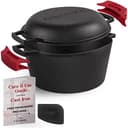
This is the product that justifies the brand. A 5-quart bare iron pot with a lid that flips over and becomes a 10-inch skillet: two usable vessels, one purchase, with two silicone handle covers and a pan scraper in the box. Published figures are 13 x 10 x 6.4 inches, 14.86 pounds for the pair, and an oven rating of 500°F with any cooktop including induction.
It is also the Cuisinel product with the clearest price advantage over the American-made equivalent, which is a shape Lodge sells too — and the gap here is real money rather than the rounding error it is on the 12-inch skillet. The honest caveats: 14.86 pounds is a lot to lift out of a hot oven two-handed, the shallow skillet half is where the dough goes for bread (Cuisinel’s own instruction, and a good one — no reaching into a hot pot), and if you want the same two-in-one shape made in Tennessee, our Dutch ovens for sourdough page ranks Lodge’s combo cooker and double Dutch oven against it.
Three-skillet set — the best starter set
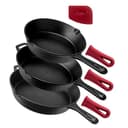
Three pans, three sizes, silicone handle covers for each: this is the other place bundling wins, because buying three separate budget skillets plus covers costs more than the set does. Cuisinel sells the combination in two useful spans — a 6, 8 and 10-inch set for small pans, and an 8, 10 and 12-inch set that covers almost everything a kitchen needs.
The trade-off is the one every budget import set has: a rougher as-cast surface and a factory seasoning that takes a few months of cooking to slick up, with no published origin. If a set is what you want, compare it with the Lodge three-pan set in our cast iron cookware sets roundup before you commit — sets are the one category where the price gap between import and American-made is still wide enough to argue about.
7-quart Dutch oven — the best for a crowd
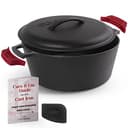
Seven quarts of bare iron with a drip-point lid that bastes as it cooks, published as serving six to eight. This is the second place Cuisinel is meaningfully rather than marginally cheaper: large bare pots cost real money, and on the day we checked this one came in clearly under Lodge’s American-made 7-quart rather than a dollar or two under it.
Two honest problems. The listing publishes no weight at all for a pot this large, which is the single spec that decides whether you will actually use it — a 7-quart bare iron Dutch oven loaded with stew is a two-handed, oven-mitts lift. And bare iron this size is genuinely annoying to care for: hand wash only, dry on the burner, oil while warm, every time. Our large Dutch oven roundup sets it against the alternatives, and enameled vs bare cast iron is the decision to settle first if that care routine sounds like a chore. And if you are eyeing seven quarts because of a holiday bird, read Dutch oven vs roasting pan before you buy: past about six pounds of poultry, no pot of any brand is the right vessel.
12-inch skillet with lid — the best bundle
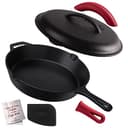
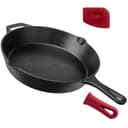
A 12-inch pan, a lid, a silicone handle cover and a scraper. As a first cast iron kit it is well judged: the lid turns a skillet into a shallow braiser, and the extras are the things new cast iron owners buy within a month anyway. Cuisinel sells two 12-inch lidded versions, and the listings are not equally clear about what the lid is: one says “Glass Lid” outright, and this one never states whether the cover is iron or glass. Worth knowing before you buy, because a glass lid brings that 350°F ceiling with it.
For what a lidded skillet is worth owning at all, and which lid material survives real oven temperatures, our best cast iron skillets with lids roundup ranks the field — including the honest option of buying a lid for the pan you already have.
12-inch plain skillet — the one to think about twice
There is nothing wrong with this pan. It publishes 8.44 pounds, it has an assist handle opposite the main one, it comes with the silicone holder and a hang hole, and its listing rates it for induction, grill and campfire. If it arrived in your kitchen you would cook happily on it for twenty years.
The problem is the shelf next to it. On the day we checked, Lodge’s 12-inch skillet with a silicone handle holder was listed within pennies of this pan — and Lodge publishes a Tennessee foundry, a weight, a temperature, a care page and a warranty that does not require registration. Prices move, so check both before you buy; but when the import and the American-made pan cost the same, there is no argument left. Our Lodge review is the other half of that comparison, and best budget cast iron skillets ranks the cheap pans against each other properly.
How Cuisinel compares with the brands around it
Against Lodge:Lodge wins on single pans, on documentation and on origin, and it is not usually much dearer. Cuisinel wins on combination products — the double Dutch oven, the multi-pan sets, the big bare pot — and on including accessories Lodge sells separately.
Against Amazon Basics:Cuisinel wins. Amazon Basics publishes no warranty, no care page and no origin; Cuisinel publishes two of the three. In enameled pots that calculus flips, because Cuisinel does not sell enamel and Amazon Basics’ enameled pot is the cheapest in the category.
Against Victoria:Victoria publishes a Colombian foundry, dimensions, weights and seasoning details for everything it makes, and its long angled handles are better than anyone’s at this price. If documentation and origin are what you want from a budget brand, read our Victoria review before buying Cuisinel.
Against Cuisinart:different material, different question. Cuisinart’s cast iron is enameled, so there is no seasoning to maintain and acidic food is not a concern. Our enameled vs bare comparison settles that choice before brand enters into it.
Caring for Cuisinel cast iron
It is bare cast iron, so the routine is the standard one, with two points where Cuisinel’s own guidance is stricter than the internet’s. First, drying: “DO NOT airdry, as airdrying is guaranteed to rust cast iron” — put the pan back on a warm burner until every trace of water has gone. Second, oil quantity: wipe on a high smoke-point oil, but the pan should not be “dripping in oil, as this will create a sticky surface”, which is the single most common cause of the problem in our sticky cast iron guide.
Cuisinel permits soap, as Lodge does, and forbids the dishwasher and soaking. For a full re-season it gives a specific method — a little soap and water, then 400°F for 45 minutes to an hour — which is close enough to the standard approach in our seasoning guide. If a Cuisinel pan does arrive with patchy factory seasoning, which is the common complaint about every budget import, one proper seasoning cycle at home fixes it for good.
The verdict
Cuisinel is a better-run budget brand than its anonymity suggests: it writes real care instructions, publishes warranty terms you can read, and bundles the accessories that genuinely help a beginner. It also will not tell you what country its iron comes from, caps its own accessories at 350°F without saying so on the listing, and sells single pans at a price where Lodge’s American-made equivalent is effectively free of extra cost.
So: buy the combinations, skip the standalone pans. The 2-in-1 double Dutch oven is a genuinely good buy and the big 7-quart pot is a lot of iron for the money. For one skillet, buy the Lodge.