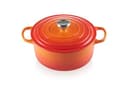
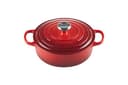
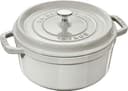
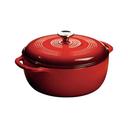
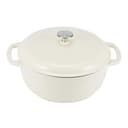
Finding one: only two of the four things you are paying for are about cooking
Separate the price into parts and the review almost writes itself.
A light sand-colored interior (cooking).This is the most underrated functional feature in enameled cast iron and the one we would pay for. Fond — the browned film on the base that becomes the sauce — is a color change, and you cannot judge a color change against a black background. Every cook who says they “cook better” in a Le Creuset is, we think, describing this. Staub, with its dark searing interior, deliberately trades it away.
The fewest care rules in cast iron (cooking, sort of).On the Signature line Le Creuset’s dealer documentation states dishwasher safe, metal-utensil safe and 500°F. Set that against Lodge’s hand wash and no metal utensils, and Staub’s care page naming Bar Keepers Friend for cleaning. It does not change the food; it changes how much thought the pot requires, every day, for decades.
A lifetime warranty (not cooking).Worth more here than on most products, because enameled cast iron has exactly one failure mode — a chip in the coating — and no food-safe home repair. We have not put a claim through it, and we will not imply we have.
A French foundry, a color range and resale value (not cooking). Unfashionable to mention and straightforwardly true: these pots are worth money second-hand in a decade, and nothing cheaper is. If you buy one and sell it in ten years, the real cost of ownership is nothing like the sticker.
Finding two: the pot most people buy is the wrong Le Creuset
The 5.5-quart round is the default recommendation everywhere, and it is a capacity-led recommendation in a product category where shape decides the only phase of cooking you can ruin. Capacity is measured to the rim, so it tells you how much soup fits and nothing about how much meat browns at once. A deep 5.5-quart has a modest floor; a wide 3.5-quart publishes a 9.4 x 9.4-inch footprint. If you braise, roast or sear before adding liquid — which is nearly every reason to own one of these pots — the wide pot does the job better and costs less.
Buy the 5.5-quart deep round if you cook for five or more, make large batches, or want one pot for stock as well. Otherwise, the wide pot is the better object and we will say so even though it is cheaper.
Finding three: a higher price does not buy better documentation here
This surprised us and it is worth stating plainly. Lodge publishes a cooking-surface width and a flat-bottom diameter for its enameled pots. Le Creuset’s own pages do not. Lodge publishes a weight per pot, an oven ceiling, a fridge rating, a hob compatibility list and a country of manufacture. Staub publishes a third-party testing statement, a knob temperature rating separate from the body, and a care page specific enough to name a cleaning product. Le Creuset’s own site would not serve us a page at all, and the figures we do have for this line come from a dealer.
None of that makes the pot worse. It does mean that the cheapest pot in this review and the most expensive sit at opposite ends of price and nearly the same end of disclosure, which is not the relationship anyone assumes.
Finding four: what it does not buy, listed honestly
A better braise.Three hours at 300°F under a lid converts collagen to gelatine at a rate set by thermal mass and lid fit. A $25 enameled pot has both. You cannot taste the price.
More heat tolerance.500°F, the same figure Lodge and Amazon Basics publish for their enameled pots. Staub goes higher without its lid on certain cocottes; Le Creuset does not.
Fire.Enameled cast iron is not for a grill or an open fire — Lodge states this explicitly for its own line and the physics is the same for every coating. If a campfire is part of the plan you want a bare iron pot at a fraction of the cost.
Immunity from chipping. Enamel is a glass coating. Drop it, knock it against a tap, or shock it from hot to cold and it can chip, and there is no food-safe home repair. What the money buys is a warranty for that event, not immunity from it.
Who should buy it
Buy it if you cook for five or more, you want a light readable interior, you value a warranty and French manufacture, and you intend to keep it for decades or pass it on. On a thirty-year view, and accounting for resale, it is a defensible purchase rather than an extravagance.
Buy the wide 3.5-quart instead if you brown more than you boil, which is most people.
Do not buy it as your first Dutch oven, as a gift for someone who has never used one, or because you believe it cooks better. Buy a pot under a hundred dollars, learn what you actually want from the shape, and then spend the money if the gap still bothers you. That is the sequence we would follow ourselves.
Where to read the rest
Our Le Creuset brand review covers the company and the line; best Le Creuset cast iron ranks the pieces against each other; Lodge vs Le Creuset is the direct price comparison; and best Dutch ovens under $200 is the band immediately below this pot, where a French cocotte first becomes possible and the trade gets interesting.