What each one actually is
These two things get compared because they are both large oven vessels, but they are built from different materials for different physics, and almost everything below follows from that.
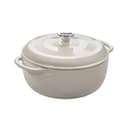
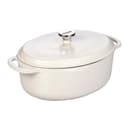
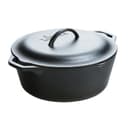
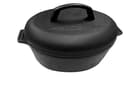
A Dutch ovenis a thick-walled cast iron pot with a heavy, close-fitting lid, either bare or coated in vitreous enamel. It stores a large amount of heat, gives it back slowly, and seals in steam. It goes on a burner, in an oven, and — if it is bare iron — on a grill or in a fire.
A roasting pan, in the sense almost everyone means when they search for one, is a wide shallow tray of thin steel coated in enamel, usually sold with a rack and sometimes with a domed lid. Granite Ware — the speckled black enamelware brand, operated by CINSA, whose own site dates the business to 1871 on one page and 1876 on another — describes them as enameled steel with a “vitrified enamel coating” and a non-porous surface. The rack lifts the bird out of its own drippings so hot air reaches the underside.
The second difference matters more than the shape: cast iron is thick and massive, enamel-on-steel is thin and light. One is a heat reservoir, the other is a tray that gets hot quickly and holds almost nothing. Our guide to enameled cast iron explains why the enamel coating is the same idea on both and the metal underneath is not.
What the makers publish, side by side
Every figure below is the maker’s own, or the listing’s where the maker publishes nothing. The roasting pan column is a genuine problem for this kind of table, and we have flagged it rather than papering over it: Granite Ware’s own site publishes no temperature rating, no cooktop guidance, no dishwasher advice and no country of manufacture at all. The numbers in that column come from the Amazon listings for specific Granite Ware models, read live on October 22, 2026, where those claims do appear.
| | Enameled cast iron Dutch oven | Enamel-on-steel roasting pan |
|---|
| Example | Lodge 6 qt round; Lodge 7 qt oval | Granite Ware 19 in open roaster with rack |
| Material | Cast iron, vitreous enamel both sides | Thin steel, vitrified enamel coating |
| Published size | 13.25 x 11.6 x 6.0 in (round); 15.56 x 10.18 x 12.43 in (oval) | 19 x 12 x 2.7 in |
| Published empty weight | 13.52 lb (round); 16.36 lb (oval) | 4.05 lb, pan and rack together |
| Capacity as sold | By volume: 6 and 7 quarts | By bird: “up to a 25 lb poultry or roast” |
| Oven ceiling | 500°F (Lodge, both pots) | “up to 935°” on the roaster listing, 932°F on the roasting-set listing; nothing on Granite Ware’s own site |
| Stovetop | Any stovetop including induction (Lodge) | “NOT SUITABLE for use on GLASS COOKTOPS or INDUCTION STOVETOPS” (Granite Ware set listing) |
| Lid | Heavy cast iron lid, included, seals steam in | Open with a flat rack; covered oval roasters sold separately |
| Dishwasher | Hand wash recommended (Lodge) | “Dishwasher Safe” (listing) |
| Fire / grill | Bare iron yes; Lodge’s enamel “Not made for use on a grill or over a fire” | Listing names broiling and grilling among its uses |
| Published origin | Lodge enamel: made by Lodge’s partners in China or Vietnam. Bare Lodge: USA | Not stated — the site says only “reliable national manufacturing” |
| Warranty | Lodge’s published Made Right guarantee | None published |
Two of those rows contradict each other in the roasting pan’s own paperwork, and we are reporting both rather than choosing: the open roaster’s listing says “up to 935°” while the three-piece set’s says 932°F, and the maker’s own site publishes no number at all. Either way the steel pan has far more oven headroom than the 500°F an enameled pot is rated to, which is a real advantage at high-heat roasting temperatures.
Where the roasting pan genuinely wins
1. A big bird, which is the whole reason it exists
This is not a close call and nothing else on this page matters if it applies to you. Dutch ovens are sold by volume, but a bird is a solid awkward object, so the numbers that decide it are interior width and lid clearance. Lodge publishes a 10.5-inch cooking-surface width and 4.75 inches of cooking-surface height on the 6-quart round, and 15.56 x 10.18 inches of overall footprint on the 7-quart oval. A four to five pound chicken fits. A 12 to 20 pound turkey does not fit in any Dutch oven sold for a home kitchen, and the published capacities on roasting pans — 7 lb of poultry in a 13-inch oval, 10 lb in a 15-inch, up to 25 lb in the 19-inch rectangular pan — are exactly the range the pot cannot reach.
2. Crisp skin, because the vessel is open
A lid traps steam, and steam is the enemy of crisp skin. That is why our own Dutch oven roast chicken roundup tells you to take the lid off, and why a bird on a rack in an open pan browns more evenly: air circulates underneath it instead of the underside stewing in its own juices. A Dutch oven can be used uncovered and it will roast a chicken well, but the open pan plus rack is the geometry the job actually wants.
3. Weight, which you feel at the worst moment
The listing publishes 4.05 pounds for Granite Ware’s 19-inch pan and rack together. Lodge publishes 16.36 pounds for the empty 7-quart oval enamel pot. Put the same five-pound chicken in each and the pot is carrying three times its own weight in iron out of a hot oven with mitts on; the pan is barely carrying itself. For anyone with wrist or grip problems that is the deciding row rather than a footnote, and it is the same argument that runs through our lightweight cast iron roundup.
4. Drippings, gravy and dishwashers
A wide shallow pan spreads the drippings into a thin layer that browns rather than pooling deep and steaming, which is better fond and more gravy. The pan is also dishwasher safe per its listing, where Lodge recommends hand washing its enamel. And it stores flat: a 2.7-inch deep tray slides beside a baking sheet, while a Dutch oven with its lid on is a 12-inch-tall object you have to find a home for.
Where the Dutch oven wins
1. It browns, and it does it on the burner
Every braise, pot roast and stew starts with searing, and a Dutch oven does that on the hob in the same vessel the dish finishes in — Lodge publishes “Compatible with any stovetop (including induction) or oven up to 500℉” for both the round and the oval pot. The roasting pan cannot promise that: Granite Ware’s set listing explicitly bans glass cooktops and induction, and thin steel over a gas burner has nothing like cast iron’s heat retention anyway. If your hob is glass or induction — most new kitchens — a roasting pan is an oven-only vessel, and the searing and the gravy move to another pan and another sink load.
2. Braising, which needs a sealed lid and stored heat
A braise is a long wet cook that wants an even, stable, low temperature and almost no evaporation. Thick cast iron is a heat reservoir, so the pot barely notices the oven door opening; the lid keeps the liquid where it belongs. A thin steel pan with foil over the top does neither well. This is the single biggest category of cooking the two vessels nominally share, and the pot wins it outright.
3. Bread — not a close contest
People do search “dutch oven vs roasting pan for sourdough”, so here is the straight answer: a roasting pan is not a bread vessel. A loaf gets its rise and its crust from a blast of stored heat into the dough’s base plus trapped steam for the first part of the bake. A preheated cast iron pot with a heavy lid supplies both. Thin steel stores almost no heat, and an open pan traps no steam at all, so the result is a flat pale loaf. If bread is the reason you are buying anything, our Dutch ovens for sourdough page is the one to read, and the lidded options in it are the ones that matter.
4. Everything else it does the other 360 days
A roasting pan roasts, and then it waits for next Thanksgiving. A Dutch oven does soup, stew, chili, braises, beans, rice, pasta, deep-frying, bread and a chicken, which is why it is the one pot most kitchens should own first — see what you can cook in a Dutch oven. If you are choosing which single vessel to buy, this row settles it.
5. Lifespan and documentation
Enamel chips on both of these, and on thin steel it chips more easily because the metal flexes under the coating. Beyond that it is a documentation gap: Lodge publishes dimensions, weights, a temperature rating, a cooktop list, care rules, a country of manufacture and a warranty for its pots. For the roasters, the maker’s own site publishes none of those — not even an origin — and the temperature figures live only on the retail listings, where they disagree with each other by three degrees. If the enamel on a pot does chip, our guide to chipped enamel covers when it is still safe to use.
What neither one does well
Shallow frying and a hard sear on a flat surface.The pot’s walls are too tall and the pan’s metal is too thin. That job belongs to a cast iron skillet.
A turkey on a glass or induction hob, start to finish. No single vessel here does it: the pot cannot hold the bird and the pan cannot go on that hob. The honest answer is a roasting pan in the oven plus a skillet or saucepan for the gravy.
Open-fire cooking in enamel.Lodge says of both enameled pots, in its own care notes, “Not made for use on a grill or over a fire”. Bare cast iron is the one that goes outside — our camp Dutch oven roundup ranks the footed pots built for it.
So which should you buy?
Buy the Dutch oven first.It browns, braises, bakes bread, holds soup for a week of lunches, works on every cooktop including induction, and will outlive the kitchen. For a chicken, a pork shoulder or a small roast it is also a perfectly good roasting vessel — lid off for the last stretch.
Add a roasting pan when the bird outgrows the pot. If you cook a turkey once a year, a 15 or 19-inch enamel-on-steel roaster with a rack costs less than most skillets, weighs four pounds, and does the one job the pot physically cannot. Buying it instead of a Dutch oven is the mistake; buying it alongside one, for the fortnight a year it earns its shelf, is simply sensible.
If it is the shape rather than the material you are weighing up, our round vs oval Dutch oven comparison works through the footprint question on both makers’ published dimensions, and Dutch oven vs casserole dish covers the other open-vessel decision people run into.