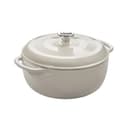
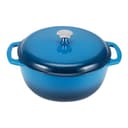
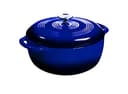
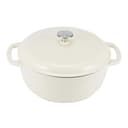
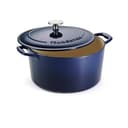
The spec sheets, side by side
Every figure below is the maker’s or the listing’s own, and “Not published” means exactly that: we read the page and the number was not on it. We do not estimate missing specs.
| Published spec | Lodge Essential Enamel 6 qt | Amazon Basics 6 qt | Amazon Basics 4.3 qt |
|---|
| Capacity | 6 qt | 6 qt | 4.3 qt, “serves 3–4” |
| Oven ceiling | 500°F, stated by Lodge | Not published | 500°F, stated on the listing |
| Weight | 13.52 lb | Not published | 11.24 lb |
| Cooking surface width | 10.5 in | Not published | Not published |
| Flat bottom | 6.87 in | Not published | Not published |
| Cooktops | Any stovetop including induction | Not published (iron is ferromagnetic) | Not published (iron is ferromagnetic) |
| Fridge storage | “Safe to store in the fridge” | Not published | Not published |
| Grill / open fire | Ruled out by Lodge | Not published | Not published |
| Care rules | Hand wash, no metal utensils | Not published | Hand wash; no citrus cleaners or metal utensils |
| PFAS statement | Made without PFAS | Not published | Not published |
| Made in | China or Vietnam, stated by Lodge | Not published | Not published |
| Included extras | Enamel lid, pot protectors, steel knob | Lid | Lid |
What the missing oven rating actually costs you
It is tempting to treat an unpublished oven temperature as a technicality. It is not, and here is the specific reason. Enamel is glass. Glass fails on thermal shock and it fails at its limit, and the two home cooks who run into that are the bread baker and the high-heat roaster — a no-knead loaf wants 450–500°F, and plenty of recipes preheat the empty pot that hot before the dough goes in.
With the Lodge you have a number to work against: 500°F, from Lodge, in writing. With the Amazon Basics 6-quart you have nothing, so the sensible thing is to treat the pot as unrated and keep it below 450°F — which means the cheaper pot quietly costs you the hottest bread bake. Note that the brand’s own 4.3-quart listing publishes 500°F, so the pots themselves are very likely fine; you are just being asked to assume it.
Our sourdough Dutch oven roundup goes into which pots we would actually put a 500°F loaf in, and why an unrated pot is the wrong place to find out.
The warranty is the real price difference
Thirty dollars is the sticker gap. The more useful way to look at it is what happens in year three, because enameled cast iron has exactly one common failure mode: a chip or a craze in the glaze. On a bare iron pan, damage is repairable — you reseason it. On enamel, it is not. There is no food-safe home repair for fired glass.
So the question becomes who stands behind the pot. Lodge publishes care rules and a warranty, which gives you a conversation to have. The Amazon Basics listings we read publish neither, which makes the pot a consumable at a very low price. Neither answer is wrong — it is a genuine choice between the cheapest possible entry and a pot with a backstop — but it should be a choice you make knowingly. If it is a chip you are dealing with right now, our chipped enamel guide is the page you want, and it covers where the chip has to be before the pot is finished.
What neither of these tells you about lead and cadmium
One question gets asked about cheap enamel more than any other, and it deserves a straight answer: neither of these pots is accompanied by published test results. Lodge states that its enamel is made without PFAS, which is a real but narrow claim. The Amazon Basics listings state nothing on the subject at all.
For contrast, the one brand on this site that publishes the full set is Staub, whose own materials page states cadmium-free, lead-free, PFOA-free, PTFE-free and PFAS-free, with third-party certified lab testing against FDA guidelines and California Proposition 65. That is what a complete answer looks like, and it is worth knowing that the budget pots do not give you one. An absence of a test result is not the same as a failed test, and we are not going to imply otherwise — our enameled cast iron safety guide works through what regulators do and do not actually say.
When neither of these is the right pot
If you want bare cast iron rather than enamel — cheaper per quart, usable on a campfire, repairable forever, and no glaze to chip — the comparison you want is enameled vs bare cast iron, and the pots are in our bare cast iron Dutch oven roundup. If you are weighing one of these against the French names instead, read Lodge vs Le Creuset. And if you want the broader field of budget pots rather than this head-to-head, best budget Dutch ovens ranks them all, while best Dutch oven brands compares the makers on exactly this disclosure-and-recourse basis.