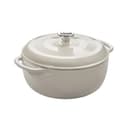
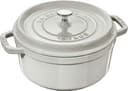
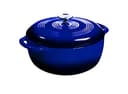
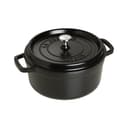
Lodge vs Staub at a glance
| Attribute | Lodge Essential Enamel | Staub |
|---|
| Interior enamel | Conventional glossy porcelain enamel on the pots (Lodge describes it only as standing up to acidic ingredients); matte black on the skillet | Textured matte black, described by Staub as made for browning and needing no seasoning |
| Lid | Plain lid; stainless steel knob on the 3-quart by Lodge’s page | Cast iron lid with self-basting spikes; brass or nickel-plated knob rated to 464°F |
| Oven rating | 500°F (Lodge’s figure for the 3-quart pot and the 11-inch skillet) | 500°F on Staub’s retail spec and skillet page; one Amazon listing claims 900°F without the lid, which its own knob rating contradicts |
| Where made | Lodge states its enamel line is made by partners in China or Vietnam, unlike its US-made bare iron | France |
| Care rules | Hand wash; no metal utensils; not made for a grill or open fire | Dishwasher safe with hand washing recommended |
| Warranty | Lifetime limited (Lodge’s Made Right warranty on the skillet listing) | Limited lifetime against manufacturing defects |
| Price band | Mid — roughly a quarter of the French pots | Premium — Le Creuset money |
Why the cooking is nearly a tie
An enameled Dutch oven works by mass and by a tight lid. Heavy iron holds a braise at a steady murmur; the lid keeps the moisture in. Neither brand has a monopoly on either. A chili, a pot roast, a batch of stock or a boule of no-knead bread comes out of a Lodge and a Staub the same, and no one at the table can tell which pot it came from. If that were the whole story this page would be one sentence long.
Where they genuinely differ
The interior
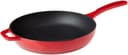
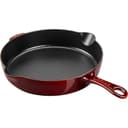
This is the one that changes the cooking. Staub’s interior is a textured matte black enamel the maker describes as built for searing; it takes hard browning without the fussing a light glossy enamel wants, and it hides stains. The cost is that it also hides the fond: you judge browning by smell, sound and time rather than by eye. Lodge describes its pot interior only as porcelain enamel that stands up to acidic ingredients — a conventional glossy finish that shows you what is happening and shows marks afterwards. On the skillets the gap closes, because Lodge’s Essential Enamel skillet has a matte black interior too.
The lid and the knob
Staub’s spiked lid drips condensation back over the food through a long braise; it is a real feature, if a modest one. More practically, the knob is where an enameled pot’s oven ceiling usually lives. Staub’s brass or nickel-plated knobs are rated to 464°F by its listing; Lodge fits a stainless steel knob on the 3-quart and publishes 500°F for the pot. Neither is a bread-baking problem, since our sourdough roundup bakes at or under those figures, but it is the number to know before you follow a recipe that asks for more. Our oven guide lists every maker’s ceiling in one place.
Where they are made, and what that costs
Lodge is admirably plain about it: the enamel line is made by partners in China or Vietnam, and the 11-inch skillet listing says China outright, while its bare iron is made in Tennessee. Staub is made in France. If provenance is part of why you are buying, that sentence settles the comparison and no amount of value arithmetic will change it. If it is not, the price gap buys you the interior, the lid and a French name, and the Lodge buys you the same dinner with money left over for a bare skillet or two.
Care
Lodge asks for hand washing, no metal utensils, and keeps its enamel off the grill and the fire. Staub says dishwasher safe with hand washing recommended. In practice both want the same treatment — warm soapy water, no thermal shock, no dropping — and our enameled cleaning guide covers it. Both chip if abused; that is enamel, not a brand.
The three pairs
Everyday pots. Lodge’s 6-quart is the value benchmark of the whole category and the pot most people should buy; Staub’s 5.5-quart cocotte is the braiser’s choice, with the searing interior and the spiked lid. The Lodge holds half a quart more. Small pots. Lodge’s 3-quart is the small enameled pot most people should own, 9.5 lb by Lodge’s figure, and a fraction of any French 3-quart. Staub’s 4-quart is the most capable small pot we know of and the most expensive by a wide margin. Skillets. The closest pair: both have matte black interiors and 500°F ratings. Lodge publishes its full spec; Staub publishes no weight, base or height, and on the day we checked its buy box was held by a third-party seller. The enameled skillet roundup ranks both against four others.
Which should you buy?
Buy the Lodge if you want an enameled pot that does the job, you would rather spend the difference elsewhere, and you do not need an interior designed for searing. Buy the Staub if you sear before you braise and want an interior built for it, if the self-basting lid appeals, or if French-made is part of the purchase. If you are choosing between the two French houses instead, Le Creuset vs Staub is the page; if you are choosing between Lodge and the other French name, Lodge vs Le Creuset.